
Volume 12, Issue 1 (Autumn 2026)
Health in Emergencies and Disasters Quarterly 2026, 12(1): 71-78 |
Back to browse issues page



Ethics code: IR.KHOY.REC.1402.036


Download citation:
BibTeX | RIS | EndNote | Medlars | ProCite | Reference Manager | RefWorks
Send citation to:


BibTeX | RIS | EndNote | Medlars | ProCite | Reference Manager | RefWorks
Send citation to:
Sabri V, Sodeify R, Mokhtari L, Habibpour Z. Resilience and Spiritual Well-being as Predictors of Post-Traumatic Stress Disorder among Earthquake Survivors in Khoy, Iran, 2023. Health in Emergencies and Disasters Quarterly 2026; 12 (1) :71-78
URL: http://hdq.uswr.ac.ir/article-1-759-en.html
URL: http://hdq.uswr.ac.ir/article-1-759-en.html


1- Department of Clinical Psychology, Khoy University of Medical Sciences, Khoy, Iran.
2- Department of Nursing, Khoy University of Medical Sciences, Khoy, Iran.
3- Department of Nursing, Khoy University of Medical Sciences, Khoy, Iran. ,habibpoor_z@khoyums.ac.ir
2- Department of Nursing, Khoy University of Medical Sciences, Khoy, Iran.
3- Department of Nursing, Khoy University of Medical Sciences, Khoy, Iran. ,
Full-Text [PDF 547 kb]
(586 Downloads)
| Abstract (HTML) (1719 Views)
Full-Text: (3 Views)
Introduction
Earthquakes are among the most destructive natural disasters, causing not only widespread loss of life and economic damage [1, 2] but also profound social and psychological disruption, including the erosion of social norms and values [3]. Post-traumatic stress disorder (PTSD) is a prevalent psychological condition following earthquakes, characterized by intrusive memories, avoidance, and negative alterations in cognition and mood [4]. A meta-analysis of 46 studies (n=76101) reported a pooled post-earthquake PTSD prevalence of 23.66% [5], and long-term PTSD has been linked to substance use disorders [6], social isolation [7], and increased suicide risk [8]. Therefore, paying attention to factors that influence post-earthquake PTSD is crucial for maintaining and improving mental and physical health.
Undoubtedly, disaster experience is one of the main factors that influence post-disaster response. Research has consistently demonstrated a dose-response relationship between trauma severity and the likelihood of developing PTSD [4-6]. This means that greater exposure to traumatic events is associated with an increased risk of PTSD. Objective factors, such as the death or injury of family members, property destruction, and loss of personal belongings, have been identified as significant predictors of PTSD severity [7, 8]. Additionally, subjective experiences, including perceived life threat and concern for others, also contribute substantially to PTSD development [4, 9]. Although traumatic exposure is a key factor in PTSD, psychological and sociodemographic variables beyond trauma severity may further influence its onset and severity. In a study of Turkish earthquake survivors, PTSD symptoms were significantly associated with multiple factors, including female gender, older age, a history of prior psychological distress, acute psychological reactions during the earthquake, proximity to the epicenter, repeated exposure to trauma-related reminders, ethnicity, resilience, spirituality and religious involvement, and negative subjective appraisals of the disaster [10].
Resilience, defined as a person’s capacity not only to endure but also to thrive when confronted with significant challenges, is a critical element in managing severe life disruptions [11]. This capacity can also alter the relationship among exposure to catastrophic events, financial losses, and the subsequent development of PTS. The influence of various determinants can vary greatly among individuals from diverse cultural backgrounds, social environments, and physical locations [11]. Furthermore, resilience, in conjunction with support from one’s social network, has been shown to exert both a direct influence on PTSD symptoms and an indirect effect mediated through symptoms of anxiety and depressive disorders [4].
Recent studies have identified religious faith as a significant source of psychological and social support for managing stress, especially following events that cause trauma to a community. When examining the complex structure of faith-based worldviews, both personal spirituality and organized religious practice function as mechanisms that facilitate positive psychological adaptation to difficult circumstances [3]. Religious beliefs as a whole are a double-edged sword with various positive or negative aspects in adaptation to traumatic stress and may be influential. Variations in religious teachings, ceremonial practices, community reinforcement, cultural influences, personal traits, and spiritual experiences can significantly influence how faith shapes reactions to traumatic stress and suicidal behavior [12].
Studies following the Haiti earthquake indicated that, in the aftermath of the trauma, many individuals reported increased faith in a higher power and a renewed commitment to religious rituals. However, some reports also documented inter-religious tensions, including conflicts between adherents of different Christian sects and violent confrontations with practitioners of Voodoo, whose beliefs and practices were perceived by some groups as representing divine retribution [13]. Thus, spirituality plays a dual role in the context of PTSD: While it often serves as a protective resource, it may, under certain conditions, contribute to symptom exacerbation [14]. Reports on the relationship between resilience and spirituality have been mixed. Some studies have reported no significant relationship between resilience and spirituality [13, 15]. Considering that some studies have reported the roles of resilience and spirituality in the occurrence of various problems, and given the prevalence of earthquakes in certain areas, research has also reported a positive association between spirituality and people’s resilience to trauma after earthquakes [16].
In the specific context of Khoy, a city with a long history of seismic activity, including seven major earthquakes since 1843 and hundreds of aftershocks, the psychological aftermath of the January 2023 earthquake was further intensified by the proximity of the catastrophic Turkey earthquake just ten days later, as well as by the spread of distressing misinformation on social media. These compounding stressors created a unique psychosocial context in which resilience and spiritual well-being may serve particularly salient protective functions. Given the region’s strong cultural and religious foundations and the absence of localized research on these factors among Khoy’s earthquake survivors, this study aimed to address a critical gap in the trauma and mental health literature. Based on prior evidence, this study aimed to examine whether resilience and spiritual well-being predict PTSD symptom severity among adult survivors of the 2023 earthquake in Khoy, Iran.
Materials and Methods
This investigation utilized a cross-sectional, correlational design. The study population included all adult residents of Khoy City who had been exposed to the seismic events that occurred on October 6, 2020, and/or January 28, 2023.
A cohort of 164 potential subjects was initially recruited. Recruitment took place through outpatient facilities at eight different urban health service centers located throughout Khoy. The centers were selected using a two-phase cluster sampling technique. During the initial phase, eight primary health service hubs were purposively chosen to provide comprehensive geographical coverage of the various areas within the city. In the subsequent phase, a single auxiliary center was randomly picked from each primary hub. From each of these auxiliary centers, approximately 23 to 25 individuals were selected to participate using a convenience sampling approach.
Verbal screening was performed at the time of invitation to confirm eligibility. Individuals who failed to satisfy the inclusion criteria or who met any of the predefined exclusion conditions were not included in the research project. Of the original group of 164 invited participants, 36 were subsequently excluded. Twenty exclusions were due to incomplete responses to essential study measures, including assessments of psychological resilience, spiritual well-being, or PTSD. An additional 16 exclusions were based on self-reported information indicating a preexisting diagnosis of a psychological disorder, the use of psychotropic medication before the earthquakes, or the experience of another significant traumatic event within the six months preceding the study. Examples of such events were severe accidents, physical or sexual assault, a critical medical diagnosis, or the loss of an immediate family member. Consequently, the final sample for data analysis included 164 adult earthquake survivors.
Data collection was conducted between December 2023 and February 2024, following approval by the Institutional Research Ethics Committee of Khoy University of Medical Sciences. Written informed consent was obtained from all participants after they received a clear explanation of the study’s purpose, the voluntary nature of participation, their right to withdraw at any time without penalty, and the confidentiality of their responses. All data were anonymized at the time of collection using participant identification codes instead of names, stored on a password-protected computer accessible only to the research team, and retained in accordance with national data protection guidelines. No identifying information appears in any published material.
Participants completed three validated Persian instruments. Psychological resilience was assessed using the 10-item Connor-Davidson resilience scale (CD-RISC-10), a brief version of the original scale validated by Campbell-Sills and Stein [17]. Each item is rated on a 5-point Likert scale ranging from 0 (not true at all) to 4 (true nearly all the time), yielding a total score ranging from 0 to 40, with higher scores indicating greater resilience. The Persian version has demonstrated strong internal consistency (Cronbach’s α=0.85) and content validity among Iranian nursing populations [18]. In the current sample, Cronbach’s α was 0.84.
Spiritual well-being was assessed using the 20-item spiritual well-being scale (SWBS). This instrument is divided into two domains: Religious well-being and existential well-being. Participants indicated their level of agreement with each statement on a 6-point Likert scale, ranging from 1 (strongly disagree) to 6 (strongly agree). Total scores range from 20 to 120, with higher scores indicating a greater degree of spiritual well-being. The Persian version of this scale has demonstrated satisfactory reliability and construct validity for use among adults in Iran [19]. In the present research, the calculated Cronbach’s α coefficient was 0.78.
PTSD symptom severity was assessed using the PTSD Checklist for DSM-5 (PCL-5), a 20-item self-report measure developed to align with the DSM-5 diagnostic criteria [20]. Items are rated on a 5-point scale from 0 (not at all) to 4 (extremely), producing a total score ranging from 0 to 80. The Persian version has demonstrated a five-factor structure, high internal consistency (α=0.92), and strong convergent validity in trauma-exposed Iranian samples [20]. In our sample, Cronbach’s α was 0.91.
Trauma exposure was assessed using a researcher-developed checklist. Property damage was coded as follows: 1=minor, 2=moderate, 3=severe, and 4=total destruction. Displacement was categorized as follows: 1=living in a tent, 2=residing in one’s own home, and 3=displaced outside the city. Physical injury was recorded dichotomously (0=no, 1=yes).
Data were analyzed using SPSS software, version 22. Descriptive statistics (frequencies, Mean±SD) and Pearson correlation coefficients were computed. A stepwise regression analysis was conducted to predict PTSD symptom severity (PCL-5 total score). In step 1, resilience (CD-RISC-10 score), was entered into the model; in Step 2, spiritual well-being (SWBS) was added to evaluate its incremental predictive contribution. Demographic variables (age, gender, education, and marital status) and trauma-related factors (property damage, displacement, and injury) were examined in preliminary analyses but were not significantly associated with PTSD and were therefore excluded from the final regression model to maintain parsimony and avoid over-fitting.
Results
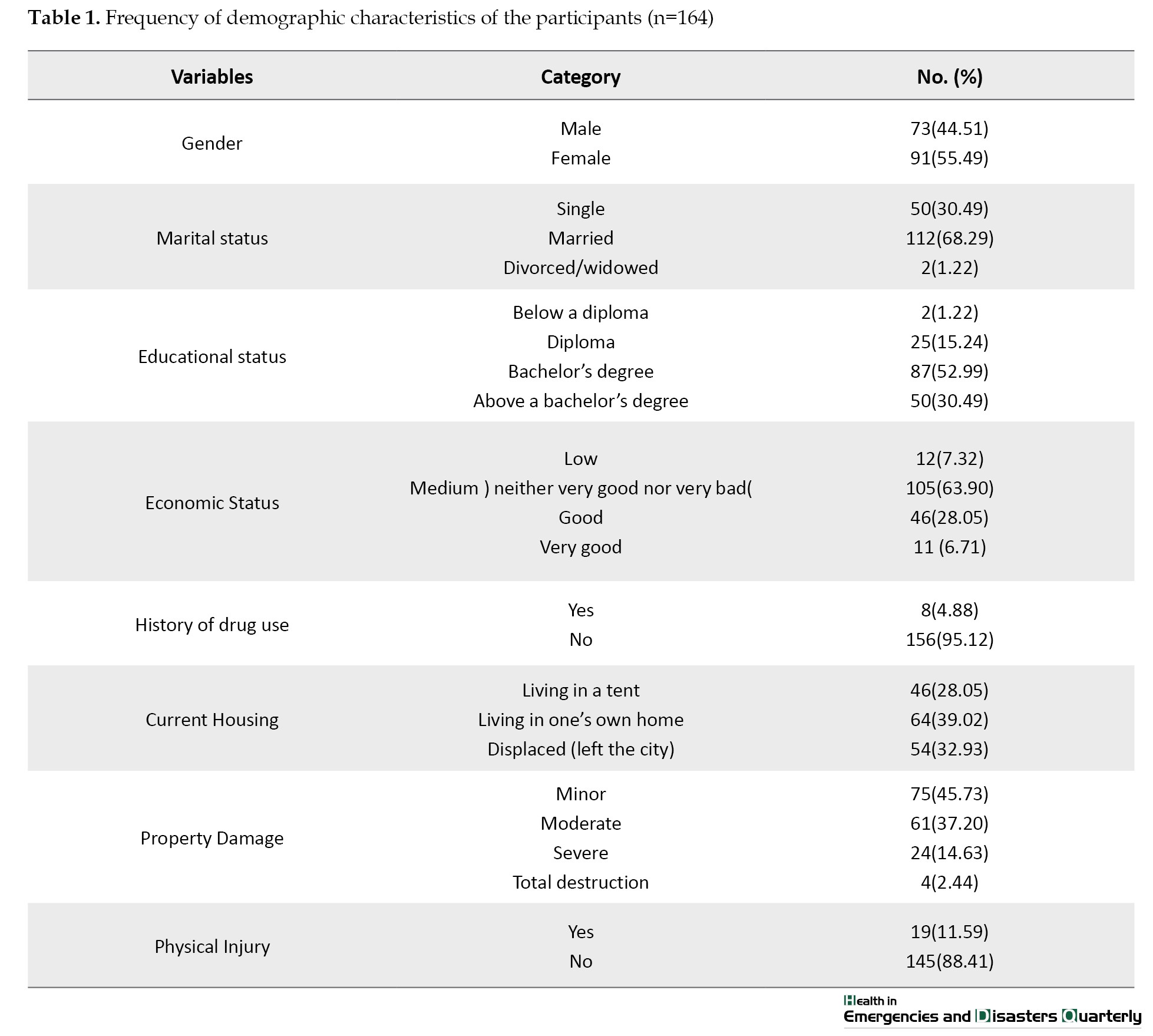
Of the 184 participants initially recruited, 20 were excluded due to incomplete questionnaires and 16 more were excluded because of missing data on key variables (resilience, spiritual well-being, or PTSD scales), yielding a final analytical sample of 164 participants. The mean age was 37.69±10.73 years. The majority of participants were female (55.5%), married (68.3%), held at least a bachelor’s degree (84.1%), and reported medium to good economic status (87.2%). Most participants (95.1%) had no history of drug use, and 63.4% were currently living in their own homes. Full demographic characteristics are presented in Table 1.
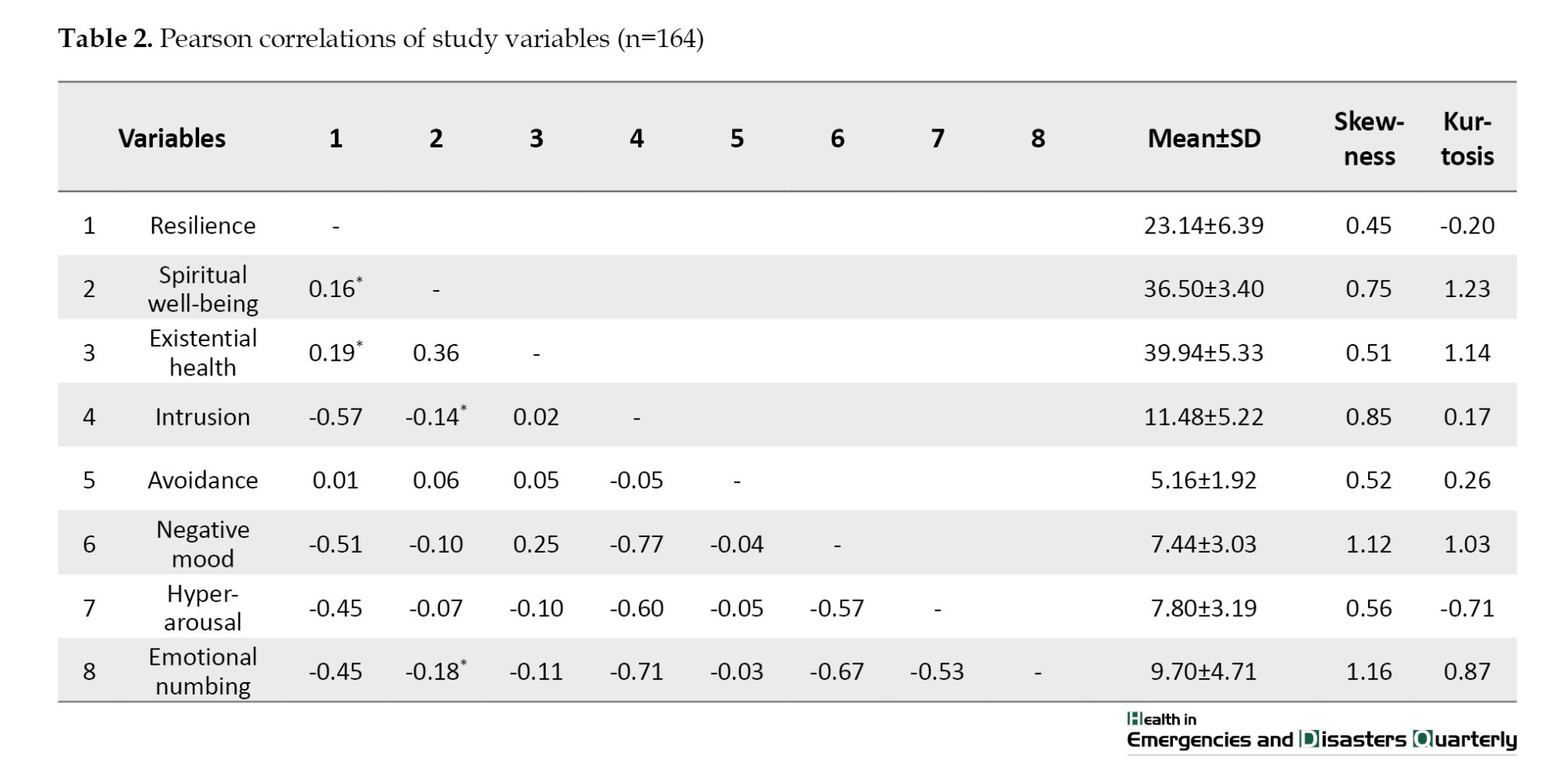
Pearson correlation analyses revealed that resilience was significantly negatively correlated with all PTSD symptom clusters except avoidance (all P<0.01), while spiritual well-being showed weaker but statistically significant negative associations with intrusion and emotional numbing (P<0.05). All study variables met the assumptions of normality (skewness and kurtosis within ±2), independence of errors (Durbin-Watson=1.96), and the absence of multicollinearity (VIF<1.03). Correlation coefficients and descriptive statistics are summarized in Table 2.
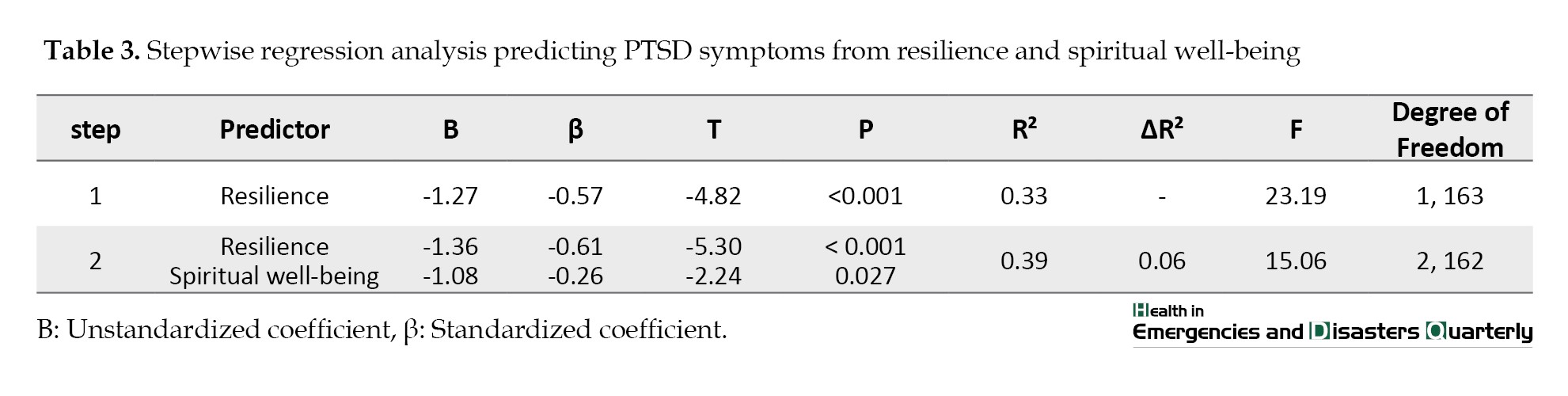
A stepwise regression analysis indicated that resilience alone accounted for 33% of the variance in total PTSD symptoms (R²=0.33, F(1, 163)=23.19, P<0.001). Adding spiritual well-being in the second step significantly improved the model, explaining an additional 6% of variance (ΔR²=0.06, P=0.027), for a total of 39% of the variance explained (R²=0.39, F(2, 162)=15.06, P<0.001). In the final model, both resilience (β=–0.61, P<0.001) and spiritual well-being (β=–0.26, P=0.027) emerged as significant unique negative predictors of PTSD symptom severity. Existential well-being did not contribute significantly and was excluded from the model. Regression results are detailed in Table 3.
Discussion
This study examined the role of resilience and spiritual well-being in relation to PTSD symptoms among survivors of the 2023 Khoy earthquake. The findings indicated that individuals with greater resilience and higher levels of spiritual well-being tend to experience less severe PTSD symptoms, suggesting that these internal resources may buffer the psychological impact of traumatic disaster exposure.
These results are consistent with prior research on disasters, such as floods, hurricanes, and wildfires, which have shown that spirituality encompassing both religious and existential dimensions, can serve as a critical component of resilience by fostering adaptive coping, strengthening social bonds, enhancing self-efficacy, and providing meaning in the face of loss [21, 22]. In a study of survivors of the 2023 Turkey earthquake, Kirks and Shanley [23] found that spirituality exerted a strong positive influence on resilience, particularly by mitigating symptoms of depression, anxiety, and stress in the aftermath of disaster. Similarly, research among African American survivors of Hurricane Katrina revealed that spiritual and religious practices served as key resources for enhancing resilience, primarily through improving social support, reducing PTSD symptoms, and facilitating post-disaster reconstruction [24]. Following the Alberta wildfires, strengths-based, spiritually mindful interventions were identified as protective factors and therapeutic tools that helped children, youth, and families cope with trauma and build long-term resilience [25].
The protective effect of resilience may be explained by its association with adaptive cognitive emotion regulation strategies, which help individuals reframe negative experiences and reduce emotional reactivity [26]. In line with the findings of Wang et al. [27, 28], our findings support the notion that resilience buffers the impact of trauma exposure on PTSD, particularly by mitigating the effects of sleep disturbance and negative mood. Specifically, their moderated mediation analyses indicated that the association between earthquake exposure and PTSD was significant only among individuals with low resilience, underscoring resilience as a key moderator of post-trauma adaptation.
Spiritual well-being, on the other hand, may operate through meaning-making and existential coherence. Spirituality constitutes an essential part of the semantic system for many individuals and shapes their coping reactions. While positive spiritual appraisals can foster hope and connection, spiritual struggle, such as attributing trauma to divine punishment or perceiving a weakening of God’s power, can lead to spiritual dissatisfaction and, at higher levels, has been associated with symptoms of depression, suicide, and PTSD in various trauma samples [29].
It is also worth noting that experiential avoidance, a behavioral tendency to avoid painful internal experiences such as thoughts, emotions, or memories, may influence PTSD trajectories [30]. Although avoidance was not significantly associated with resilience in our sample, this finding may reflect the specific context of the Khoy earthquake, which involved limited structural collapse and mass casualties, potentially reducing reliance on avoidance as a dominant coping strategy.
Further supporting the role of psychological resources, a study on military veterans found significant associations between all three PTSD subscales (re-experiencing, avoidance, and hyperarousal) and both resilience and quality of life [31]. Although that population differs from our civilian earthquake survivors, the consistent inverse relationship between resilience and PTSD across diverse trauma contexts reinforces the robustness of this protective factor.
Notably, in our study, resilience was significantly associated with all PTSD subscales except avoidance, which aligns with the contextual explanation above and suggests that the expression of PTSD symptoms may vary based on disaster characteristics and cultural coping norms.
The study has several limitations. First, the cross-sectional design precludes causal inferences. Second, data were collected via self-report measures, which may be subject to recall or social desirability bias. Third, the sample was limited to survivors in Khoy, reducing the generalizability of the findings to other cultural or geographic contexts. Finally, individuals with severe psychiatric symptoms may have been underrepresented because of nonparticipation or an inability to complete the questionnaires.
These findings support the integration of resilience-enhancing and spiritually sensitive approaches into post-disaster mental health programs. Specifically, interventions that cultivate adaptive coping, foster meaning-making, and draw on culturally relevant spiritual resources may help mitigate PTSD symptoms and promote psychological recovery among survivors. Future research should employ longitudinal or experimental designs to determine whether actively strengthening these internal resources can lead to sustained reductions in PTSD risk over time.
Conclusion
This study highlights resilience and spiritual well-being as significant protective factors against PTSD symptoms among earthquake survivors in Khoy. While these associations do not imply causation, they suggest that culturally sensitive interventions targeting these resources may help mitigate post-disaster psychological distress. Future longitudinal studies are needed to confirm causal pathways and evaluate the efficacy of such interventions.
Ethical Considerations
Compliance with ethical guidelines
This study was approved by the Ethics Committee of Khoy University of Medical Sciences, Khoy, Iran (Code: IR.KHOY.REC.1402.036) and was conducted in accordance with the ethical standards of the Declaration of Helsinki. Before any data were collected, informed consent was obtained from every participant. Each author contributed to the study design, data analysis, and preparation of the manuscript.
Funding
This research did not receive any grant from funding agencies in the public, commercial, or non-profit sectors.
Authors' contributions
Conceptualization and supervision: Vahid Sabri and Zeinab Habibpour; Methodology: Leila Mokhtari and Roghieh Sodeify; Data collection: Vahid Sabri, and Leila Mokhtari; Data analysis: Roghieh Sodeify and Zeinab Habibpour; Funding acquisition, resources, investigation, writing the original draft, review & editing: All authors.
Conflict of interest
The authors declared no conflicts of interest.
Acknowledgments
The writers extend their sincere thanks to Khoy University of Medical Sciences for its assistance and support. They also wish to thank all the individuals who participated in this study for dedicating their time and effort.
References
Earthquakes are among the most destructive natural disasters, causing not only widespread loss of life and economic damage [1, 2] but also profound social and psychological disruption, including the erosion of social norms and values [3]. Post-traumatic stress disorder (PTSD) is a prevalent psychological condition following earthquakes, characterized by intrusive memories, avoidance, and negative alterations in cognition and mood [4]. A meta-analysis of 46 studies (n=76101) reported a pooled post-earthquake PTSD prevalence of 23.66% [5], and long-term PTSD has been linked to substance use disorders [6], social isolation [7], and increased suicide risk [8]. Therefore, paying attention to factors that influence post-earthquake PTSD is crucial for maintaining and improving mental and physical health.
Undoubtedly, disaster experience is one of the main factors that influence post-disaster response. Research has consistently demonstrated a dose-response relationship between trauma severity and the likelihood of developing PTSD [4-6]. This means that greater exposure to traumatic events is associated with an increased risk of PTSD. Objective factors, such as the death or injury of family members, property destruction, and loss of personal belongings, have been identified as significant predictors of PTSD severity [7, 8]. Additionally, subjective experiences, including perceived life threat and concern for others, also contribute substantially to PTSD development [4, 9]. Although traumatic exposure is a key factor in PTSD, psychological and sociodemographic variables beyond trauma severity may further influence its onset and severity. In a study of Turkish earthquake survivors, PTSD symptoms were significantly associated with multiple factors, including female gender, older age, a history of prior psychological distress, acute psychological reactions during the earthquake, proximity to the epicenter, repeated exposure to trauma-related reminders, ethnicity, resilience, spirituality and religious involvement, and negative subjective appraisals of the disaster [10].
Resilience, defined as a person’s capacity not only to endure but also to thrive when confronted with significant challenges, is a critical element in managing severe life disruptions [11]. This capacity can also alter the relationship among exposure to catastrophic events, financial losses, and the subsequent development of PTS. The influence of various determinants can vary greatly among individuals from diverse cultural backgrounds, social environments, and physical locations [11]. Furthermore, resilience, in conjunction with support from one’s social network, has been shown to exert both a direct influence on PTSD symptoms and an indirect effect mediated through symptoms of anxiety and depressive disorders [4].
Recent studies have identified religious faith as a significant source of psychological and social support for managing stress, especially following events that cause trauma to a community. When examining the complex structure of faith-based worldviews, both personal spirituality and organized religious practice function as mechanisms that facilitate positive psychological adaptation to difficult circumstances [3]. Religious beliefs as a whole are a double-edged sword with various positive or negative aspects in adaptation to traumatic stress and may be influential. Variations in religious teachings, ceremonial practices, community reinforcement, cultural influences, personal traits, and spiritual experiences can significantly influence how faith shapes reactions to traumatic stress and suicidal behavior [12].
Studies following the Haiti earthquake indicated that, in the aftermath of the trauma, many individuals reported increased faith in a higher power and a renewed commitment to religious rituals. However, some reports also documented inter-religious tensions, including conflicts between adherents of different Christian sects and violent confrontations with practitioners of Voodoo, whose beliefs and practices were perceived by some groups as representing divine retribution [13]. Thus, spirituality plays a dual role in the context of PTSD: While it often serves as a protective resource, it may, under certain conditions, contribute to symptom exacerbation [14]. Reports on the relationship between resilience and spirituality have been mixed. Some studies have reported no significant relationship between resilience and spirituality [13, 15]. Considering that some studies have reported the roles of resilience and spirituality in the occurrence of various problems, and given the prevalence of earthquakes in certain areas, research has also reported a positive association between spirituality and people’s resilience to trauma after earthquakes [16].
In the specific context of Khoy, a city with a long history of seismic activity, including seven major earthquakes since 1843 and hundreds of aftershocks, the psychological aftermath of the January 2023 earthquake was further intensified by the proximity of the catastrophic Turkey earthquake just ten days later, as well as by the spread of distressing misinformation on social media. These compounding stressors created a unique psychosocial context in which resilience and spiritual well-being may serve particularly salient protective functions. Given the region’s strong cultural and religious foundations and the absence of localized research on these factors among Khoy’s earthquake survivors, this study aimed to address a critical gap in the trauma and mental health literature. Based on prior evidence, this study aimed to examine whether resilience and spiritual well-being predict PTSD symptom severity among adult survivors of the 2023 earthquake in Khoy, Iran.
Materials and Methods
This investigation utilized a cross-sectional, correlational design. The study population included all adult residents of Khoy City who had been exposed to the seismic events that occurred on October 6, 2020, and/or January 28, 2023.
A cohort of 164 potential subjects was initially recruited. Recruitment took place through outpatient facilities at eight different urban health service centers located throughout Khoy. The centers were selected using a two-phase cluster sampling technique. During the initial phase, eight primary health service hubs were purposively chosen to provide comprehensive geographical coverage of the various areas within the city. In the subsequent phase, a single auxiliary center was randomly picked from each primary hub. From each of these auxiliary centers, approximately 23 to 25 individuals were selected to participate using a convenience sampling approach.
Verbal screening was performed at the time of invitation to confirm eligibility. Individuals who failed to satisfy the inclusion criteria or who met any of the predefined exclusion conditions were not included in the research project. Of the original group of 164 invited participants, 36 were subsequently excluded. Twenty exclusions were due to incomplete responses to essential study measures, including assessments of psychological resilience, spiritual well-being, or PTSD. An additional 16 exclusions were based on self-reported information indicating a preexisting diagnosis of a psychological disorder, the use of psychotropic medication before the earthquakes, or the experience of another significant traumatic event within the six months preceding the study. Examples of such events were severe accidents, physical or sexual assault, a critical medical diagnosis, or the loss of an immediate family member. Consequently, the final sample for data analysis included 164 adult earthquake survivors.
Data collection was conducted between December 2023 and February 2024, following approval by the Institutional Research Ethics Committee of Khoy University of Medical Sciences. Written informed consent was obtained from all participants after they received a clear explanation of the study’s purpose, the voluntary nature of participation, their right to withdraw at any time without penalty, and the confidentiality of their responses. All data were anonymized at the time of collection using participant identification codes instead of names, stored on a password-protected computer accessible only to the research team, and retained in accordance with national data protection guidelines. No identifying information appears in any published material.
Participants completed three validated Persian instruments. Psychological resilience was assessed using the 10-item Connor-Davidson resilience scale (CD-RISC-10), a brief version of the original scale validated by Campbell-Sills and Stein [17]. Each item is rated on a 5-point Likert scale ranging from 0 (not true at all) to 4 (true nearly all the time), yielding a total score ranging from 0 to 40, with higher scores indicating greater resilience. The Persian version has demonstrated strong internal consistency (Cronbach’s α=0.85) and content validity among Iranian nursing populations [18]. In the current sample, Cronbach’s α was 0.84.
Spiritual well-being was assessed using the 20-item spiritual well-being scale (SWBS). This instrument is divided into two domains: Religious well-being and existential well-being. Participants indicated their level of agreement with each statement on a 6-point Likert scale, ranging from 1 (strongly disagree) to 6 (strongly agree). Total scores range from 20 to 120, with higher scores indicating a greater degree of spiritual well-being. The Persian version of this scale has demonstrated satisfactory reliability and construct validity for use among adults in Iran [19]. In the present research, the calculated Cronbach’s α coefficient was 0.78.
PTSD symptom severity was assessed using the PTSD Checklist for DSM-5 (PCL-5), a 20-item self-report measure developed to align with the DSM-5 diagnostic criteria [20]. Items are rated on a 5-point scale from 0 (not at all) to 4 (extremely), producing a total score ranging from 0 to 80. The Persian version has demonstrated a five-factor structure, high internal consistency (α=0.92), and strong convergent validity in trauma-exposed Iranian samples [20]. In our sample, Cronbach’s α was 0.91.
Trauma exposure was assessed using a researcher-developed checklist. Property damage was coded as follows: 1=minor, 2=moderate, 3=severe, and 4=total destruction. Displacement was categorized as follows: 1=living in a tent, 2=residing in one’s own home, and 3=displaced outside the city. Physical injury was recorded dichotomously (0=no, 1=yes).
Data were analyzed using SPSS software, version 22. Descriptive statistics (frequencies, Mean±SD) and Pearson correlation coefficients were computed. A stepwise regression analysis was conducted to predict PTSD symptom severity (PCL-5 total score). In step 1, resilience (CD-RISC-10 score), was entered into the model; in Step 2, spiritual well-being (SWBS) was added to evaluate its incremental predictive contribution. Demographic variables (age, gender, education, and marital status) and trauma-related factors (property damage, displacement, and injury) were examined in preliminary analyses but were not significantly associated with PTSD and were therefore excluded from the final regression model to maintain parsimony and avoid over-fitting.
Results
Of the 184 participants initially recruited, 20 were excluded due to incomplete questionnaires and 16 more were excluded because of missing data on key variables (resilience, spiritual well-being, or PTSD scales), yielding a final analytical sample of 164 participants. The mean age was 37.69±10.73 years. The majority of participants were female (55.5%), married (68.3%), held at least a bachelor’s degree (84.1%), and reported medium to good economic status (87.2%). Most participants (95.1%) had no history of drug use, and 63.4% were currently living in their own homes. Full demographic characteristics are presented in Table 1.
Pearson correlation analyses revealed that resilience was significantly negatively correlated with all PTSD symptom clusters except avoidance (all P<0.01), while spiritual well-being showed weaker but statistically significant negative associations with intrusion and emotional numbing (P<0.05). All study variables met the assumptions of normality (skewness and kurtosis within ±2), independence of errors (Durbin-Watson=1.96), and the absence of multicollinearity (VIF<1.03). Correlation coefficients and descriptive statistics are summarized in Table 2.
A stepwise regression analysis indicated that resilience alone accounted for 33% of the variance in total PTSD symptoms (R²=0.33, F(1, 163)=23.19, P<0.001). Adding spiritual well-being in the second step significantly improved the model, explaining an additional 6% of variance (ΔR²=0.06, P=0.027), for a total of 39% of the variance explained (R²=0.39, F(2, 162)=15.06, P<0.001). In the final model, both resilience (β=–0.61, P<0.001) and spiritual well-being (β=–0.26, P=0.027) emerged as significant unique negative predictors of PTSD symptom severity. Existential well-being did not contribute significantly and was excluded from the model. Regression results are detailed in Table 3.
Discussion
This study examined the role of resilience and spiritual well-being in relation to PTSD symptoms among survivors of the 2023 Khoy earthquake. The findings indicated that individuals with greater resilience and higher levels of spiritual well-being tend to experience less severe PTSD symptoms, suggesting that these internal resources may buffer the psychological impact of traumatic disaster exposure.
These results are consistent with prior research on disasters, such as floods, hurricanes, and wildfires, which have shown that spirituality encompassing both religious and existential dimensions, can serve as a critical component of resilience by fostering adaptive coping, strengthening social bonds, enhancing self-efficacy, and providing meaning in the face of loss [21, 22]. In a study of survivors of the 2023 Turkey earthquake, Kirks and Shanley [23] found that spirituality exerted a strong positive influence on resilience, particularly by mitigating symptoms of depression, anxiety, and stress in the aftermath of disaster. Similarly, research among African American survivors of Hurricane Katrina revealed that spiritual and religious practices served as key resources for enhancing resilience, primarily through improving social support, reducing PTSD symptoms, and facilitating post-disaster reconstruction [24]. Following the Alberta wildfires, strengths-based, spiritually mindful interventions were identified as protective factors and therapeutic tools that helped children, youth, and families cope with trauma and build long-term resilience [25].
The protective effect of resilience may be explained by its association with adaptive cognitive emotion regulation strategies, which help individuals reframe negative experiences and reduce emotional reactivity [26]. In line with the findings of Wang et al. [27, 28], our findings support the notion that resilience buffers the impact of trauma exposure on PTSD, particularly by mitigating the effects of sleep disturbance and negative mood. Specifically, their moderated mediation analyses indicated that the association between earthquake exposure and PTSD was significant only among individuals with low resilience, underscoring resilience as a key moderator of post-trauma adaptation.
Spiritual well-being, on the other hand, may operate through meaning-making and existential coherence. Spirituality constitutes an essential part of the semantic system for many individuals and shapes their coping reactions. While positive spiritual appraisals can foster hope and connection, spiritual struggle, such as attributing trauma to divine punishment or perceiving a weakening of God’s power, can lead to spiritual dissatisfaction and, at higher levels, has been associated with symptoms of depression, suicide, and PTSD in various trauma samples [29].
It is also worth noting that experiential avoidance, a behavioral tendency to avoid painful internal experiences such as thoughts, emotions, or memories, may influence PTSD trajectories [30]. Although avoidance was not significantly associated with resilience in our sample, this finding may reflect the specific context of the Khoy earthquake, which involved limited structural collapse and mass casualties, potentially reducing reliance on avoidance as a dominant coping strategy.
Further supporting the role of psychological resources, a study on military veterans found significant associations between all three PTSD subscales (re-experiencing, avoidance, and hyperarousal) and both resilience and quality of life [31]. Although that population differs from our civilian earthquake survivors, the consistent inverse relationship between resilience and PTSD across diverse trauma contexts reinforces the robustness of this protective factor.
Notably, in our study, resilience was significantly associated with all PTSD subscales except avoidance, which aligns with the contextual explanation above and suggests that the expression of PTSD symptoms may vary based on disaster characteristics and cultural coping norms.
The study has several limitations. First, the cross-sectional design precludes causal inferences. Second, data were collected via self-report measures, which may be subject to recall or social desirability bias. Third, the sample was limited to survivors in Khoy, reducing the generalizability of the findings to other cultural or geographic contexts. Finally, individuals with severe psychiatric symptoms may have been underrepresented because of nonparticipation or an inability to complete the questionnaires.
These findings support the integration of resilience-enhancing and spiritually sensitive approaches into post-disaster mental health programs. Specifically, interventions that cultivate adaptive coping, foster meaning-making, and draw on culturally relevant spiritual resources may help mitigate PTSD symptoms and promote psychological recovery among survivors. Future research should employ longitudinal or experimental designs to determine whether actively strengthening these internal resources can lead to sustained reductions in PTSD risk over time.
Conclusion
This study highlights resilience and spiritual well-being as significant protective factors against PTSD symptoms among earthquake survivors in Khoy. While these associations do not imply causation, they suggest that culturally sensitive interventions targeting these resources may help mitigate post-disaster psychological distress. Future longitudinal studies are needed to confirm causal pathways and evaluate the efficacy of such interventions.
Ethical Considerations
Compliance with ethical guidelines
This study was approved by the Ethics Committee of Khoy University of Medical Sciences, Khoy, Iran (Code: IR.KHOY.REC.1402.036) and was conducted in accordance with the ethical standards of the Declaration of Helsinki. Before any data were collected, informed consent was obtained from every participant. Each author contributed to the study design, data analysis, and preparation of the manuscript.
Funding
This research did not receive any grant from funding agencies in the public, commercial, or non-profit sectors.
Authors' contributions
Conceptualization and supervision: Vahid Sabri and Zeinab Habibpour; Methodology: Leila Mokhtari and Roghieh Sodeify; Data collection: Vahid Sabri, and Leila Mokhtari; Data analysis: Roghieh Sodeify and Zeinab Habibpour; Funding acquisition, resources, investigation, writing the original draft, review & editing: All authors.
Conflict of interest
The authors declared no conflicts of interest.
Acknowledgments
The writers extend their sincere thanks to Khoy University of Medical Sciences for its assistance and support. They also wish to thank all the individuals who participated in this study for dedicating their time and effort.
References
- Meng Z, Wu X, Han L. Post-traumatic stress disorder and post-traumatic growth among the adult survivors of the Lushan earthquake: Selecting resilience as the moderator. International Journal of Disaster Risk Reduction. 2018; 27:524-9. [DOI:10.1016/j.ijdrr.2017.11.016]
- Eivazi A, Noorbala A, Meysami A. Comparison of the prevalence of post-traumatic stress disorder, 18 months after the Bam earthquake in the two cities of Bam and Kerman. Journal of Rescue and Relief. 2016; 8(1):55-67. [Link]
- Xi Y, Yu H, Yao Y, Peng K, Wang Y, Chen R. Post-traumatic stress disorder and the role of resilience, social support, anxiety and depression after the Jiuzhaigou earthquake: A structural equation model. Asian Journal of Psychiatry. 2020; 49:101958. [DOI:10.1016/j.ajp.2020.101958] [PMID]
- Furr JM, Comer JS, Edmunds JM, Kendall PC. Disasters and youth: A meta-analytic examination of posttraumatic stress. Journal of Consulting and Clinical Psychology. 2010;78(6):765. [DOI:10.1037/a0021482] [PMID]
- Johnson H, Thompson A. The development and maintenance of post-traumatic stress disorder (PTSD) in civilian adult survivors of war trauma and torture: A review. Clinical Psychology Review. 2008; 28(1):36-47. [DOI:10.1016/j.cpr.2007.01.017] [PMID]
- Kolassa IT, Ertl V, Eckart C, Kolassa S, Onyut LP, Elbert T. Spontaneous remission from PTSD depends on the number of traumatic event types experienced. Psychological Trauma: Theory, Research, Practice, and Policy. 2010; 2(3):169. [DOI:10.1037/a0019362]
- Cao X, Wang L, Cao C, Zhang J, Liu P, Zhang B, et al. Patterns of DSM-5 posttraumatic stress disorder and depression symptoms in an epidemiological sample of Chinese earthquake survivors: A latent profile analysis. Journal of Affective Disorders. 2015; 186:58-65. [DOI:10.1016/j.jad.2015.06.058] [PMID]
- Tang W, Zhao J, Lu Y, Zha Y, Liu H, Sun Y, et al. Suicidality, posttraumatic stress, and depressive reactions after earthquake and maltreatment: A cross-sectional survey of a random sample of 6132 Chinese children and adolescents. Journal of Affective Disorders. 2018; 232:363-9. [DOI:10.1016/j.jad.2018.02.081] [PMID]
- Carmassi C, Stratta P, Calderani E, Bertelloni CA, Menichini M, Massimetti E, et al. Impact of mood spectrum spirituality and mysticism symptoms on suicidality in earthquake survivors with PTSD. Journal of Religion and Health. 2016; 55(2):641-9. [DOI:10.1007/s10943-015-0072-z] [PMID]
- Pearce M, Haynes K, Rivera NR, Koenig HG. Spiritually integrated cognitive processing therapy: A new treatment for post-traumatic stress disorder that targets moral injury. Global Advances in Health and Medicine. 2018; 7:2164956118759939. [DOI:10.1177/2164956118759939] [PMID]
- Tauba AM, Rafiyah I. The Lived Experiences of the Lombok Earthquake Survivors. Nurse Media Journal of Nursing. 2020; 10(1):22-35. [DOI:10.14710/nmjn.v10i1.24964]
- Lai L, Ren Z, Yan Y, Niu G, Zhao C, Luo M, et al. The double-edged-sword effect of empathy: The secondary traumatic stress and vicarious posttraumatic growth of psychological hotline counselors during the outbreak of COVID-19. Acta Psychologica Sinica. 2021; 53(9):992-1002. [DOI:10.3724/SP.J.1041.2021.00992]
- Blanc J, Rahill GJ, Laconi S, Mouchenik Y. Religious beliefs, PTSD, depression and resilience in survivors of the 2010 Haiti earthquake. Journal of Affective Disorders. 2016; 190:697-703. [DOI:10.1016/j.jad.2015.10.046] [PMID]
- Xiao W, Liu X, Wang H, Huang Y, Dai Z, Si M, et al. Mediating role of resilience in the relationship between COVID-19 related stigma and mental health among COVID-19 survivors: A cross-sectional study. Infectious Diseases of Poverty. 2023; 12(1):27. [DOI:10.1186/s40249-023-01074-3] [PMID]
- Bhattarai M, Maneewat K, Sae-Sia W. Psychosocial factors affecting resilience in Nepalese individuals with earthquake-related spinal cord injury: A cross-sectional study. BMC Psychiatry. 2018; 18(1):60. [DOI:10.1186/s12888-018-1640-z] [PMID]
- Januarista A. Spiritual Analysis of the Ability of Community Resilience to Post-earthquake Trauma in the ATC Temporary Shelter At Mpanau Village Sigi District. Jurnal Kawistara. 2020; 10(3):343-51. [DOI:10.22146/kawistara.61030]
- Campbell‐Sills L, Stein MB. Psychometric analysis and refinement of the connor-davidson resilience scale (CD‐RISC): Validation of a 10‐item measure of resilience. Journal of Traumatic Stress: Official Publication of The International Society for Traumatic Stress Studies. 2007; 20(6):1019-28. [DOI:10.1002/jts.20271] [PMID]
- Salimi S, Pakpour V, Feizollahzadeh H, Rahmani A. [Resilience and its association with the intensive care unit nurses’ intention to leave their profession (Persian)]. Hayat. 2017; 23(3):254-65. [Link]
- Siwinski L, Blankenship PA. Dissociating first responder Trauma: Examining patterns of self-reported Trauma exposures in single-role firefighters and paramedics. Psychology. 2024; 15(6):984-98. [DOI:10.4236/psych.2024.156059]
- Varmaghani H, Fathi Ashtiani A, Poursharifi H. [Psychometric properties of the Persian version of the posttraumatic stress disorder checklist for DSM-5 (PCL-5) (Persian)]. Journal of Applied Psychological Research. 2018; 9(3):131-42. [DOI:10.22059/japr.2018.69707]
- Aten JD, Smith WR, Davis EB, Van Tongeren DR, Hook JN, Davis DE, et al. The psychological study of religion and spirituality in a disaster context: A systematic review. Psychological Trauma: Theory, Research, Practice, and Policy. 2019; 11(6):597-613. [DOI:10.1037/tra0000431] [PMID]
- Brown MR, Agyapong V, Greenshaw AJ, Cribben I, Brett-MacLean P, Drolet J, et al. Significant PTSD and other mental health effects present 18 months after the Fort McMurray wildfire: findings from 3,070 grades 7-12 students. Frontiers in Psychiatry. 2019; 10:623. [DOI:10.3389/fpsyt.2019.00623] [PMID]
- Kerkez M, Şanli ME. Mediating role of spirituality in the relationship of anxiety, stress and depression with resilience in individuals exposed to earthquakes in Türkiye. International Journal of Disaster Risk Reduction. 2024; 104:104347. [DOI:10.1016/j.ijdrr.2024.104347]
- Alawiyah T, Bell H, Pyles L, Runnels RC. Spirituality and faith-based interventions: Pathways to disaster resilience for African American Hurricane Katrina survivors. Journal of Religion & Spirituality in Social Work: Social Thought. 2011; 30(3):294-319. [DOI:10.1080/15426432.2011.587388]
- Lalani N, Drolet JL, McDonald-Harker C, Brown MR, Brett-MacLean P, Agyapong VI, et al. Nurturing spiritual resilience to promote post-disaster community recovery: The 2016 Alberta Wildfire in Canada. Frontiers in Public Health. 2021; 9:682558. [DOI:10.3389/fpubh.2021.682558] [PMID]
- Kay SA. Emotion regulation and resilience: Overlooked connections. Industrial and Organizational Psychology. 2016; 9(2):411-5. [DOI:10.1017/iop.2016.31]
- Wang S, Shi X, Chen X, Zhu Y, Chen H, Fan F. Earthquake exposure and PTSD symptoms among disaster-exposed adolescents: A moderated mediation model of sleep problems and resilience. Frontiers in Psychiatry. 2021; 12:577328. [DOI:10.3389/fpsyt.2021.577328] [PMID]
- Zhou X, Wu X, An Y. Understanding the relationship between trauma exposure and depression among adolescents after earthquake: the roles of fear and resilience. Frontiers in Psychology. 2016; 7:2044. [DOI:10.3389/fpsyg.2016.02044] [PMID]
- Neyer MA, Henry RS, Carrier ME, Kwakkenbos L, Wojeck RK, Gietzen A, et al. Validity, Reliability, and Differential Item Functioning of English and French Versions of the 10‐Item Connor‐Davidson Resilience Scale in Systemic Sclerosis: A Scleroderma Patient‐Centered Intervention Network Cohort Study. Arthritis Care & Research. 2023; 75(11):2369-78. [DOI:10.1002/acr.25139] [PMID]
- Ahmadi F, Goodarzi MA, Taghavi M R, Imani M. [Modeling structural relationships between trauma experience and peritraumatic dissociation in people with earthquake trauma experience: The mediating role of experiential avoidance (Persian)]. Iranian Journal of Psychiatric Nursing. 2022; 10(5):14-26. [DOI:10.22034/IJPN.10.5.1]
- Elliott TR, Hsiao YY, Kimbrel NA, Meyer E, DeBeer BB, Gulliver SB, et al. Resilience and traumatic brain injury among Iraq/Afghanistan war veterans: Differential patterns of adjustment and quality of life. Journal of Clinical Psychology. 2017; 73(9):1160-78. [DOI:10.1002/jclp.22414]
Type of article: Research |
Subject:
Special
Received: 2025/07/15 | Accepted: 2025/12/8 | Published: 2026/09/28
Received: 2025/07/15 | Accepted: 2025/12/8 | Published: 2026/09/28
Send email to the article author
| Rights and permissions | |
 |
This work is licensed under a Creative Commons Attribution-NonCommercial 4.0 International License. |

Copyright © The Author(s);
This is an open access article distributed under the terms of the Creative Commons Attribution-NonCommercial 4.0 (CC-By-NC 4.0), which permits use, distribution, and reproduction in any medium, provided the original work is properly cited and is not used for commercial purposes.
Contact Information
This is an open access article distributed under the terms of the Creative Commons Attribution-NonCommercial 4.0 (CC-By-NC 4.0), which permits use, distribution, and reproduction in any medium, provided the original work is properly cited and is not used for commercial purposes.
Contact Information
