
Volume 12, Issue 1 (Autumn 2026)
Health in Emergencies and Disasters Quarterly 2026, 12(1): 31-38 |
Back to browse issues page



Ethics code: IR.RCS.REC.1402.015


Download citation:
BibTeX | RIS | EndNote | Medlars | ProCite | Reference Manager | RefWorks
Send citation to:


BibTeX | RIS | EndNote | Medlars | ProCite | Reference Manager | RefWorks
Send citation to:
Salehi H, Sharififar S, Sharifian S, Dabbagh Moghaddam A, Nazari S, Karimi Kivi H. The Psychological Impact of Losing Pets in the 2023 Antakya Earthquake. Health in Emergencies and Disasters Quarterly 2026; 12 (1) :31-38
URL: http://hdq.uswr.ac.ir/article-1-661-en.html
URL: http://hdq.uswr.ac.ir/article-1-661-en.html
Hossein Salehi1 

 , SiminTaj Sharififar *2 , Sakineh Sharifian3 , Arasb Dabbagh Moghaddam4 , Saeed Nazari5 , Hamid Karimi Kivi6
1- Department of Health in Disasters and Emergencies, Aja University of Medical Sciences, Tehran, Iran.
2- Department of Health in Disasters and Emergencies, Faculty of Nursing, Aja University of Medical Sciences, Tehran, Iran. ,s_sharififar@yahoo.com
3- Department of Health in Disasters and Emergencies, Faculty of Nursing, Aja University of Medical Sciences, Tehran, Iran.
4- Nursing and midwifery care research center, Iran University of Medical Sciences, Tehran, Iran.
5- Infectious Diseases Research Center, Aja University of Medical Sciences, Tehran, Iran.
6- Department of Health in Disasters and Emergencies, Miandoab School of Medical Sciences, Urmia University of Medical Sciences, Urmia, Iran.
2- Department of Health in Disasters and Emergencies, Faculty of Nursing, Aja University of Medical Sciences, Tehran, Iran. ,
3- Department of Health in Disasters and Emergencies, Faculty of Nursing, Aja University of Medical Sciences, Tehran, Iran.
4- Nursing and midwifery care research center, Iran University of Medical Sciences, Tehran, Iran.
5- Infectious Diseases Research Center, Aja University of Medical Sciences, Tehran, Iran.
6- Department of Health in Disasters and Emergencies, Miandoab School of Medical Sciences, Urmia University of Medical Sciences, Urmia, Iran.
Keywords: Disaster psychology, Companion animals, Pet Loss, Grief, Phenomenology, Earthquake, Antakya 2023
Full-Text [PDF 439 kb]
(574 Downloads)
| Abstract (HTML) (1768 Views)
References
Full-Text: (5 Views)
Introduction
Natural disasters are among the most profound disruptors of human and social life, causing not only physical destruction and population displacement but also widespread psychological distress [1, 2].
Within disaster psychology, emotional suffering after the loss of loved ones, homes, or livelihoods has been widely investigated; however, the psychological implications of losing companion animals have received comparatively limited scholarly attention [3, 4]. For a large number of people, pets function as essential family members, offering emotional comfort, social support, while adding routine and stability to everyday living. Their sudden loss during a disaster can trigger a complex form of bereavement that may parallel or, in some cases, surpass the grief experienced after the loss of a human loved one [5, 6].
The devastating earthquake that struck Antakya, Turkey, in February 2023, with a magnitude of 7.8, resulted in immense human casualties and the collapse of both urban and rural infrastructures [7]. Alongside the human tragedy, thousands of animals, particularly pets, such as dogs and cats were lost, injured, or separated from their owners. For many families who survived, the loss of their pets was described as a “second disaster,” representing the rupture of their pre-disaster identity and emotional world [8]. Despite the growing global recognition of the human–animal bond in mental health, few empirical studies have examined how pet loss in disaster contexts contributes to psychological distress or post-traumatic stress [9, 10].
Existing evidence suggests that pet owners’ grief is often disenfranchised, socially unacknowledged, or invalidated because cultural norms tend to prioritize human loss [11]. This may result in prolonged emotional suffering, guilt, and social withdrawal, particularly in collectivist societies where emotional expression is often constrained [12, 13]. Moreover, post-disaster psychosocial interventions rarely consider the needs of individuals mourning their animal companions, leaving them underserved in both humanitarian and clinical frameworks. The absence of veterinary–psychological collaboration in disaster response planning further deepens this gap [14].
The 2023 Antakya earthquake thus provides a distinctive context to examine these dynamics, as it represents one of the rare disasters in which both veterinary and psychological relief teams operated jointly in the field. Exploring the lived experiences of pet owners who endured the loss of their animals during this catastrophe may yield valuable insights into the nature of grief, trauma, and resilience in post-disaster life. Therefore, this research sought to investigate the psychological experiences and underlying meanings related to losing companion animals during the 2023 Antakya earthquake, employing a phenomenological approach to capture the depth and complexity of this understudied dimension of disaster-related grief.
Materials and Methods
A qualitative phenomenological approach was employed to examine the lived psychological experiences of people who lost their companion animals in the 2023 Antakya earthquake. This methodology was selected because phenomenology enables a deep exploration of how individuals interpret their emotional distress and reconstruct their sense of self in the aftermath of loss [1, 2].
Study setting and period
The study was conducted between February 15 and March 30, 2023, in Antakya, Turkey, one of the region’s most severely affected by the earthquake. Data collection took place at temporary shelters and mobile veterinary clinics operated by Iranian humanitarian teams in collaboration with local veterinary volunteers.
Participants and sampling
Participants were recruited through purposive sampling to ensure the inclusion of individuals who had directly experienced the loss of a companion animal. The eligibility requirements were as follows:
1) Being 18 years of age or older; 2) having owned at least one dog or cat before the earthquake; 3) having experienced the confirmed loss or separation of that animal during the event; and 4) being willing to discuss their personal experiences.
Of the 63 people assessed for eligibility, 10 met all inclusion criteria and agreed to participate by providing informed consent.
Data collection
Data collection was carried out using semi-structured, in-depth interviews lasting 45 to 70 minutes. All interviews were conducted face-to-face in Turkish with the assistance of bilingual interpreters, and audio recordings were obtained with participants’ consent. The interview protocol explored several core areas, including emotional responses to losing a pet, coping strategies, perceptions of social support, and disruptions to daily routines. Field notes were also compiled to document contextual details, non-verbal behaviors, and the researcher’s reflections.
Ethical considerations
Ethical clearance for the study was secured from the institutional review board of the partnering university before any data were collected. All participants received detailed information about the study’s aims, were reminded that they could discontinue participation at any stage, and were assured that their data would remain confidential. To protect privacy, pseudonyms were assigned in all interview transcripts. Given the emotionally sensitive nature of discussing pet loss, supportive measures were made available to any participants who experienced distress during the interview process.
Data analysis
Data were transcribed verbatim and analyzed using Colaizzi’s seven-step phenomenological method [15]. The analysis followed a systematic sequence that included:
1) Reading all transcripts repeatedly to obtain a comprehensive understanding of the data; 2) extracting statements of particular relevance; 3) interpreting these statements to develop underlying meanings; 4) grouping the meanings into thematic categories and clusters; 5) producing detailed descriptive accounts; 6) synthesizing these descriptions into an essential structure of the phenomenon; and 7) confirming the accuracy of the interpretations through member checking with participants.
Manual coding was conducted independently by two researchers to strengthen analytical credibility, with any disagreements addressed through collaborative discussion. In addition, reflexive journaling and peer debriefing were employed to support the study’s trustworthiness and transparency.
Results
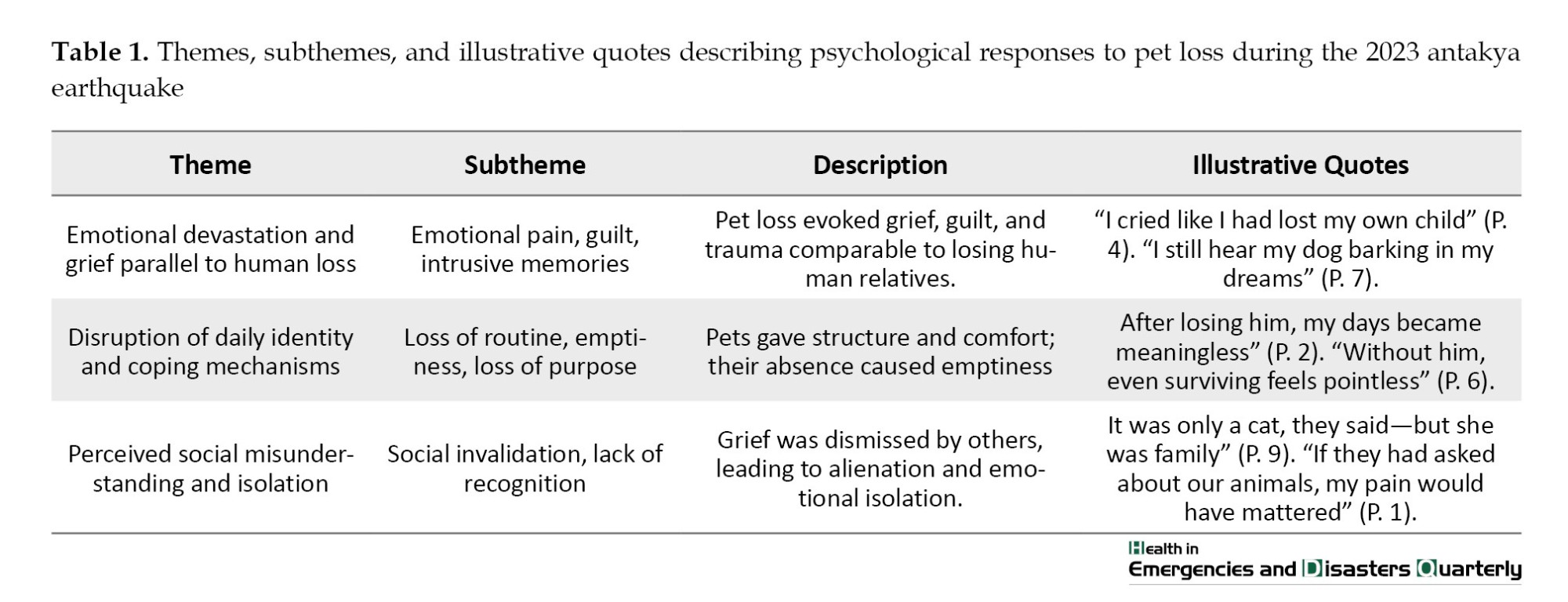
The analysis generated three major themes and seven corresponding subthemes that captured the essence of participants’ psychological experiences after losing their companion animals in the 2023 Antakya earthquake (Table 1).
Theme 1: Emotional devastation and grief parallel to human loss
Participants consistently described their pets as integral members of the family, whose deaths evoked intense emotional pain, guilt, and trauma. For many, the grief associated with losing a pet was indistinguishable from the grief associated with losing a human relative.
“When I realized my cat was buried under the rubble, I cried like I had lost my own child. People told me to be thankful I was alive, but my heart felt empty” (Participant 4 [P. 4]).
Several participants also reported experiencing survivor’s guilt and questioned their inability to save their animals during the chaos of the earthquake. Feelings of helplessness and intrusive memories, such as recalling the sounds or images of trapped pets, were common. Some participants described sleep disturbances, nightmares, and ongoing emotional numbness.
“Every night I hear the sound of my dog barking for help in my dreams. It’s like he’s still trapped somewhere, calling me” (P. 7).
Theme 2: Disruption of daily identity and coping mechanisms
The loss of pets disrupted participants’ sense of self, daily structure, and sources of comfort. Caring for their animals had provided stability and purpose in daily life; their absence created a void that intensified the trauma of displacement and uncertainty.
“Before the earthquake, I woke up early every morning to feed and walk my dog. After losing him, my days became meaningless. I stopped talking to people and lost interest in everything” (P. 2).
Many participants reported that their pets had served as emotional buffers against loneliness and anxiety. Their absence amplified feelings of detachment, depression, and loss of identity, especially among those who lived alone. This disruption of normal coping mechanisms hindered psychological recovery.
“He was my reason to get through the day. Without him, even surviving feels pointless” (P. 6).
Theme 3: Perceived social misunderstanding and isolation
A recurrent experience among participants was the social invalidation of their grief. Several described how relatives, neighbors, or even aid workers minimized their pain, suggesting that “it was just an animal.” This lack of empathy deepened emotional distress and created a sense of alienation.
“People said, ‘It was only a cat; you can get another one.’ But for me, she was part of my family. Their words made my pain even worse” (P. 9).
The absence of institutional or community recognition for pet-related grief further reinforced isolation. Participants expressed the need for acknowledgment from both humanitarian organizations and mental health professionals that the loss of an animal is a legitimate form of bereavement.
“If they had asked about our animals, maybe I would have felt that my pain mattered too” (P. 1).
Overall, the findings reveal that the loss of pets during the Antakya earthquake constituted a multilayered psychological trauma involving grief, guilt, and disenfranchisement. Participants experienced an internal conflict between personal attachment and societal expectations, which limited their access to emotional validation and support.
Discussion
This study examined the psychological consequences of losing companion animals during the 2023 Antakya earthquake using a phenomenological approach. The findings revealed three interconnected dimensions of experience among affected pet owners: profound emotional devastation, disruption of personal identity, and pervasive social invalidation. Collectively, these results emphasize that pet loss in disasters represents a form of disenfranchised grief—a deeply distressing yet socially unacknowledged psychological response that may equal or even surpass the intensity of grief following human loss.
The first theme, emotional devastation and grief parallel to human loss, corresponds with previous research indicating that companion animals often occupy kin-like emotional roles within families [1, 2]. The strength of this attachment can make their sudden loss during disasters particularly traumatic, evoking symptoms consistent with complicated grief, survivor’s guilt, and post-traumatic stress [3, 4]. Comparable observations were documented after the 2011 Tohoku earthquake in Japan, where survivors described pet loss as “losing part of oneself” [5]. Consistent with these findings, narratives from Antakya participants revealed that pets serve not only as companions but also as sources of emotional regulation, attachment security, and existential meaning elements essential to post-disaster psychological adjustment [6].
The second theme, disruption of daily identity and coping mechanisms, underscores how pet ownership structures daily routines that provide stability and purpose. The abrupt loss of these routines left survivors experiencing emptiness, purposelessness, and a sense of disconnection. This observation aligns with continuing bonds theory [7], which posits that maintaining symbolic or emotional connections with deceased loved one’s human or animal helps preserve identity coherence and psychological equilibrium. When such bonds are severed, survivors may experience destabilization of coping strategies and diminished resilience [8, 9]. From a disaster management standpoint, these insights suggest that psychosocial recovery programs should acknowledge the stabilizing role of companion animals in sustaining emotional continuity and adaptive functioning. The third theme, perceived social misunderstanding and isolation, identifies a critical gap in post-disaster mental health care: The societal invisibility of pet-related grief. Participants frequently reported feelings of invalidation and trivialization by others, echoing previous studies that describe how cultural norms often minimize the emotional significance of human animal attachments [10, 12]. This lack of empathy may intensify trauma and delay recovery. This social disregard can intensify psychological trauma and delay emotional recovery. The concept of disenfranchised grief, originally proposed by Doka [13], aptly captures this phenomenon grief that is genuine and profound but denied social legitimacy. In disaster contexts, such disenfranchisement is amplified by humanitarian priorities focused exclusively on human survival, overlooking the interdependent emotional ecosystems linking humans and animals [14, 15].
Importantly, the findings highlight the potential value of integrated veterinary psychological interventions within disaster response frameworks. The collaborative operations of veterinary relief and psychosocial support teams observed in Antakya provide a promising example of holistic humanitarian care. Existing interdisciplinary models, such as One Health and Disaster Mental Health Integration, advocate for close coordination between animal health and human mental health professionals to enhance community resilience [16, 17]. Recognizing pet loss as a legitimate psychological stressor may promote more inclusive, compassionate, and sustainable recovery strategies.
From a sociocultural perspective, the results also reflect how collectivist and religious norms influence the expression and regulation of grief. In Turkish and broader Middle Eastern contexts, emotional restraint is culturally esteemed, and overt mourning— especially for animals—may be stigmatized [18, 19]. Such normative suppression can lead to internalized distress, further reinforcing isolation. Hence, culturally sensitive mental health interventions that respect religious and societal values while validating emotional experiences are essential for effective disaster psychosocial programming.
Finally, the implications of this study extend to policy and practice. Disaster preparedness plans should incorporate protocols for pet evacuation, registration, and reunification. Post-disaster mental health programs must include modules addressing animal-related grief and develop assessment tools sensitive to this form of loss. Additionally, training humanitarian workers and veterinarians to recognize and respond to disenfranchised grief could substantially strengthen psychosocial resilience and community recovery following disasters.
Conclusion
This phenomenological study demonstrated that the loss of companion animals during the 2023 Antakya earthquake produced profound psychological trauma, disrupted personal identity, and caused experiences of social disenfranchisement among survivors. These findings underscore that pet loss in disaster contexts is not a marginal or sentimental concern but a significant dimension of human suffering that warrants systematic inclusion in disaster mental health and recovery frameworks.
The participants’ accounts revealed that the human–animal bond extends beyond species boundaries, functioning as a crucial source of emotional regulation, attachment, and resilience. The abrupt severance of this bond generates grief reactions comparable to those associated with human bereavement, which are further exacerbated by societal invalidation and the absence of institutional support.
Addressing this neglected aspect of post-disaster recovery requires the development of integrated veterinary psychological interventions. Incorporating pet-related bereavement care into psychosocial support systems may mitigate long-term psychological consequences and promote a more compassionate, inclusive, and holistic approach to recovery. Furthermore, disaster preparedness policies should prioritize mechanisms for pet evacuation, identification, and reunification in alignment with One Health and whole-of society resilience principles.
Future research should examine the longitudinal trajectories of grief, coping, and adaptation among bereaved pet owners across different cultural settings. Evaluating the effectiveness of interventions that combine animal welfare and human psychological support can provide an evidence base for policy integration. Ultimately, recognizing the interdependence of human and animal well-being is not merely an ethical obligation; it constitutes an essential foundation for achieving sustainable resilience in the face of disasters.
Ethical Considerations
Compliance with ethical guidelines
This study was approved by the Ethics Committee of the Iraninan Red Crescent, Tehran, Iran (Code:IR.RCS.REC.1402.015). The participants were informed of the purpose of the research and its implementation stages. They were also assured about the confidentiality of their information and were free to leave the study whenever they wished, and if desired, the research results would be available to them. A written consent has been obtained from the subjects. principles of the Helsinki Convention was also observed.
Funding
This research did not receive any grant from funding agencies in the public, commercial, or non-profit sectors.
Authors' contributions
Conceptualization: Hossein Salehi; Methodology: Simin-Taj Sharififar, Sakineh Sharifian and Arasb Dabbagh Moghaddam; Initial draft writing: Hossein Salehi; Data collection: Saeed Nazari and Hamid Karimi Kivi; Methodology; Review and Editing: All authors.
Conflict of interest
The authors declared no conflict of interest.
Acknowledgments
The authors express their gratitude to all those who participated in the research and pray for the souls of those who lost their lives in this tragic incident.
Natural disasters are among the most profound disruptors of human and social life, causing not only physical destruction and population displacement but also widespread psychological distress [1, 2].
Within disaster psychology, emotional suffering after the loss of loved ones, homes, or livelihoods has been widely investigated; however, the psychological implications of losing companion animals have received comparatively limited scholarly attention [3, 4]. For a large number of people, pets function as essential family members, offering emotional comfort, social support, while adding routine and stability to everyday living. Their sudden loss during a disaster can trigger a complex form of bereavement that may parallel or, in some cases, surpass the grief experienced after the loss of a human loved one [5, 6].
The devastating earthquake that struck Antakya, Turkey, in February 2023, with a magnitude of 7.8, resulted in immense human casualties and the collapse of both urban and rural infrastructures [7]. Alongside the human tragedy, thousands of animals, particularly pets, such as dogs and cats were lost, injured, or separated from their owners. For many families who survived, the loss of their pets was described as a “second disaster,” representing the rupture of their pre-disaster identity and emotional world [8]. Despite the growing global recognition of the human–animal bond in mental health, few empirical studies have examined how pet loss in disaster contexts contributes to psychological distress or post-traumatic stress [9, 10].
Existing evidence suggests that pet owners’ grief is often disenfranchised, socially unacknowledged, or invalidated because cultural norms tend to prioritize human loss [11]. This may result in prolonged emotional suffering, guilt, and social withdrawal, particularly in collectivist societies where emotional expression is often constrained [12, 13]. Moreover, post-disaster psychosocial interventions rarely consider the needs of individuals mourning their animal companions, leaving them underserved in both humanitarian and clinical frameworks. The absence of veterinary–psychological collaboration in disaster response planning further deepens this gap [14].
The 2023 Antakya earthquake thus provides a distinctive context to examine these dynamics, as it represents one of the rare disasters in which both veterinary and psychological relief teams operated jointly in the field. Exploring the lived experiences of pet owners who endured the loss of their animals during this catastrophe may yield valuable insights into the nature of grief, trauma, and resilience in post-disaster life. Therefore, this research sought to investigate the psychological experiences and underlying meanings related to losing companion animals during the 2023 Antakya earthquake, employing a phenomenological approach to capture the depth and complexity of this understudied dimension of disaster-related grief.
Materials and Methods
A qualitative phenomenological approach was employed to examine the lived psychological experiences of people who lost their companion animals in the 2023 Antakya earthquake. This methodology was selected because phenomenology enables a deep exploration of how individuals interpret their emotional distress and reconstruct their sense of self in the aftermath of loss [1, 2].
Study setting and period
The study was conducted between February 15 and March 30, 2023, in Antakya, Turkey, one of the region’s most severely affected by the earthquake. Data collection took place at temporary shelters and mobile veterinary clinics operated by Iranian humanitarian teams in collaboration with local veterinary volunteers.
Participants and sampling
Participants were recruited through purposive sampling to ensure the inclusion of individuals who had directly experienced the loss of a companion animal. The eligibility requirements were as follows:
1) Being 18 years of age or older; 2) having owned at least one dog or cat before the earthquake; 3) having experienced the confirmed loss or separation of that animal during the event; and 4) being willing to discuss their personal experiences.
Of the 63 people assessed for eligibility, 10 met all inclusion criteria and agreed to participate by providing informed consent.
Data collection
Data collection was carried out using semi-structured, in-depth interviews lasting 45 to 70 minutes. All interviews were conducted face-to-face in Turkish with the assistance of bilingual interpreters, and audio recordings were obtained with participants’ consent. The interview protocol explored several core areas, including emotional responses to losing a pet, coping strategies, perceptions of social support, and disruptions to daily routines. Field notes were also compiled to document contextual details, non-verbal behaviors, and the researcher’s reflections.
Ethical considerations
Ethical clearance for the study was secured from the institutional review board of the partnering university before any data were collected. All participants received detailed information about the study’s aims, were reminded that they could discontinue participation at any stage, and were assured that their data would remain confidential. To protect privacy, pseudonyms were assigned in all interview transcripts. Given the emotionally sensitive nature of discussing pet loss, supportive measures were made available to any participants who experienced distress during the interview process.
Data analysis
Data were transcribed verbatim and analyzed using Colaizzi’s seven-step phenomenological method [15]. The analysis followed a systematic sequence that included:
1) Reading all transcripts repeatedly to obtain a comprehensive understanding of the data; 2) extracting statements of particular relevance; 3) interpreting these statements to develop underlying meanings; 4) grouping the meanings into thematic categories and clusters; 5) producing detailed descriptive accounts; 6) synthesizing these descriptions into an essential structure of the phenomenon; and 7) confirming the accuracy of the interpretations through member checking with participants.
Manual coding was conducted independently by two researchers to strengthen analytical credibility, with any disagreements addressed through collaborative discussion. In addition, reflexive journaling and peer debriefing were employed to support the study’s trustworthiness and transparency.
Results
The analysis generated three major themes and seven corresponding subthemes that captured the essence of participants’ psychological experiences after losing their companion animals in the 2023 Antakya earthquake (Table 1).
Theme 1: Emotional devastation and grief parallel to human loss
Participants consistently described their pets as integral members of the family, whose deaths evoked intense emotional pain, guilt, and trauma. For many, the grief associated with losing a pet was indistinguishable from the grief associated with losing a human relative.
“When I realized my cat was buried under the rubble, I cried like I had lost my own child. People told me to be thankful I was alive, but my heart felt empty” (Participant 4 [P. 4]).
Several participants also reported experiencing survivor’s guilt and questioned their inability to save their animals during the chaos of the earthquake. Feelings of helplessness and intrusive memories, such as recalling the sounds or images of trapped pets, were common. Some participants described sleep disturbances, nightmares, and ongoing emotional numbness.
“Every night I hear the sound of my dog barking for help in my dreams. It’s like he’s still trapped somewhere, calling me” (P. 7).
Theme 2: Disruption of daily identity and coping mechanisms
The loss of pets disrupted participants’ sense of self, daily structure, and sources of comfort. Caring for their animals had provided stability and purpose in daily life; their absence created a void that intensified the trauma of displacement and uncertainty.
“Before the earthquake, I woke up early every morning to feed and walk my dog. After losing him, my days became meaningless. I stopped talking to people and lost interest in everything” (P. 2).
Many participants reported that their pets had served as emotional buffers against loneliness and anxiety. Their absence amplified feelings of detachment, depression, and loss of identity, especially among those who lived alone. This disruption of normal coping mechanisms hindered psychological recovery.
“He was my reason to get through the day. Without him, even surviving feels pointless” (P. 6).
Theme 3: Perceived social misunderstanding and isolation
A recurrent experience among participants was the social invalidation of their grief. Several described how relatives, neighbors, or even aid workers minimized their pain, suggesting that “it was just an animal.” This lack of empathy deepened emotional distress and created a sense of alienation.
“People said, ‘It was only a cat; you can get another one.’ But for me, she was part of my family. Their words made my pain even worse” (P. 9).
The absence of institutional or community recognition for pet-related grief further reinforced isolation. Participants expressed the need for acknowledgment from both humanitarian organizations and mental health professionals that the loss of an animal is a legitimate form of bereavement.
“If they had asked about our animals, maybe I would have felt that my pain mattered too” (P. 1).
Overall, the findings reveal that the loss of pets during the Antakya earthquake constituted a multilayered psychological trauma involving grief, guilt, and disenfranchisement. Participants experienced an internal conflict between personal attachment and societal expectations, which limited their access to emotional validation and support.
Discussion
This study examined the psychological consequences of losing companion animals during the 2023 Antakya earthquake using a phenomenological approach. The findings revealed three interconnected dimensions of experience among affected pet owners: profound emotional devastation, disruption of personal identity, and pervasive social invalidation. Collectively, these results emphasize that pet loss in disasters represents a form of disenfranchised grief—a deeply distressing yet socially unacknowledged psychological response that may equal or even surpass the intensity of grief following human loss.
The first theme, emotional devastation and grief parallel to human loss, corresponds with previous research indicating that companion animals often occupy kin-like emotional roles within families [1, 2]. The strength of this attachment can make their sudden loss during disasters particularly traumatic, evoking symptoms consistent with complicated grief, survivor’s guilt, and post-traumatic stress [3, 4]. Comparable observations were documented after the 2011 Tohoku earthquake in Japan, where survivors described pet loss as “losing part of oneself” [5]. Consistent with these findings, narratives from Antakya participants revealed that pets serve not only as companions but also as sources of emotional regulation, attachment security, and existential meaning elements essential to post-disaster psychological adjustment [6].
The second theme, disruption of daily identity and coping mechanisms, underscores how pet ownership structures daily routines that provide stability and purpose. The abrupt loss of these routines left survivors experiencing emptiness, purposelessness, and a sense of disconnection. This observation aligns with continuing bonds theory [7], which posits that maintaining symbolic or emotional connections with deceased loved one’s human or animal helps preserve identity coherence and psychological equilibrium. When such bonds are severed, survivors may experience destabilization of coping strategies and diminished resilience [8, 9]. From a disaster management standpoint, these insights suggest that psychosocial recovery programs should acknowledge the stabilizing role of companion animals in sustaining emotional continuity and adaptive functioning. The third theme, perceived social misunderstanding and isolation, identifies a critical gap in post-disaster mental health care: The societal invisibility of pet-related grief. Participants frequently reported feelings of invalidation and trivialization by others, echoing previous studies that describe how cultural norms often minimize the emotional significance of human animal attachments [10, 12]. This lack of empathy may intensify trauma and delay recovery. This social disregard can intensify psychological trauma and delay emotional recovery. The concept of disenfranchised grief, originally proposed by Doka [13], aptly captures this phenomenon grief that is genuine and profound but denied social legitimacy. In disaster contexts, such disenfranchisement is amplified by humanitarian priorities focused exclusively on human survival, overlooking the interdependent emotional ecosystems linking humans and animals [14, 15].
Importantly, the findings highlight the potential value of integrated veterinary psychological interventions within disaster response frameworks. The collaborative operations of veterinary relief and psychosocial support teams observed in Antakya provide a promising example of holistic humanitarian care. Existing interdisciplinary models, such as One Health and Disaster Mental Health Integration, advocate for close coordination between animal health and human mental health professionals to enhance community resilience [16, 17]. Recognizing pet loss as a legitimate psychological stressor may promote more inclusive, compassionate, and sustainable recovery strategies.
From a sociocultural perspective, the results also reflect how collectivist and religious norms influence the expression and regulation of grief. In Turkish and broader Middle Eastern contexts, emotional restraint is culturally esteemed, and overt mourning— especially for animals—may be stigmatized [18, 19]. Such normative suppression can lead to internalized distress, further reinforcing isolation. Hence, culturally sensitive mental health interventions that respect religious and societal values while validating emotional experiences are essential for effective disaster psychosocial programming.
Finally, the implications of this study extend to policy and practice. Disaster preparedness plans should incorporate protocols for pet evacuation, registration, and reunification. Post-disaster mental health programs must include modules addressing animal-related grief and develop assessment tools sensitive to this form of loss. Additionally, training humanitarian workers and veterinarians to recognize and respond to disenfranchised grief could substantially strengthen psychosocial resilience and community recovery following disasters.
Conclusion
This phenomenological study demonstrated that the loss of companion animals during the 2023 Antakya earthquake produced profound psychological trauma, disrupted personal identity, and caused experiences of social disenfranchisement among survivors. These findings underscore that pet loss in disaster contexts is not a marginal or sentimental concern but a significant dimension of human suffering that warrants systematic inclusion in disaster mental health and recovery frameworks.
The participants’ accounts revealed that the human–animal bond extends beyond species boundaries, functioning as a crucial source of emotional regulation, attachment, and resilience. The abrupt severance of this bond generates grief reactions comparable to those associated with human bereavement, which are further exacerbated by societal invalidation and the absence of institutional support.
Addressing this neglected aspect of post-disaster recovery requires the development of integrated veterinary psychological interventions. Incorporating pet-related bereavement care into psychosocial support systems may mitigate long-term psychological consequences and promote a more compassionate, inclusive, and holistic approach to recovery. Furthermore, disaster preparedness policies should prioritize mechanisms for pet evacuation, identification, and reunification in alignment with One Health and whole-of society resilience principles.
Future research should examine the longitudinal trajectories of grief, coping, and adaptation among bereaved pet owners across different cultural settings. Evaluating the effectiveness of interventions that combine animal welfare and human psychological support can provide an evidence base for policy integration. Ultimately, recognizing the interdependence of human and animal well-being is not merely an ethical obligation; it constitutes an essential foundation for achieving sustainable resilience in the face of disasters.
Ethical Considerations
Compliance with ethical guidelines
This study was approved by the Ethics Committee of the Iraninan Red Crescent, Tehran, Iran (Code:IR.RCS.REC.1402.015). The participants were informed of the purpose of the research and its implementation stages. They were also assured about the confidentiality of their information and were free to leave the study whenever they wished, and if desired, the research results would be available to them. A written consent has been obtained from the subjects. principles of the Helsinki Convention was also observed.
Funding
This research did not receive any grant from funding agencies in the public, commercial, or non-profit sectors.
Authors' contributions
Conceptualization: Hossein Salehi; Methodology: Simin-Taj Sharififar, Sakineh Sharifian and Arasb Dabbagh Moghaddam; Initial draft writing: Hossein Salehi; Data collection: Saeed Nazari and Hamid Karimi Kivi; Methodology; Review and Editing: All authors.
Conflict of interest
The authors declared no conflict of interest.
Acknowledgments
The authors express their gratitude to all those who participated in the research and pray for the souls of those who lost their lives in this tragic incident.
References
- Cordaro M. Pet loss and disenfranchised grief: Implications for mental health counseling practice. Journal of Mental Health Counseling. 2012; 34(4):283-94. [DOI:10.17744/mehc.34.4.41q0248450t98072]
- Adams J. Pet death as disenfranchised loss: Examining posttraumatic growth and attachment in college students [PhD dissertation]. Colorado: Colorado State University; 2021. [Link]
- Chapaux V, Mégret F, Natarajan U. The Routledge handbook of international law and anthropocentrism. London: Routledge; 2023. [DOI:10.4324/9781003201120]
- Reese LA. Fostering and the human-animal bond: A guide for companion animal foster care providers and shelters. location: Academic Press; 2025. [DOI:10.1016/B978-0-443-43832-5.00001-1]
- Kajiwara H. Surviving with companion animals in Japan: Life after a Tsunami and Nuclear Disaster: Berlin: Springer Nature; 2020. [DOI:10.1007/978-3-030-49328-8]
- O’Haire ME, Tedeschi P, Jenkins M, Braden SR, Rodriguez KE. The impact of human animal interaction in trauma recovery. In: Tedeschi P, Jenkins MA, Perry BC, editors. Transforming Trauma: Resilience and Healing Through Our Connections With Animals. Indiana: Purdue University Press; 2019. [DOI:10.2307/j.ctv2x00vgg.5]
- Klass D, Silverman PR, Nickman S. Continuing bonds: New understandings of grief. New York: Taylor & Francis; 2014. [DOI:10.4324/9781315800790]
- Nogueira Borden LJ, Adams CL, Bonnett BN, Shaw JR, Ribble CS. Use of the measure of patient-centered communication to analyze euthanasia discussions in companion animal practice. Journal of the American Veterinary Medical Association. 2010; 237(11):1275-87. [DOI:10.2460/javma.237.11.1275] [PMID]
- Chur‐Hansen A. Grief and bereavement issues and the loss of a companion animal: People living with a companion animal, owners of livestock, and animal support workers. Clinical Psychologist. 2010; 14(1):14-21. [DOI:10.1080/13284201003662800]
- Kogan L, Erdman P. Pet Loss, Grief, and Therapeutic Interventions. New York: Routledge; 2020. 11. [DOI:10.4324/9780429505201]
- Czycholl JK. Complexity and continuity in the human-animal bond-a thematic and storied exploration of companion animal bereavement [PhD dissertation]. Bristol: University of West of England; 2024. [Link]
- Irvine L. Animals in disasters: Issues for animal liberation activism and policy. Animal Liberation Philosophy and Policy Journal. 2006; IV(1):1-16. [Link]
- Doka KJ. Disenfranchised grief. Bereavement Care. 1999; 18(3):37-9. [DOI:10.1080/02682629908657467]
- Heath SE, Linnabary RD. Challenges of managing animals in disasters in the US. Animals. 2015; 5(2):173-92. [DOI:10.3390/ani5020173] [PMID]
- Morrow R, Rodriguez A, King N. Colaizzi’s descriptive phenomenological method. The Psychologist. 2015; 28(8):643-4. [DOI:10.1016/j.jcin.2015.03.004]
- Prasad MNV. Iodine essentiality for human health: Sources, toxicity, biogeochemistry, and strategies for alleviation of iodine deficiency disorders. In: Narasimha Vara Prasad M, Vithanage M, editors. Medical Geology: En route to One Health. Hoboken: John Wiley & Sons, Inc; 2023. [DOI:10.1002/9781119867371.ch10]
- WHO. WHO benchmarks for strengthening health emergency capacities. Geneva: World Health Organization; 2024. [Link]
- Karanci NA, Acarturk C. Post-traumatic growth among Marmara earthquake survivors involved in disaster preparedness as volunteers. Traumatology. 2005; 11(4):307-23. [DOI:10.1177/153476560501100409]
- Masarwi M. Part Three: Coping with Bereavement in the Religious, Cultural and Societal Contexts-How Religion and Culture Shape Bereavement. In: The Bereavement of Martyred Palestinian Children. Palgrave Studies in Cultural Heritage and Conflict. Cham: Palgrave Macmillan; 2019. [DOI:10.1007/978-3-030-18087-4_4]
Type of article: Research |
Subject:
Qualitative
Received: 2024/09/21 | Accepted: 2025/12/6 | Published: 2026/09/28
Received: 2024/09/21 | Accepted: 2025/12/6 | Published: 2026/09/28
Send email to the article author
| Rights and permissions | |
 |
This work is licensed under a Creative Commons Attribution-NonCommercial 4.0 International License. |

Copyright © The Author(s);
This is an open access article distributed under the terms of the Creative Commons Attribution-NonCommercial 4.0 (CC-By-NC 4.0), which permits use, distribution, and reproduction in any medium, provided the original work is properly cited and is not used for commercial purposes.
Contact Information
This is an open access article distributed under the terms of the Creative Commons Attribution-NonCommercial 4.0 (CC-By-NC 4.0), which permits use, distribution, and reproduction in any medium, provided the original work is properly cited and is not used for commercial purposes.
Contact Information
