
Volume 11, Issue 3 (Spring 2026)
Health in Emergencies and Disasters Quarterly 2026, 11(3): 201-208 |
Back to browse issues page



Ethics code: IR.TUMS.FNM.REC.1402.112


Download citation:
BibTeX | RIS | EndNote | Medlars | ProCite | Reference Manager | RefWorks
Send citation to:


BibTeX | RIS | EndNote | Medlars | ProCite | Reference Manager | RefWorks
Send citation to:
Jahed Y, Nabi Foodani M, Mehrsorosh S, Abbasi Dolatabadi Z. Factors Influencing Adherence to Standard Infection Control Precautions Among Prehospital Emergency Personnel. Health in Emergencies and Disasters Quarterly 2026; 11 (3) :201-208
URL: http://hdq.uswr.ac.ir/article-1-731-en.html
URL: http://hdq.uswr.ac.ir/article-1-731-en.html


1- Department of Medical Surgical Nursing, School of Nursing and Midwifery, Tehran University of Medical Sciences, Tehran, Iran.
2- Nursing and Midwifery Care Research Center, Tehran University of Medical Sciences, Tehran, Iran
3- Department of Head of Education, Tehran Emergency Organization, Tehran, Iran.
4- Department of Medical Surgical Nursing, School of Nursing and Midwifery, Tehran University of Medical Sciences, Tehran, Iran. & Nursing and Midwifery Care Research Center, Tehran University of Medical Sciences, Tehran, Iran. ,Zahra_abasi2000@yahoo.com
2- Nursing and Midwifery Care Research Center, Tehran University of Medical Sciences, Tehran, Iran
3- Department of Head of Education, Tehran Emergency Organization, Tehran, Iran.
4- Department of Medical Surgical Nursing, School of Nursing and Midwifery, Tehran University of Medical Sciences, Tehran, Iran. & Nursing and Midwifery Care Research Center, Tehran University of Medical Sciences, Tehran, Iran. ,
Keywords: Emergency medical services (EMS), Standard precautions, Occupational hazards, Infection control, Compliance, Personal protective equipment (PPE), Healthcare-associated infections
Full-Text [PDF 460 kb]
(924 Downloads)
| Abstract (HTML) (2910 Views)
Full-Text: (88 Views)
Introduction
Prehospital emergency personnel are exposed to various occupational hazards due to the nature of their work [1]. These hazards include complex patient conditions, logistical interruptions, health risks, interpersonal and interprofessional conflicts, and legal challenges [2]. Direct contact with patients and victims who may carry known or unknown pathogens places these personnel at risk of transmitting infectious diseases to themselves, others, and the environment, often unknowingly [3, 4]. Additionally, they face risks, such as injuries from sharp instruments and exposure to bodily fluids, which increase the likelihood of contracting diseases like hepatitis, HIV, and respiratory infections [5]. In rare cases, emergency deliveries occur in ambulances before reaching medical centers, further complicating infection control [6]. All these factors make prehospital emergency settings a potential source of infection within the healthcare system.
Each year, approximately 3 million healthcare workers are at risk of contracting blood-borne and fluid-transmitted diseases worldwide. In response to this growing concern, the World Health Organization (WHO) and the centers for disease control and prevention (CDC) introduced the concept of “standard precautions” [7]. These measures include hand hygiene, use of personal protective equipment (PPE), and safe handling of sharp instruments. They represent the minimum infection prevention strategies applicable to all patients at all times, regardless of diagnosis [8].
In modern healthcare systems, it is assumed that every patient may be infectious or colonized with microorganisms capable of transmission. Therefore, it is essential for prehospital emergency personnel to consistently apply standard precautions and infection control measures to themselves, their equipment, and the care environment to minimize infection risks [9]. Studies have shown that ambulances and emergency equipment may harbor infectious microorganisms, such as Staphylococcus aureus, Enterobacter, and methicillin-resistant bacteria [10]. Recognizing the level of adherence to standard precautions among pre-hospital emergency personnel, and identifying the factors influencing their implementation, is crucial for infection prevention and control [11].
According to the Ministry of Health and Medical Education, the rate of healthcare-associated infections in Iran was 26.57 per 1000 people in 2020, with regional variation. For instance, a 2022 study in eastern provinces reported a rate of 17.1 per 1000, while the global rate was 0.14% in the same year [12]. These infections are directly linked to prolonged hospitalization, delayed recovery, increased mortality, and higher healthcare costs. Given the importance of infection control, it is vital to identify critical points for prevention and the individual factors influencing adherence to standard precautions [13]. Moreover, prehospital emergency personnel play a key role in disaster and epidemic response, often facing challenges such as lack of PPE, which can negatively impact their mental health and professional well-being [14].
Most studies have focused on hospitals and hospital staff. However, given that the starting point of healthcare services is the prehospital emergency setting, it is essential to assess the level of adherence to standard precautions and identify the factors influencing their implementation. Tehran, as the capital and most populous city of Iran, has a dense network of pre-hospital emergency bases and faces frequent traffic congestion, high accident rates, and increased exposure to infectious risks. These factors make it a critical setting for evaluating adherence to standard precautions and infection control practices.
Therefore, this study aimed to answer the following research questions:
What is the level of adherence to standard precautions among prehospital emergency personnel in Tehran?
Which individual and contextual factors are associated with adherence to these precautions?
Materials and Methods
This descriptive-analytical cross-sectional study was conducted from September to February 2023 on 215 personnel from the prehospital emergency operations unit in Tehran. The study population includes all operational staff of the prehospital emergency services in Tehran, and the study environment encompasses all pre-hospital emergency bases in Tehran, including both urban and road bases.
The subjects were selected through convenient sampling based on inclusion criteria, following informed consent and awareness of the study’s objectives. The inclusion criteria were as follows: A minimum of 6 months of recent work experience in the pre-hospital emergency service, employment in the operational unit of the pre-hospital emergency service, possession of an associate degree or higher, and membership in the emergency staff (motor ambulance, ambulance, or bus ambulance). The exclusion criterion was failure to complete more than 10% of the questionnaire. Incomplete questionnaires exceeding this threshold were excluded from the analysis. For partially missing data within accepted questionnaires, listwise deletion was applied, assuming the data were missing completely at random.
The G*Power software, version 3.1 software was used to calculate the sample size considering the minimum correlation of 0.2, which was the weak correlation based on Cohen’s effect size [15] and considering this value provided the high sample size, as well as the type 1 error of 0.05 and the second type error was calculated as 0.2, or in other words, the power of the test was 80% and sample size of 193 people was calculated in each group. Considering a 10% drop in the sample, this amount increased to 215 people.
The data collection instruments included a demographic information questionnaire, which captured details such as educational degree, age, work experience, and type of base, as well as the compliance with standard precautions scale (CSPS). The CSPS tool, initially developed by the CDC in 1996, was revised in 2010 by Simon Ching Lam in Hong Kong based on the WHO guidelines for standard precautions [16]. This tool has been translated and utilized in various languages. It consists of 20 items, with 16 positively phrased and 4 negatively phrased. Responses are provided on a four-point Likert scale ranging from “never” to “always.” For the 16 positively phrased items, only the “always” response receives a score of 1, while other responses are scored 0. Regarding the 4 negatively phrased items, the “never” response is scored 1, and other responses are scored 0. The total score ranges from 0 to 20, with higher scores indicating greater adherence to standard precautions. The correlation coefficient of 0.2 was selected as the minimum effect size based on Cohen’s criteria, which classify an r value of 0.1–0.3 as a small effect size. This threshold was chosen to ensure sufficient statistical power (80%) to detect even weak associations between variables, which are common in behavioral and health sciences.
In Iran, the CSPS tool was first employed in 2021 in a study by Nabi Foodani et al. [17], where it was translated into Persian and its validity and reliability were assessed. In the present study, the validity and reliability of the tool were re-examined. The validity of the tools was confirmed using the Lawshe method with content validity index (CVI) and content validity ratio (CVR) of 1. The reliability of the tool was determined through Cronbach α (0.78).
After explaining the study objectives, an informed consent was obtained from eligible participants before starting the study. Then, the paper-based questionnaires were distributed to the research units during their work shifts. Participants completed the forms in the presence of the researcher, who was available to provide clarification if needed. This supervised administration aimed to minimize response bias and ensure accurate data collection. The collected data were analyzed using SPSS software, version 25. Descriptive statistics, including absolute and relative frequencies, Mean±SD, were used to summarize demographic variables. The Kolmogorov-Smirnov test was applied to assess the normality of continuous variables. For categorical variables, the chi-square test and Fisher exact test were used to examine associations between demographic factors and compliance with standard precautions.
The Spearman rank correlation was employed to assess relationships between ordinal variables and compliance scores. A significance level of P<0.05 was considered statistically significant.
Results
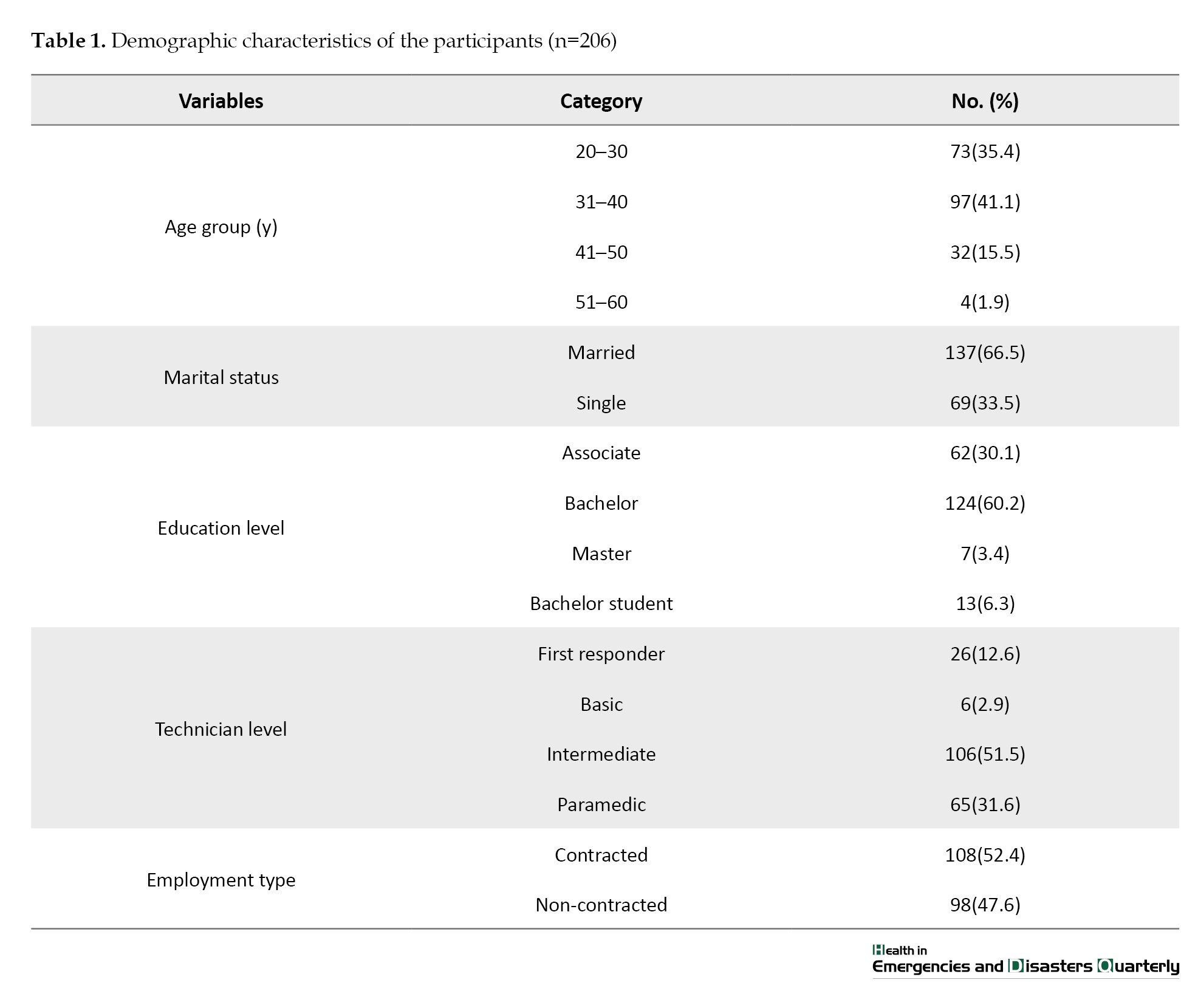
A total of 206 personnel from the prehospital emergency operations unit in Tehran participated in this study. The mean age of the participants was 33.82±7 years (95% CI, 32.91%, 34.73%). The majority held a bachelor’s degree in emergency medical services (EMS) (59%). The overall mean compliance score with standard precautions was 13.27±3.38 (95% CI, 12.85%, 13.69%), indicating low adherence. Detailed demographic characteristics are presented in Table 1.
Significant associations were found between compliance and marital status (P=0.034), history of general health check-ups (P=0.004), experience of exposure to body fluids in the past year (P=0.006), and the quality of PPE available during shifts (P=0.006). For example, married personnel had a higher mean compliance score (13.89±3.21) compared to single personnel (12.45±3.52). Similarly, those with a history of general health check-ups scored higher (14.02±3.18) than those without (12.76±3.41). Factors associated with compliance are summarized in Table 2.
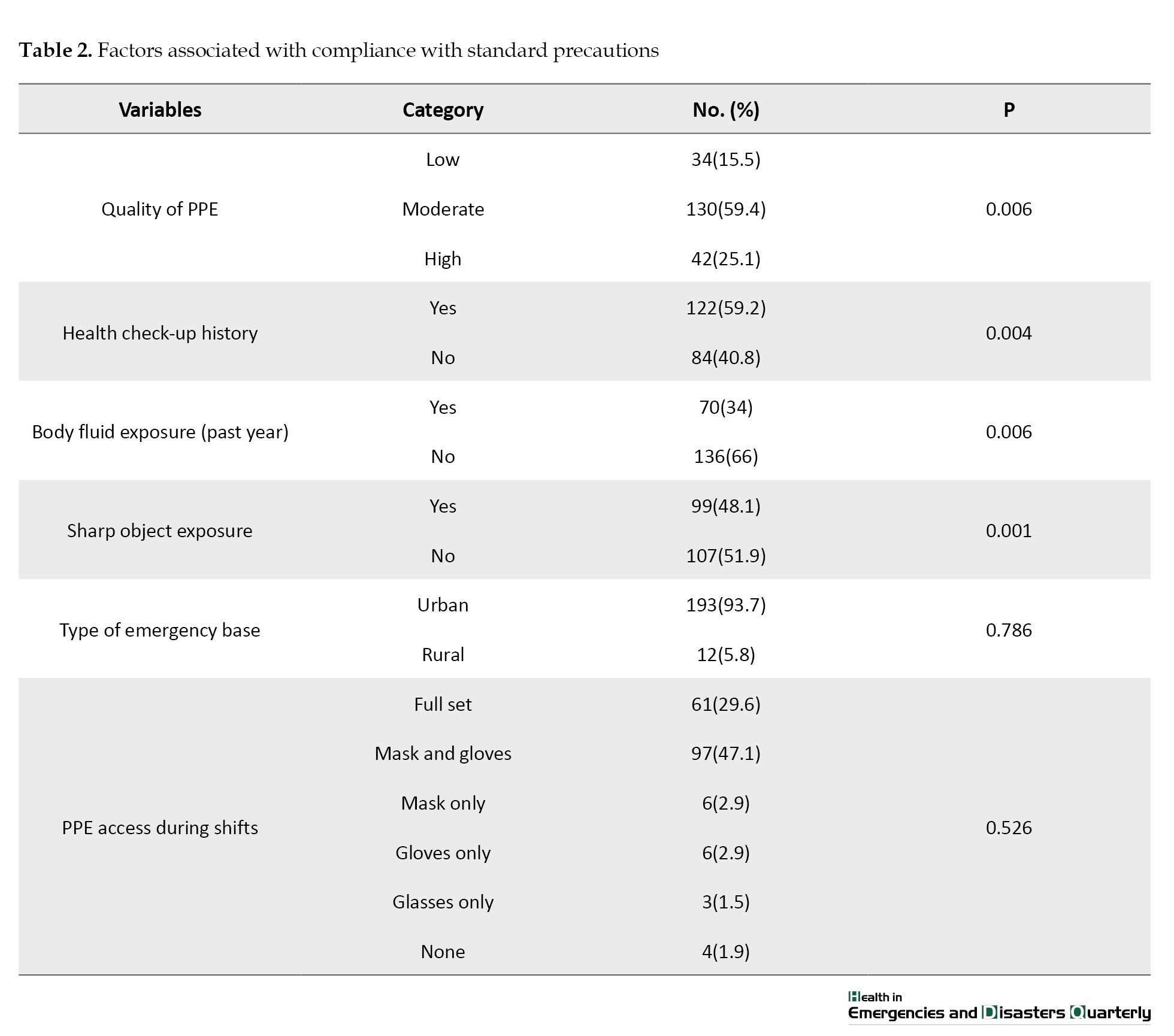
No statistically significant relationship was found between compliance and certain demographic characteristics, including the type of emergency base (urban vs rural, P=0.786) and access to specific types of PPE (P=0.526). PPE availability was categorized based on combinations of items (e.g. gloves only, masks only, full set). However, the type of PPE available did not significantly impact compliance, suggesting that perceived quality may be more influential than quantity. The Pearson correlation test revealed weak negative correlations between compliance and both age (r=-0.031, P=0.668) and work experience (r=-0.075, P=0.292). According to Cohen’s criteria, these effect sizes are considered negligible (r<0.1), indicating no meaningful relationship. Given the number of statistical tests performed, no formal adjustment for multiple comparisons was applied. Therefore, findings should be interpreted with caution regarding potential type I errors.
Discussion
This study revealed low adherence to standard precautions among prehospital emergency personnel in Tehran, consistent with previous findings in Iran [17, 18], Pakistan [17], and Australia [3]. For instance, Taylor et al. [3]highlighted inadequate performance among paramedics regarding infection control. Similarly, Mohamad Nejad [17] reported weak compliance among ICU nurses, and Amavasi et al. [18] found poor adherence among physicians.
Vikke et al. [5] reported that only 56.9% of EMS providers arrived wearing gloves, hand hygiene was observed in 27.8% of providers, and reusable equipment disinfection occurred in just 31.6% of opportunities. These findings highlight the need for improved adherence to standard precautions to mitigate the risk of infection transmission.
Alhazmi et al. [1] found that 76% of EMS providers consistently complied with standard precautions, although urban providers reported inconsistent use more frequently than rural ones. This variability underscores the influence of geographic and operational factors.
The significant relationship between marital status and compliance in the present study contrasts with Mehravar et al. [7], who found no such correlation, and Mendes et al. [13], who reported higher adherence among single individuals. These differences may reflect demographic or cultural variations.
Employment status also showed a significant association with compliance. Mehravar et al. [7] found formal nurses had higher adherence, while Khodaveisi et al. [19] reported no correlation. These discrepancies may be due to differences in workplace conditions and job security. The link between health check-ups and compliance is supported by Soltanzadeh et al. [20], who emphasized the impact of shift schedules on metabolic health. Mohamadkhani et al. [21] found low awareness among EMS personnel regarding post-hepatitis B vaccination serology, and Amini et al. [22] highlighted the role of occupational health examinations in injury prevention.
Exposure to body fluids was associated with higher compliance, possibly due to increased risk perception. Moshksar et al. [23] reported that 39.8% of healthcare workers had experienced such exposure, and Khodaveisi et al. [19] concluded that perceived risk enhances adherence.
The quality of PPE was a key determinant of compliance. Ahmadi Marzaleh et al. [24] identified poor-quality gloves as a barrier, and Siam and Alreshidi [25] found high usage rates of gloves and masks among emergency nurses during exposure to body fluids. Sharp object injuries were also linked to adherence. Siam and ALreshidi [25] reported 87.5% compliance during use of disposable sharps, and Kim et al. [26] emphasized the role of training and supervision in reducing such injuries. This study found weak, non-significant correlations between compliance and both age and work experience. While Brandão et al. [27] reported improved adherence with experience, other studies [19, 25] found no such relationship. These inconsistencies may reflect variations in training, workplace policies, or cultural factors.
This study contributes to the literature by focusing specifically on prehospital emergency personnel—a group often overlooked in infection control research [1–4, 6, 11, 14]. Given their frontline role and exposure to high-risk environments, targeted interventions for this population are essential.
One of the challenges encountered by the research team in this study was the uneven participation from various operational areas across Tehran. To mitigate this limitation, appropriate statistical tests were applied. It is recommended that future research compare and contextualize the findings of this study with other investigations on standard precautions in prehospital emergency settings. A primary limitation of this study is the reliance on self-reporting tools, which may introduce response bias. Nonetheless, efforts were made to minimize this bias by clearly explaining the study’s purpose to participants and ensuring confidentiality. Additionally, the use of convenience sampling may have introduced selection bias, as participants were recruited based on availability rather than random selection. This could affect the representativeness of the sample and limit the generalizability of the findings. Future studies are encouraged to employ probabilistic sampling methods to enhance the validity and applicability of results.
Conclusion
Adherence to standard precautions among prehospital emergency personnel was found to be suboptimal. To address this issue, specific interventions should be implemented, including regular training on infection control, provision of high-quality PPE, and mandatory health check-ups. Policymakers should prioritize infection prevention strategies in prehospital settings, recognizing their critical role in the healthcare system. Strengthening these measures can enhance safety for both healthcare providers and the communities they serve. Future research should investigate the effectiveness of structured educational programs, the role of psychological factors such as perceived vulnerability, and the impact of organizational support on compliance. Longitudinal studies are also recommended to assess changes in adherence over time and in response to policy interventions or public health emergencies.
Ethical Considerations
Compliance with ethical guidelines
This study was approved by the Research Ethics Committee of the School of Nursing and Midwifery, Tehran University of Medical Sciences, Tehran, Iran (Code: IR.TUMS.FNM.REC.1402.112). All participants were informed about the study details, and informed consent was obtained from them.
Funding
This article was extracted from the master's thesis of Yasaman Jahed, approved by the Department of Medical Surgical Nursing, School of Nursing and Midwifery, Tehran University of Medical Sciences, Tehran, Iran. (Code: 40011270003).
Authors' contributions
Conceptualization, Supervision, and Funding Acquisition: Zahra Abbasi Dolatabadi; Methodology: Yasaman Jahed, Mahdi Nabi Foodani and Saeed Mehrsorosh; Investigation, data curation, and writing the original draft: Yasaman Jahed; Formal analysis: Mahdi Nabi Foodani; Review and editing: Zahra Abbasi Dolatabadi, Mahdi Nabi Foodani; Final approval: All authors.
Conflict of interest
The authors declared no conflict of interest.
Acknowledgments
The authors would like to thank the EMS personnel of Tehran for their participation in this research.
References
Prehospital emergency personnel are exposed to various occupational hazards due to the nature of their work [1]. These hazards include complex patient conditions, logistical interruptions, health risks, interpersonal and interprofessional conflicts, and legal challenges [2]. Direct contact with patients and victims who may carry known or unknown pathogens places these personnel at risk of transmitting infectious diseases to themselves, others, and the environment, often unknowingly [3, 4]. Additionally, they face risks, such as injuries from sharp instruments and exposure to bodily fluids, which increase the likelihood of contracting diseases like hepatitis, HIV, and respiratory infections [5]. In rare cases, emergency deliveries occur in ambulances before reaching medical centers, further complicating infection control [6]. All these factors make prehospital emergency settings a potential source of infection within the healthcare system.
Each year, approximately 3 million healthcare workers are at risk of contracting blood-borne and fluid-transmitted diseases worldwide. In response to this growing concern, the World Health Organization (WHO) and the centers for disease control and prevention (CDC) introduced the concept of “standard precautions” [7]. These measures include hand hygiene, use of personal protective equipment (PPE), and safe handling of sharp instruments. They represent the minimum infection prevention strategies applicable to all patients at all times, regardless of diagnosis [8].
In modern healthcare systems, it is assumed that every patient may be infectious or colonized with microorganisms capable of transmission. Therefore, it is essential for prehospital emergency personnel to consistently apply standard precautions and infection control measures to themselves, their equipment, and the care environment to minimize infection risks [9]. Studies have shown that ambulances and emergency equipment may harbor infectious microorganisms, such as Staphylococcus aureus, Enterobacter, and methicillin-resistant bacteria [10]. Recognizing the level of adherence to standard precautions among pre-hospital emergency personnel, and identifying the factors influencing their implementation, is crucial for infection prevention and control [11].
According to the Ministry of Health and Medical Education, the rate of healthcare-associated infections in Iran was 26.57 per 1000 people in 2020, with regional variation. For instance, a 2022 study in eastern provinces reported a rate of 17.1 per 1000, while the global rate was 0.14% in the same year [12]. These infections are directly linked to prolonged hospitalization, delayed recovery, increased mortality, and higher healthcare costs. Given the importance of infection control, it is vital to identify critical points for prevention and the individual factors influencing adherence to standard precautions [13]. Moreover, prehospital emergency personnel play a key role in disaster and epidemic response, often facing challenges such as lack of PPE, which can negatively impact their mental health and professional well-being [14].
Most studies have focused on hospitals and hospital staff. However, given that the starting point of healthcare services is the prehospital emergency setting, it is essential to assess the level of adherence to standard precautions and identify the factors influencing their implementation. Tehran, as the capital and most populous city of Iran, has a dense network of pre-hospital emergency bases and faces frequent traffic congestion, high accident rates, and increased exposure to infectious risks. These factors make it a critical setting for evaluating adherence to standard precautions and infection control practices.
Therefore, this study aimed to answer the following research questions:
What is the level of adherence to standard precautions among prehospital emergency personnel in Tehran?
Which individual and contextual factors are associated with adherence to these precautions?
Materials and Methods
This descriptive-analytical cross-sectional study was conducted from September to February 2023 on 215 personnel from the prehospital emergency operations unit in Tehran. The study population includes all operational staff of the prehospital emergency services in Tehran, and the study environment encompasses all pre-hospital emergency bases in Tehran, including both urban and road bases.
The subjects were selected through convenient sampling based on inclusion criteria, following informed consent and awareness of the study’s objectives. The inclusion criteria were as follows: A minimum of 6 months of recent work experience in the pre-hospital emergency service, employment in the operational unit of the pre-hospital emergency service, possession of an associate degree or higher, and membership in the emergency staff (motor ambulance, ambulance, or bus ambulance). The exclusion criterion was failure to complete more than 10% of the questionnaire. Incomplete questionnaires exceeding this threshold were excluded from the analysis. For partially missing data within accepted questionnaires, listwise deletion was applied, assuming the data were missing completely at random.
The G*Power software, version 3.1 software was used to calculate the sample size considering the minimum correlation of 0.2, which was the weak correlation based on Cohen’s effect size [15] and considering this value provided the high sample size, as well as the type 1 error of 0.05 and the second type error was calculated as 0.2, or in other words, the power of the test was 80% and sample size of 193 people was calculated in each group. Considering a 10% drop in the sample, this amount increased to 215 people.
The data collection instruments included a demographic information questionnaire, which captured details such as educational degree, age, work experience, and type of base, as well as the compliance with standard precautions scale (CSPS). The CSPS tool, initially developed by the CDC in 1996, was revised in 2010 by Simon Ching Lam in Hong Kong based on the WHO guidelines for standard precautions [16]. This tool has been translated and utilized in various languages. It consists of 20 items, with 16 positively phrased and 4 negatively phrased. Responses are provided on a four-point Likert scale ranging from “never” to “always.” For the 16 positively phrased items, only the “always” response receives a score of 1, while other responses are scored 0. Regarding the 4 negatively phrased items, the “never” response is scored 1, and other responses are scored 0. The total score ranges from 0 to 20, with higher scores indicating greater adherence to standard precautions. The correlation coefficient of 0.2 was selected as the minimum effect size based on Cohen’s criteria, which classify an r value of 0.1–0.3 as a small effect size. This threshold was chosen to ensure sufficient statistical power (80%) to detect even weak associations between variables, which are common in behavioral and health sciences.
In Iran, the CSPS tool was first employed in 2021 in a study by Nabi Foodani et al. [17], where it was translated into Persian and its validity and reliability were assessed. In the present study, the validity and reliability of the tool were re-examined. The validity of the tools was confirmed using the Lawshe method with content validity index (CVI) and content validity ratio (CVR) of 1. The reliability of the tool was determined through Cronbach α (0.78).
After explaining the study objectives, an informed consent was obtained from eligible participants before starting the study. Then, the paper-based questionnaires were distributed to the research units during their work shifts. Participants completed the forms in the presence of the researcher, who was available to provide clarification if needed. This supervised administration aimed to minimize response bias and ensure accurate data collection. The collected data were analyzed using SPSS software, version 25. Descriptive statistics, including absolute and relative frequencies, Mean±SD, were used to summarize demographic variables. The Kolmogorov-Smirnov test was applied to assess the normality of continuous variables. For categorical variables, the chi-square test and Fisher exact test were used to examine associations between demographic factors and compliance with standard precautions.
The Spearman rank correlation was employed to assess relationships between ordinal variables and compliance scores. A significance level of P<0.05 was considered statistically significant.
Results
A total of 206 personnel from the prehospital emergency operations unit in Tehran participated in this study. The mean age of the participants was 33.82±7 years (95% CI, 32.91%, 34.73%). The majority held a bachelor’s degree in emergency medical services (EMS) (59%). The overall mean compliance score with standard precautions was 13.27±3.38 (95% CI, 12.85%, 13.69%), indicating low adherence. Detailed demographic characteristics are presented in Table 1.
Significant associations were found between compliance and marital status (P=0.034), history of general health check-ups (P=0.004), experience of exposure to body fluids in the past year (P=0.006), and the quality of PPE available during shifts (P=0.006). For example, married personnel had a higher mean compliance score (13.89±3.21) compared to single personnel (12.45±3.52). Similarly, those with a history of general health check-ups scored higher (14.02±3.18) than those without (12.76±3.41). Factors associated with compliance are summarized in Table 2.
No statistically significant relationship was found between compliance and certain demographic characteristics, including the type of emergency base (urban vs rural, P=0.786) and access to specific types of PPE (P=0.526). PPE availability was categorized based on combinations of items (e.g. gloves only, masks only, full set). However, the type of PPE available did not significantly impact compliance, suggesting that perceived quality may be more influential than quantity. The Pearson correlation test revealed weak negative correlations between compliance and both age (r=-0.031, P=0.668) and work experience (r=-0.075, P=0.292). According to Cohen’s criteria, these effect sizes are considered negligible (r<0.1), indicating no meaningful relationship. Given the number of statistical tests performed, no formal adjustment for multiple comparisons was applied. Therefore, findings should be interpreted with caution regarding potential type I errors.
Discussion
This study revealed low adherence to standard precautions among prehospital emergency personnel in Tehran, consistent with previous findings in Iran [17, 18], Pakistan [17], and Australia [3]. For instance, Taylor et al. [3]highlighted inadequate performance among paramedics regarding infection control. Similarly, Mohamad Nejad [17] reported weak compliance among ICU nurses, and Amavasi et al. [18] found poor adherence among physicians.
Vikke et al. [5] reported that only 56.9% of EMS providers arrived wearing gloves, hand hygiene was observed in 27.8% of providers, and reusable equipment disinfection occurred in just 31.6% of opportunities. These findings highlight the need for improved adherence to standard precautions to mitigate the risk of infection transmission.
Alhazmi et al. [1] found that 76% of EMS providers consistently complied with standard precautions, although urban providers reported inconsistent use more frequently than rural ones. This variability underscores the influence of geographic and operational factors.
The significant relationship between marital status and compliance in the present study contrasts with Mehravar et al. [7], who found no such correlation, and Mendes et al. [13], who reported higher adherence among single individuals. These differences may reflect demographic or cultural variations.
Employment status also showed a significant association with compliance. Mehravar et al. [7] found formal nurses had higher adherence, while Khodaveisi et al. [19] reported no correlation. These discrepancies may be due to differences in workplace conditions and job security. The link between health check-ups and compliance is supported by Soltanzadeh et al. [20], who emphasized the impact of shift schedules on metabolic health. Mohamadkhani et al. [21] found low awareness among EMS personnel regarding post-hepatitis B vaccination serology, and Amini et al. [22] highlighted the role of occupational health examinations in injury prevention.
Exposure to body fluids was associated with higher compliance, possibly due to increased risk perception. Moshksar et al. [23] reported that 39.8% of healthcare workers had experienced such exposure, and Khodaveisi et al. [19] concluded that perceived risk enhances adherence.
The quality of PPE was a key determinant of compliance. Ahmadi Marzaleh et al. [24] identified poor-quality gloves as a barrier, and Siam and Alreshidi [25] found high usage rates of gloves and masks among emergency nurses during exposure to body fluids. Sharp object injuries were also linked to adherence. Siam and ALreshidi [25] reported 87.5% compliance during use of disposable sharps, and Kim et al. [26] emphasized the role of training and supervision in reducing such injuries. This study found weak, non-significant correlations between compliance and both age and work experience. While Brandão et al. [27] reported improved adherence with experience, other studies [19, 25] found no such relationship. These inconsistencies may reflect variations in training, workplace policies, or cultural factors.
This study contributes to the literature by focusing specifically on prehospital emergency personnel—a group often overlooked in infection control research [1–4, 6, 11, 14]. Given their frontline role and exposure to high-risk environments, targeted interventions for this population are essential.
One of the challenges encountered by the research team in this study was the uneven participation from various operational areas across Tehran. To mitigate this limitation, appropriate statistical tests were applied. It is recommended that future research compare and contextualize the findings of this study with other investigations on standard precautions in prehospital emergency settings. A primary limitation of this study is the reliance on self-reporting tools, which may introduce response bias. Nonetheless, efforts were made to minimize this bias by clearly explaining the study’s purpose to participants and ensuring confidentiality. Additionally, the use of convenience sampling may have introduced selection bias, as participants were recruited based on availability rather than random selection. This could affect the representativeness of the sample and limit the generalizability of the findings. Future studies are encouraged to employ probabilistic sampling methods to enhance the validity and applicability of results.
Conclusion
Adherence to standard precautions among prehospital emergency personnel was found to be suboptimal. To address this issue, specific interventions should be implemented, including regular training on infection control, provision of high-quality PPE, and mandatory health check-ups. Policymakers should prioritize infection prevention strategies in prehospital settings, recognizing their critical role in the healthcare system. Strengthening these measures can enhance safety for both healthcare providers and the communities they serve. Future research should investigate the effectiveness of structured educational programs, the role of psychological factors such as perceived vulnerability, and the impact of organizational support on compliance. Longitudinal studies are also recommended to assess changes in adherence over time and in response to policy interventions or public health emergencies.
Ethical Considerations
Compliance with ethical guidelines
This study was approved by the Research Ethics Committee of the School of Nursing and Midwifery, Tehran University of Medical Sciences, Tehran, Iran (Code: IR.TUMS.FNM.REC.1402.112). All participants were informed about the study details, and informed consent was obtained from them.
Funding
This article was extracted from the master's thesis of Yasaman Jahed, approved by the Department of Medical Surgical Nursing, School of Nursing and Midwifery, Tehran University of Medical Sciences, Tehran, Iran. (Code: 40011270003).
Authors' contributions
Conceptualization, Supervision, and Funding Acquisition: Zahra Abbasi Dolatabadi; Methodology: Yasaman Jahed, Mahdi Nabi Foodani and Saeed Mehrsorosh; Investigation, data curation, and writing the original draft: Yasaman Jahed; Formal analysis: Mahdi Nabi Foodani; Review and editing: Zahra Abbasi Dolatabadi, Mahdi Nabi Foodani; Final approval: All authors.
Conflict of interest
The authors declared no conflict of interest.
Acknowledgments
The authors would like to thank the EMS personnel of Tehran for their participation in this research.
References
- Alhazmi RA, Parker RD, Wen S. Standard precautions among emergency medical services in urban and rural areas. Workplace Health & Safety. 2020; 68(2):73-80. [DOI:10.1177/2165079919864118] [PMID]
- Afshari A, Borzou SR, Shamsaei F, Mohammadi E, Tapak L. Perceived occupational stressors among emergency medical service providers: A qualitative study. BMC Emergency Medicine. 2021; 21:35. [DOI:10.1186/s12873-021-00430-6] [PMID]
- Taylor N, Simpson M, Cox J, Ebbs P, Vanniasinkam T. Infection prevention and control among paramedics: A scoping review. American Journal of Infection Control. 2024; 52(10):1128-34. [DOI:10.1016/j.ajic.2024.06.014] [PMID]
- Ghasemi S, Nosrati S, Fakhry M, Khadang M. [Investigating the rate of nosocomial infections and providing solutions to prevent and control it (Persian)]. Paramedical Sciences and Military Health. 2021; 15(4):64-71. [Link]
- Vikke HS, Vittinghus S, Giebner M, Kolmos HJ, Smith K, Castrén M, et al. Compliance with hand hygiene in emergency medical services: An international observational study. Emergency Medicine Journal. 2019; 36(3):171-5. [DOI:10.1136/emermed-2018-207872] [PMID]
- Sheikhi RA, Heidari M. The challenges of delivery in pre-hospital emergency medical services ambulances in Iran: a qualitative study. BMC Emergency Medicine. 2024; 24:156. [DOI:10.1186/s12873-024-01073-z] [PMID]
- Mehravar A, Mokhtari Lakeh N, Emami Sigaroudi A, Maroufizadeh S. Nurses’ compliance with standard precautions based on health belief model in emergency departments. Journal of Holistic Nursing And Midwifery. 2022; 32(2):135-43. [DOI:10.32598/jhnm.32.2.2188]
- WHO. Infection prevention and control during health care when novel coronavirus (nCoV) infection is suspected: interim guidance. Geneva: World Health Organization; 2020. [Link]
- Saraie Z, Azadi A. [Knowledge and compliance with standard precautions and its predictors among health care workers in teaching hospitals, Ilam, Iran (Persian)]. Ilam University of Medical Science. 2021; 29(3):1-11. [DOI:10.52547/sjimu.29.3.1]
- Obenza A, Cruz P, Buttner M, Woodard D. Microbial contamination on ambulance surfaces. Journal of Hospital Infection. 2022; 122:44-59. [DOI:10.1016/j.jhin.2021.12.020] [PMID]
- Babaei HA, Ferdosi M, Masoumi G, Rezaei F. A comparative study on specialized services in pre-hospital emergencies in Iran and selected countries. Journal of Education and Health Promotion. 2023; 12:414. [DOI:10.4103/jehp.jehp_232_23]
- Bunduki GK, Masoamphambe E, Fox T, Musaya J, Musicha P, Feasey N. Prevalence, risk factors, and antimicrobial resistance of endemic healthcare-associated infections in Africa: a systematic review and meta-analysis. BMC Infectious Diseases. 2024; 24:158. [DOI:10.1186/s12879-024-09038-0] [PMID]
- Mendes AMV, de Sousa Lima MM, de Araújo DV, Albuquerque IM, Santiago LM, Barros LM. Adherence to standard precaution measures between pre-and in-hospital emergency nursing professionals in a northeast county. Revista Brasileira de Medicina do Trabalho. 2019; 17(4):573-81. [DOI:10.5327/Z1679443520190390] [PMID]
- Khazaei A, Torabi M, Shayganihonar M, Bayat AR. Exploring the challenges of emergency medical service providers in the initial phase of the COVID-19 pandemic: a qualitative content analysis. BMC Emergency Medicine. 2024; 24(159):1-14. [DOI:10.1186/s12873-024-01079-7] [PMID]
- AlWahaibi IS, AlHadabi DA, AlKharusi HA. Cohen's Criteria for interpreting practical significance indicators: A critical study. Cypriot Journal of Educational Sciences. 2020; 15(2):246-58. [Link]
- Simon LC. Compliance with Standard Precautions Scale (CSPS): Fact sheet. 2019. [Link]
- Nabi Foodani M, Mohamadnejad Ostad F, Navab E, Bahrampouri S, Abbasi Dolatabadi Z. Self-care and standard precaution observance in intensive care nurses during COVID 19. Health Education and Health Promotion. 2023; 11(1):3-10. [DOI:10.5812/jnms-135972]
- Amavasi B, Zimmerman PA. Infection prevention and control continuous education and training in pre-registration nursing programmes. Nurse Education Today. 2024; 133:106051. [DOI:10.1016/j.nedt.2023.106051] [PMID]
- Khodaveisi M, Mohamadkhani M, Amini R, Karami M. [Factors predicting the standard precautions for infection control among pre-hospital emergency staff of Hamadan based on the health belief model (Persian)]. Journal of Education and Community Health. 2017; 4(3):12-8. [DOI:10.21859/jech.4.3.12]
- Soltanzadeh A, Eyvazlou M, Mohammad Ghasemi M. investigating the relationship between shift work schedule and blood and metabolic parameters: A 10 years retrospective cohort study. Scientifc Reports. 2024; 14(1):17297. [DOI:10.1038/s41598-024-68378-8] [PMID]
- Mohamadkhani M, Mohamadyari T, Khodaveisi M, Amini R, Karami M. [Assessing knowledge and performance of pre-hospital emergency staff regarding infection control standard precautions (Persian)]. Iranian Journal of Emergency Care. 2017; 1(3):74-81. [Link]
- Amini R, Mohamadkhani M, Khodaveisi M, Karami M. Effect of health belief model-based education on infection control standard precautions in prehospital emergency staff: A clinical trial study. Iranian Journal of Nursing and Midwifery Research. 2021; 26(6):515-20. [DOI:10.4103/ijnmr.IJNMR_377_20] [PMID]
- Moshksar S, Nabavi MM, Danaei M, Momeni M, Askarian M. Compliance with standard precautions, sharp injuries, and blood and body fluid exposure among healthcare workers. Nursing Practice Today. 2023; 10(3):190-7. [DOI:10.18502/npt.v10i3.13428]
- Ahmadi Marzaleh M, Rezaee R, Rezaianzadeh A, Rakhshan M, Haddadi G, Peyravi M. Emergency department preparedness of hospitals for radiation, nuclear accidents, and nuclear terrorism: A qualitative study in Iran. Iranian Red Crescent Medical Journal. 2019; 21(5):3. [DOI:10.5812/ircmj.87107]
- Siam BGAH, ALreshidi OAS. Emergency nurses’ compliance with standard precautions during the COVID-19 pandemic at governmental hospitals in Hail City, Kingdom of Saudi Arabia. Ethiopian Journal of Health Sciences. 2023; 33(1):21-30. [DOI:10.4314/ejhs.v33i1.4] [PMID]
- Kim SJ, Lee EJ. Factors influencing emergency department nurses’ compliance with standard precautions using multilevel analysis. International Journal of Environmental Research and Public Health. 2021; 18(11):6149. [DOI:10.3390/ijerph18116149] [PMID]
- Brandão P, De Luna TD, Bazilio TR, Lam SC, Góes FG, Ávila FM. Compliance with standard precaution measures by health professionals: Comparison between two hospitals. Enfermería Global. 2022; 21(1):29-41. [DOI:10.6018/eglobal.484091]
Type of article: Research |
Subject:
Emergency
Received: 2025/04/20 | Accepted: 2025/07/26 | Published: 2026/04/1
Received: 2025/04/20 | Accepted: 2025/07/26 | Published: 2026/04/1
Send email to the article author
| Rights and permissions | |
 |
This work is licensed under a Creative Commons Attribution-NonCommercial 4.0 International License. |

Copyright © The Author(s);
This is an open access article distributed under the terms of the Creative Commons Attribution-NonCommercial 4.0 (CC-By-NC 4.0), which permits use, distribution, and reproduction in any medium, provided the original work is properly cited and is not used for commercial purposes.
Contact Information
This is an open access article distributed under the terms of the Creative Commons Attribution-NonCommercial 4.0 (CC-By-NC 4.0), which permits use, distribution, and reproduction in any medium, provided the original work is properly cited and is not used for commercial purposes.
Contact Information
