

Volume 11, Issue 4 (Summer 2026)
Health in Emergencies and Disasters Quarterly 2026, 11(4): 363-378 |
Back to browse issues page




Download citation:
BibTeX | RIS | EndNote | Medlars | ProCite | Reference Manager | RefWorks
Send citation to:


BibTeX | RIS | EndNote | Medlars | ProCite | Reference Manager | RefWorks
Send citation to:
Ahmed M T, Ove M I, Hasib M I, Mollah A H. Assessing the Perceived Impacts of Cyclone Remal on Households in Patuakhali District, Bangladesh. Health in Emergencies and Disasters Quarterly 2026; 11 (4) :363-378
URL: http://hdq.uswr.ac.ir/article-1-747-en.html
URL: http://hdq.uswr.ac.ir/article-1-747-en.html


1- Department of Economics, Faculty of Social Sciences, University of Barishal, Barishal, Bangladesh.
2- Department of Economics, Faculty of Social Sciences, University of Barishal, Barishal, Bangladesh. ,ahasib20.eco@bu.ac.bd
2- Department of Economics, Faculty of Social Sciences, University of Barishal, Barishal, Bangladesh. ,
Keywords: Cyclone Remal, Perceived disaster impact, Ordered logistic regression, Household vulnerability, Community resilience, Coastal Bangladesh
Full-Text [PDF 4509 kb]
(840 Downloads)
| Abstract (HTML) (2812 Views)
Full-Text: (183 Views)
Introduction
As Bangladesh is a low-lying deltaic region, it is one of the most cyclone-prone regions in the world. The recently occurred cyclone Remal is a severe cyclonic storm (SCS) that swept over the coastal areas, including Patuakhali district in the Barishal Division of Bangladesh, on May 26, 2024 [1]. The cyclone led to severe infrastructural damage, including 40,246 houses that were completely destroyed, with an additional 131,678 experiencing partial damage, disrupted the lives of local communities, displaced approximately 4.6 million people, and caused significant environmental impacts, destroying thousands of acres of different land areas all over Bangladesh [2]. There was extreme rainfall and an 8-12 foot storm surge caused by the cyclone during the time being, and with the rainfall continuing for 48 hours [3]. This worsened the flooding in many regions, and Patuakhali is one of the worst-hit districts that experienced acute destruction. During this period, over 30 villages in Patuakhali were severely flooded due to breaches in the embankments [4]. As a result of these floods and the severe gusts accompanying the cyclone, an already difficult situation became even more difficult. Even beyond the immediate devastation, the cyclone has highlighted the ongoing challenges posed by climate change in other ways, and thus there is a need for effective disaster management strategies in that region. Although several coastal districts, including Khulna and Barguna, saw significant impact, Patuakhali’s topographical and socioeconomic characteristics render it particularly susceptible. The district’s wide low-lying floodplains, significant reliance on agriculture and fisheries, and history of recurrent embankment failures distinguish it from other cyclone-prone regions [5] a socioeconomic vulnerability index (SeVI). These attributes validate its designation as an important case study for comprehending community-level perceptions of cyclones. The study aimed to elucidate the environmental and infrastructural issues posed by the cyclone and to recognize insights for future preparedness and response initiatives.
According to the Bangladesh Red Crescent Society, cyclone Remal reached a maximum sustained wind speed of 117 km/h (60 kt) at its peak on May 27 [6]. Making landfall on May 26, 2024, with wind speeds ranging from 92 to 117 km/h.
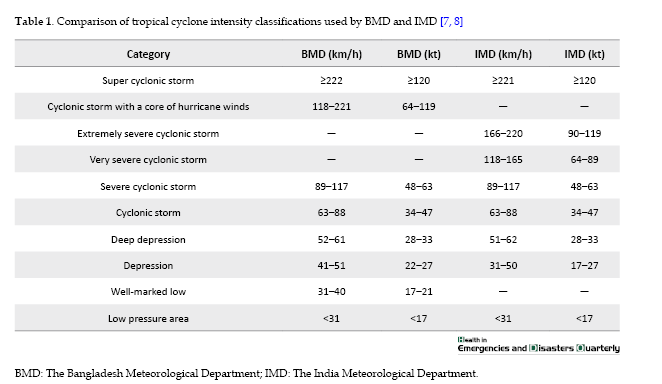
Based on its maximum sustained wind speed, it can be categorized as SCS in the disturbance classification of both the Bangladesh Meteorological Department (BMD) and the India Meteorological Department (IMD). The classification of tropical cyclones by IMD and BMD is shown in Figure 1.
Table 1 compares the tropical cyclone intensity classification systems used by the BMD and IMD. While both systems classify cyclones based on sustained wind speed, differences exist in the intermediate intensity categories and threshold ranges.
.PNG)
On May 24, the cyclone developed as a low-pressure system in the Bay of Bengal near latitude 15.0° N and longitude 88.4° E, roughly 800 km south-west of Khepupara (Bangladesh) and 810 km south of Canning (West Bengal) [9]. The pathway of cyclone Remal is shown in Figure 2.
.PNG)
Soon, due to the warm sea surface temperature of approximately 30 °C and low vertical wind shear, cyclone Remal began to rapidly intensify. It intensified and formed as SCS by May 25th evening. The cyclone was moving steadily towards the coast of southern Bangladesh, directly in the path of Patuakhali and the surrounding coastal areas. This cyclone made landfall near Kalapara, Patuakhali, around midnight on May 26, 2024 [6]. Its central pressure dropped significantly with intensification, reaching a low of approximately 978 hPa at its peak intensity before landfall [11]. Usually, there is a correlation that the lower the central pressure, the more intense the cyclone [12].
Figure 3, sourced from the IMD, shows cyclone Remal’s central pressure dynamics from 24 to 27 May 2024. Panel (A) presents the temporal variation in estimated central pressure (hPa), while Panel (B) shows the corresponding pressure drop at the cyclone center (hPa). Together, these trends highlight the cyclone’s intensification prior to landfall and its subsequent weakening thereafter.
.PNG)
This decrease in pressure at its peak suggests the cyclone strengthening because it leads to an increase in wind speed and weather severity. The pressure began to decrease after landfall. Later, it began to move inland, growing weaker as it encountered harsher terrain and increased friction over land.
While previous studies have extensively examined cyclone exposure and damage assessment in Bangladesh, less attention has been paid to how households perceive cyclone impacts and which socioeconomic and disaster-related factors shape these perceptions [5]. Such insights are essential for designing community-centered disaster preparedness and response strategies. Therefore, this study focuses on Patuakhali District as a critical case study of Cyclone Remal’s impacts. The objectives are twofold: (i) to document household perceptions of the cyclone’s overall impact, and (ii) to identify key determinants—including income, damage, shelter use, health outcomes, and aid—that influence these perceptions. By analyzing household-level survey data using ordered logistic regression (OLR), this study deepens understanding of disaster impact assessment and offers implications for strengthening cyclone preparedness in coastal Bangladesh.
Literature review
Cyclones are among the most devastating natural disasters, especially in coastal areas where populations are often densely concentrated and rely on natural resources for their livelihoods [13]. Poverty, weak infrastructure, and environmental deterioration all contribute to the regions' susceptibility [14]. Cyclones, sometimes known as hurricanes or typhoons in various parts of the world, have caused widespread economic, social, and environmental destruction [15]. These theoretical lenses directly informed variable selection in this study. For example, the protective action decision model (PADM) guided the inclusion of risk-related factors, such as shelter use and past health impacts, while the social vulnerability paradigm shaped the choice of socioeconomic indicators, such as income, education, and household size. Together, these frameworks provide a conceptual basis for interpreting how structural vulnerabilities and protective actions influence perceived cyclone impacts [16, 17]. The frequency and intensity of severe storms have grown in recent years, most likely due to climate change. For example, Emanuel (2005) and Webster (2005) found evidence of increased tropical storm intensity, which has been connected to rising sea surface temperatures [18, 19]. These developments are especially worrying for low-lying coastal communities, which are already prone to storm surges and flooding.
South Asia, particularly Bangladesh, is extremely vulnerable to cyclones due to its geographical location and socioeconomic characteristics [20]. Cyclones Sidr (2007) and Aila (2009) are two of the most destructive cyclones to hit the region, causing widespread destruction and loss of life [21]. Poverty, limited access to healthcare, and inadequate infrastructure all contribute to the vulnerability of Bangladesh's coastal communities [22]. An expanding body of literature establishes a correlation between climate change and increased cyclone frequency and intensity. According to the Intergovernmental Panel on Climate Change, the frequency of severe tropical cyclones is expected to increase, potentially devastating vulnerable regions, such as South Asia [23]. Cyclone Remal has profoundly impacted coastal communities in Bangladesh, particularly regarding environmental degradation, disaster preparedness, and recovery challenges [5]. Additionally, saltwater intrusion from storm surges rendered large tracts of agricultural land infertile, particularly affecting rice cultivation. This has had long-lasting impacts on the livelihoods of coastal farmers [24]. The biodiversity of the Sundarbans, the world's largest mangrove forest, was also adversely affected, with numerous endangered species suffering due to habitat loss [25]. Public health challenges have emerged as a critical concern in the aftermath of Cyclone Remal [26]. In the days following Cyclone Remal, waterborne diseases, such as cholera and diarrhea, occurred due to contaminated water supplies [27]. Mental health disorders were widespread, as numerous survivors encountered heightened anxiety and sadness resulting from insufficient post-disaster care services [28].
Education is essential for catastrophe preparedness and response. Higher levels of education are linked to greater understanding of disaster risks and more proactive behavior during calamities. This is supported by research [29], which discovered that communities with higher educational attainment were better prepared and more resilient to disasters. Income is another important driver of disaster impact. Poorer households frequently reside in more vulnerable places, such as floodplains or substandard buildings, and have fewer resources to cope with the aftermath of a disaster. This has been well documented in the literature, including research by [30], which investigates the relationship between poverty and catastrophe susceptibility. Cyclones cause not only rapid physical destruction but also long-term environmental and health effects. These impacts can worsen the susceptibility of affected populations, creating a vicious cycle of disaster-induced poverty and environmental degradation. The degradation of natural barriers, such as mangroves and coral reefs, has made coastal regions more vulnerable to cyclones. According to [31], locations with intact mangrove forests receive less cyclone damage than those where mangroves have been removed. The response to Cyclone Remal revealed both strengths and weaknesses in Bangladesh's disaster management framework. The country's early warning systems were effective in saving lives, as noted by [32]. However, the evacuation and relief distribution procedures were problematic. Remote and vulnerable communities were frequently left behind during evacuations, and relief operations were impeded by logistical challenges and inconsistent resource allocation [5]. The recovery initiatives underscore the necessity of establishing durable resilience against future cyclones. Community-based disaster management strategies that engage local populations in disaster preparedness have effectively mitigated susceptibility [33]. Strategies, such as raised housing and accessible emergency shelters, have improved disaster readiness [34].
Despite the abundance of knowledge regarding the impacts of cyclones, notable gaps persist, particularly in the Patuakhali District and similar regions in Bangladesh. One of these gaps is the necessity for supplementary regional research that considers the unique environmental conditions of various areas.
Materials and Methods
This study adopted a quantitative research approach to assess the impacts of Cyclone Remal in Patuakhali District, located in the Barishal Division of Bangladesh, a region acutely vulnerable to cyclonic events due to its low-lying coastal geography [13] (Figure 4). A disproportionate stratified random sampling design was adopted. Four of the most cyclone-prone upazilas of Patuakhali—Patuakhali Sadar, Dumki, Galachipa, and Kalapara—were selected as strata based on their geographic location and exposure [35]. Household lists were obtained from local government authorities, and households were randomly selected within each stratum using a lottery method. To ensure balanced geographic representation, an equal number of 117 households was surveyed from each upazila, resulting in 468 households. Although this equal allocation was not proportional to population size, it enhanced comparability across strata. In cases of non-response, replacement households were randomly selected to minimize bias. This design represents disproportionate stratification; therefore, sampling weights were applied for district-level inference. Within each selected household, the primary decision-maker was chosen as the respondent. Non-response was minimal (<5%), and replacement households were randomly chosen from the same list to minimize bias.
.PNG)
Based on a 95% confidence level and a 5% error margin, the minimum sample size was calculated to be 370 households [36]. However, to enhance the robustness and generalizability of the findings, data were collected from 468 households from June 1 to September 17, 2024, exceeding the recommended threshold. A standardized questionnaire was developed based on prior disaster perception studies [37]. Content validity was assessed through expert review by one disaster management specialist, and a pilot survey with 20 households was conducted in Patuakhali. Enumerators received three days of training on questionnaire content, ethical protocols, and mock interviews. Paper-based surveys were used and later digitized into Stata for analysis. The overall response rate was 92.5%. Missing responses were rare (<3% per variable) and were handled through listwise deletion. Quality control procedures included daily reviews of completed questionnaires and random spot checks by supervisors. The questionnaire captured demographic characteristics, household conditions, cyclone-related damages, income levels, and post-disaster experiences. This study did not involve medical or clinical trials and therefore did not require formal ethical clearance. Participation was voluntary, and informed consent (including parental/guardian consent for respondents under 18) was obtained. Confidentiality was strictly maintained. Descriptive statistics, such as mean, median, and standard deviation, were used to summarize continuous variables, while frequencies and percentages were reported for categorical variables. To identify the determinants of the perceived overall impact of Cyclone Remal, the study employed an OLR model, appropriate for ordinal dependent variables with non-equidistant categories [38]. The regression model is specified as Equation 1:
1. y=β0+β1x1+β2x2+β3x3+β4x4+β5x5+β6x6+ β7x7+β8x8+β9x9+ β10x10+ε
The dependent variable was derived from the survey item: ‘How would you describe the overall impact of Cyclone Remal on your household?’ (0 = Low, 1 = Medium, 2 = High). As this was a single-item measure capturing direct household perceptions, no scale aggregation was applied; however, face validity was established through expert review during instrument development. x1…… x10 are the independent variables encompassing socioeconomic indicators and cyclone-related experience. β0 is the intercept term, and β1 to β10 are the coefficients associated with the respective independent variables, x1 to x10, while ε is the error term. These independent variables were carefully selected based on their relevance to disaster impact research and their ability to capture the multidimensional consequences of Cyclone Remal on households. Key variables include total damage, household income, health issues, aid received, cyclone shelter use, and demographic controls such as age, education, marital status, and place of residence. Among them, variables, such as shelter use, health issues, aid received, marital status, and residence location, were treated as dummy variables, while the rest were continuous. To improve interpretability and avoid rounding artifacts, continuous monetary variables (income and total damage) were rescaled in units of 10,000 BDT. As aid receipt is likely endogenous to impact severity, coefficients on this variable should be interpreted as associations rather than causal effects. The proportional odds assumption was assessed using the Brant test, indicating no significant violation (x²=12.34, P=0.21), supporting the use of the OLR model. Model fit and diagnostics were evaluated using log-likelihood, likelihood-ratio chi-square (χ2), Akaike information criterion (AIC), and Bayesian information criterion (BIC) values. To enhance interpretability, average marginal effects and category-specific predicted probabilities were computed for key covariates, enabling a clear understanding of how changes in independent variables affect the probability of perceiving a low, medium, or high cyclone impact. Findings are representative at the district level in Patuakhali when sampling weights are applied, but are not directly generalizable to other coastal districts.
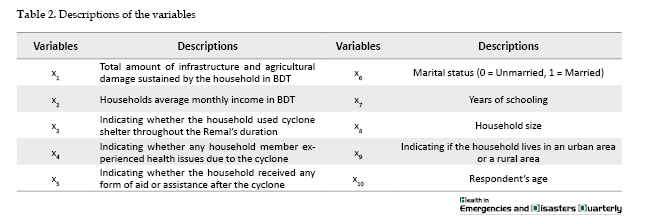
Table 2 presents the key variables employed in the analysis and their descriptions. These variables encompass household characteristics, socioeconomic aspects, and the effects of Cyclone Remal, forming the basis for evaluating the cyclone’s perceived overall impact.
The OLR model was chosen over other models, such as multinomial logistic regression, due to the ordinal nature of the dependent variable. While multinomial models treat outcome categories as nominal and unrelated, OLR respects the inherent order of perceived impact (low to high) and yields more parsimonious and interpretable estimates. This approach allows estimation of how each independent variable influences the probability that a respondent perceives the cyclone’s impact as low, medium, or high. Model diagnostics assessed goodness-of-fit, with the pseudo R-squared (R2) statistic as a key indicator. ORs were computed to interpret the direction and strength of the associations between predictor variables and the outcome. A significance threshold of 0.05 was adopted, with P-values used to evaluate the statistical significance of each coefficient.
This methodological framework ensures a robust and nuanced analysis of how various factors contribute to the perceived impacts of Cyclone Remal across diverse communities in Patuakhali District.
Results
In the study, the total number of observations is 468. Table 3 presents the descriptive summary of the variables as Mean ± standard deviation, minimum, and maximum values.
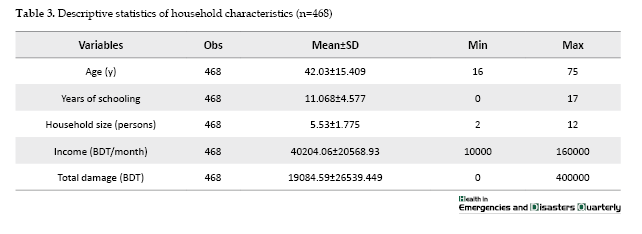
The average age of the respondents was 42.03 years, ranging from 16 to 75 years, indicating a broad age range. Respondents averaged 11 years of education, indicating diversified levels of educational achievement. The typical household size consists of five individuals, ranging from two to twelve. The mean monthly income was 40,204 BDT, with a range of incomes from 10,000 to 160,000 BDT, reflecting considerable economic variation. The total reported damage was 19,084 BDT, with significant variability, indicating heterogeneity in the cyclone’s impact across homes.
Tabulation of dummy variables
Five dummy variables are included in the research to help explain the dependent variable, which takes the value 0 or 1 to indicate the absence or presence of a particular category effect expected to influence the outcome (Table 4).
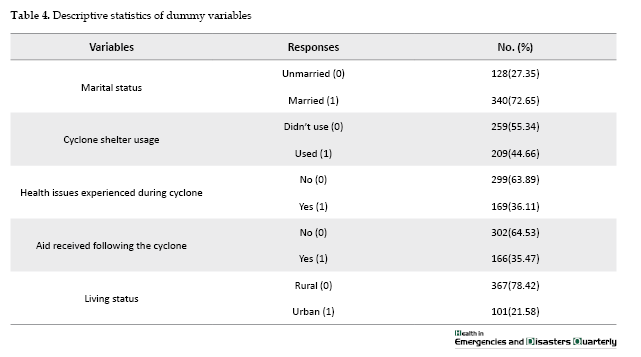
The sample includes married individuals (71%), while 29% are unmarried. Of the 468 households questioned, 209 used cyclone shelters, while 259 did not. 36.11% of households reported health difficulties related to Cyclone Remal, while 63.89% reported no health consequences. After the cyclone, 35.47% of homes received aid, leaving the remainder (64.53%) unsupported. Most responders (78.42%) live in rural regions, with only 21.58% living in cities, indicating that the cyclone had a primarily rural impact.
Table 5 presents the results of the OLR model, which explores the factors influencing the perceived overall impact of Cyclone Remal in the Patuakhali District of Bangladesh. The dependent variable, Overall Impact, is an ordinal variable with three categories: 0 (low impact), 1 (medium impact), and 2 (high impact). The model includes ten independent variables, and the results are assessed using various diagnostic metrics, including P values, confidence intervals, and model fit indices.
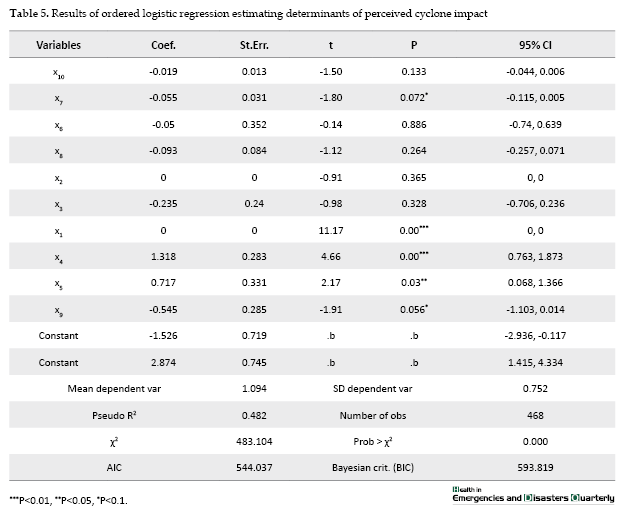
The logistic regression results reveal several significant determinants of household outcomes following Cyclone Remal. The level of damage sustained (x1) is strongly and positively associated with the dependent variable (Coef. = 0.000, P<0.01), indicating that higher infrastructure and agricultural losses substantially increased the likelihood of being affected. Health-related issues (x4) also exerted a large positive effect (Coef. = 1.318, P<0.01), suggesting that households experiencing cyclone-induced health problems were over one unit higher on the log-odds scale of the adverse outcome. Similarly, receiving aid or assistance (x5) increased the probability of being affected (Coef. = 0.717, P<0.05). On the other hand, years of schooling (x7) had a negative and marginally significant effect (Coef. = –0.055, P<0.10), implying that better-educated respondents were slightly less likely to experience adverse consequences. Residence in urban areas (x9) was also negatively associated (Coef. = –0.545, P<0.10), indicating lower vulnerability relative to rural households. In contrast, respondent’s age (x10, Coef. = –0.019, P=0.133), marital status (x6, Coef. = –0.050, P=0.886), household size (x8, Coef. = –0.093, P=0.264), average monthly income (x2, Coef. = 0.000, P=0.365), and use of cyclone shelters (x3, Coef. = –0.235, P=0.328) did not demonstrate statistically significant relationships. Overall, the model fit was robust (Pseudo R²=0.482; x²=483.104, P<0.01), highlighting the central role of cyclone-related damage, health impacts, and aid provision in shaping household vulnerability, while education and urban residence offered modest protective effects. The model has an overall strong fit, as indicated by the Pseudo R2 value of 0.482, which suggests that nearly 48% of the variance in perceived impact is explained by the independent variables. The likelihood ratio test (χ2= 483.104, P<0.001) confirms that the model is statistically significant. The AIC and BIC further support the validity of the model fit.
Table 6 presents the OLR analysis results in terms of OR, which helps interpret the likelihood of experiencing a higher perceived impact of Cyclone Remal based on various factors. Each OR is reported along with its standard error, t, P, and 95% confidence interval (CI).
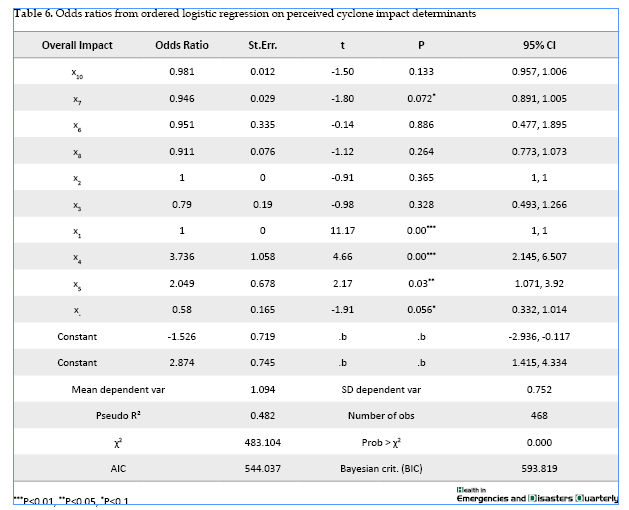
The OLR results indicate that households’ perceived cyclone impact was most strongly influenced by damage sustained (x1) and health-related issues (x4), with ORs of 1.000 (P<0.01) and 3.736 (P<0.01), respectively, showing that greater damage and cyclone-induced health problems substantially increased the likelihood of perceiving higher impact. Receiving aid or assistance (x5, OR=2.049, P<0.05) also raised the odds, while education (x7, OR=0.946, P<0.10) and urban residence (x9, OR=0.580, P<0.10) slightly reduced them. Age, marital status, household size, income, and cyclone shelter use were not significant. Overall, the model demonstrates strong explanatory power (Pseudo R²=0.482), highlighting the key roles of physical damage, health vulnerabilities, and post-disaster support in shaping perceived impact.
Figure 5 shows the comparison of monthly household income (red line, BDT) and total cyclone damage incurred (blue line, BDT) across sampled households.
.PNG)
Figure 5 shows the relationship between monthly household income (BDT) and total cyclone-related damage incurred across the sampled households in Patuakhali District. The figure shows considerable variation in both income and damage levels across observations. Cyclone-induced losses are observed among households across all income groups, indicating that disaster impacts are not confined to any specific income category. While higher-income households tend to report larger absolute losses in some cases, lower-income households are likely to experience more severe economic pressure due to their limited financial capacity to absorb such shocks. Overall, the pattern highlights the widespread nature of cyclone impacts and underscores the economic vulnerability of coastal households, particularly those with lower income levels.
Discussion
This study demonstrates the multifaceted vulnerabilities faced by communities affected by Cyclone Remal. These findings align with prior research emphasizing the disproportionate impact of cyclones on coastal areas due to poverty, inadequate infrastructure, and environmental fragility [39]. Environmental repercussions, including saltwater intrusion that rendered agricultural fields unproductive, support previous work highlighting the vulnerability of agricultural livelihoods to storm surges [40]. Similarly, the degradation of biodiversity in the Sundarbans reflects global concerns about the loss of natural protective barriers, consistent with research linking intact mangrove ecosystems to reduced cyclone damage [41]. Public health issues emerged as a significant concern, with outbreaks of waterborne diseases and increased mental health challenges. These findings echo studies documenting the health impacts of inadequate disaster preparedness and response [42]. Furthermore, households that perceived higher impacts were also more likely to report receiving aid. This association likely reflects selection effects, in which aid is directed toward the most affected, rather than a causal relationship in which aid increases vulnerability [43]. The results also align with the PADM, in which prior disaster experiences, health consequences, and warning reception shape perceptions and protective responses, such as shelter use. Similarly, social vulnerability theory helps explain the gradient of impacts across education, income, and urban–rural divides, emphasizing how structural inequalities mediate disaster outcomes. While early warning systems played a crucial role in saving lives, ongoing inefficiencies and inequities persist in disaster response. One limitation of this study is its lack of direct quantification of socioeconomic consequences, which other researchers have identified as critical to comprehensive disaster assessment [24, 44]. Future research should consider incorporating quantitative measures of economic and social disruption. Although the findings are context-specific to Patuakhali, similar vulnerability dynamics, particularly those related to health, aid distribution, and education, may apply to other cyclone-prone deltaic regions, such as the Indian Sundarbans, Myanmar's Ayeyarwady delta, or Pacific island nations. Explicitly testing these associations across regions would strengthen external validity and refine theoretical applications of PADM and social vulnerability frameworks in disaster contexts.
Policy recommendation
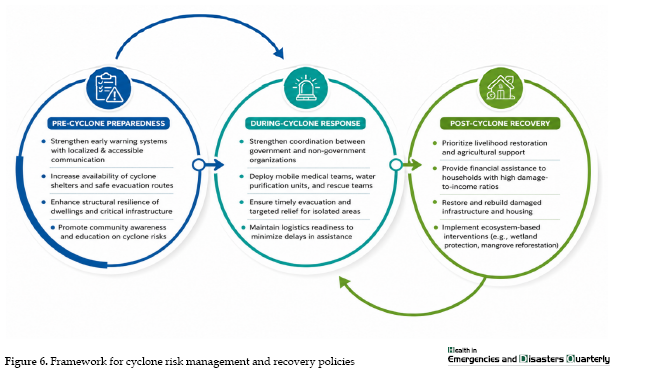
Effective cyclone management requires an integrated approach encompassing preparedness, emergency response, and long-term recovery. The findings of this study highlight several policy gaps in Patuakhali, particularly regarding rural vulnerabilities, infrastructure resilience, and disaster communication. Strengthening early warning systems is critical, with localized and accessible communication channels designed for communities with limited media access and lower educational levels. Preparedness measures should focus on increasing the availability of cyclone shelters and enhancing the structural resilience of dwellings and vital infrastructure [45]. Community-based education initiatives can promote proactive evacuation behavior and improve risk awareness. During the response phase, improved coordination between governmental and non-governmental actors is essential. Mobile medical teams, water purification units, and targeted rescue operations can ensure that isolated communities receive timely assistance, while logistical preparedness can minimize delays in evacuation and relief delivery [46].
Long-term recovery strategies should prioritize livelihood restoration, agricultural support, and financial assistance for households experiencing high damage-to-income ratios, reflecting the study’s finding that low-income families face disproportionate impacts. Ecosystem-based interventions, such as wetland protection and mangrove reforestation, can further reduce environmental vulnerability and buffer against future storm surges [47]. Although these recommendations are tailored to the specific conditions of Patuakhali, they may provide guidance for similar low-lying coastal regions, provided that local ecological, social, and infrastructural contexts are considered. By linking empirical insights from this study to policy actions, decision-makers can develop more targeted strategies to reduce the immediate and long-term impacts of cyclones on vulnerable communities (Figure 6).
Conclusion
This study offers valuable insights into how Cyclone Remal was perceived and impacted the communities in four upazilas of Patuakhali District. The results underscore the significance of socio-demographic and ambient factors influencing the perceived impact, including income level, education, and housing quality. Although these results are specific to Patuakhali, the findings regarding income-loss disparities, health vulnerabilities, and shelter effectiveness may inform disaster management in other low-lying coastal regions. For example, targeted aid distribution and strengthening of community-based evacuation strategies could be prioritized in similar deltaic environments globally, with adjustments to local socioeconomic and ecological conditions. Consequently, future research must be conducted in additional coastal districts to verify and contrast these discoveries. Nevertheless, this localized evidence can serve as a basis for disaster management planning that is more community-sensitive and tailored to similar vulnerable coastal environments.
Limitations
This study is limited to the Patuakhali District, so the findings may not be generalizable to other cyclone-affected regions of Bangladesh or beyond. The regression model explained 48.2% of the variation in perceived impact, suggesting that important factors, such as psychological resilience and access to resources, were not captured due to data constraints. Future studies should address these gaps by including additional variables, longitudinal data, and a broader geographic scope. Self-reported perceptions may lead to recall bias, potentially inflating the reported impacts of Cyclone Remal. Social desirability bias might result in underreporting of health issues or overstating compliance with evacuation. Additionally, selecting respondents based on availability may have overrepresented male or older individuals, which could skew perceived impact estimates. Future studies could implement stratified household-level random selection and triangulate survey responses with objective damage records to reduce these biases. Although perceptions are inherently subjective, they remain valuable, especially where objective data
Ethical Considerations
Compliance with ethical guidelines
This research did not involve medical or clinical trials and therefore did not require formal ethical clearance from an institutional review board. The study adhered to ethical principles for social science research. Participation was entirely voluntary, and verbal informed consent was obtained from all respondents prior to survey administration. In cases where respondents were under 18 years of age, consent was obtained from parents or household heads. Participants were assured that their responses would remain confidential and that no identifying information would be published.
Funding
This research did not receive any grant from funding agencies in the public, commercial, or non-profit sectors.
Authors' contributions
Conceptualization and supervision: Md. Tanvir Ahmed; Data analysis: Minhajul Islam Ove; Data compilation and preliminary analysis: Mohaiminul Islam Hasib; writing the original draft: Abdul Hasib Mollah; Review, editing and final approval: All authors.
Conflict of interest
The authors declared no conflict of interests.
Acknowledgments
The authors thank Saikat Hossen, Department of Soil and Environmental Sciences, University of Barishal, for his great help in designing and preparing the figure used in this work.
References
As Bangladesh is a low-lying deltaic region, it is one of the most cyclone-prone regions in the world. The recently occurred cyclone Remal is a severe cyclonic storm (SCS) that swept over the coastal areas, including Patuakhali district in the Barishal Division of Bangladesh, on May 26, 2024 [1]. The cyclone led to severe infrastructural damage, including 40,246 houses that were completely destroyed, with an additional 131,678 experiencing partial damage, disrupted the lives of local communities, displaced approximately 4.6 million people, and caused significant environmental impacts, destroying thousands of acres of different land areas all over Bangladesh [2]. There was extreme rainfall and an 8-12 foot storm surge caused by the cyclone during the time being, and with the rainfall continuing for 48 hours [3]. This worsened the flooding in many regions, and Patuakhali is one of the worst-hit districts that experienced acute destruction. During this period, over 30 villages in Patuakhali were severely flooded due to breaches in the embankments [4]. As a result of these floods and the severe gusts accompanying the cyclone, an already difficult situation became even more difficult. Even beyond the immediate devastation, the cyclone has highlighted the ongoing challenges posed by climate change in other ways, and thus there is a need for effective disaster management strategies in that region. Although several coastal districts, including Khulna and Barguna, saw significant impact, Patuakhali’s topographical and socioeconomic characteristics render it particularly susceptible. The district’s wide low-lying floodplains, significant reliance on agriculture and fisheries, and history of recurrent embankment failures distinguish it from other cyclone-prone regions [5] a socioeconomic vulnerability index (SeVI). These attributes validate its designation as an important case study for comprehending community-level perceptions of cyclones. The study aimed to elucidate the environmental and infrastructural issues posed by the cyclone and to recognize insights for future preparedness and response initiatives.
According to the Bangladesh Red Crescent Society, cyclone Remal reached a maximum sustained wind speed of 117 km/h (60 kt) at its peak on May 27 [6]. Making landfall on May 26, 2024, with wind speeds ranging from 92 to 117 km/h.
Based on its maximum sustained wind speed, it can be categorized as SCS in the disturbance classification of both the Bangladesh Meteorological Department (BMD) and the India Meteorological Department (IMD). The classification of tropical cyclones by IMD and BMD is shown in Figure 1.
Table 1 compares the tropical cyclone intensity classification systems used by the BMD and IMD. While both systems classify cyclones based on sustained wind speed, differences exist in the intermediate intensity categories and threshold ranges.
On May 24, the cyclone developed as a low-pressure system in the Bay of Bengal near latitude 15.0° N and longitude 88.4° E, roughly 800 km south-west of Khepupara (Bangladesh) and 810 km south of Canning (West Bengal) [9]. The pathway of cyclone Remal is shown in Figure 2.
Soon, due to the warm sea surface temperature of approximately 30 °C and low vertical wind shear, cyclone Remal began to rapidly intensify. It intensified and formed as SCS by May 25th evening. The cyclone was moving steadily towards the coast of southern Bangladesh, directly in the path of Patuakhali and the surrounding coastal areas. This cyclone made landfall near Kalapara, Patuakhali, around midnight on May 26, 2024 [6]. Its central pressure dropped significantly with intensification, reaching a low of approximately 978 hPa at its peak intensity before landfall [11]. Usually, there is a correlation that the lower the central pressure, the more intense the cyclone [12].
Figure 3, sourced from the IMD, shows cyclone Remal’s central pressure dynamics from 24 to 27 May 2024. Panel (A) presents the temporal variation in estimated central pressure (hPa), while Panel (B) shows the corresponding pressure drop at the cyclone center (hPa). Together, these trends highlight the cyclone’s intensification prior to landfall and its subsequent weakening thereafter.
This decrease in pressure at its peak suggests the cyclone strengthening because it leads to an increase in wind speed and weather severity. The pressure began to decrease after landfall. Later, it began to move inland, growing weaker as it encountered harsher terrain and increased friction over land.
While previous studies have extensively examined cyclone exposure and damage assessment in Bangladesh, less attention has been paid to how households perceive cyclone impacts and which socioeconomic and disaster-related factors shape these perceptions [5]. Such insights are essential for designing community-centered disaster preparedness and response strategies. Therefore, this study focuses on Patuakhali District as a critical case study of Cyclone Remal’s impacts. The objectives are twofold: (i) to document household perceptions of the cyclone’s overall impact, and (ii) to identify key determinants—including income, damage, shelter use, health outcomes, and aid—that influence these perceptions. By analyzing household-level survey data using ordered logistic regression (OLR), this study deepens understanding of disaster impact assessment and offers implications for strengthening cyclone preparedness in coastal Bangladesh.
Literature review
Cyclones are among the most devastating natural disasters, especially in coastal areas where populations are often densely concentrated and rely on natural resources for their livelihoods [13]. Poverty, weak infrastructure, and environmental deterioration all contribute to the regions' susceptibility [14]. Cyclones, sometimes known as hurricanes or typhoons in various parts of the world, have caused widespread economic, social, and environmental destruction [15]. These theoretical lenses directly informed variable selection in this study. For example, the protective action decision model (PADM) guided the inclusion of risk-related factors, such as shelter use and past health impacts, while the social vulnerability paradigm shaped the choice of socioeconomic indicators, such as income, education, and household size. Together, these frameworks provide a conceptual basis for interpreting how structural vulnerabilities and protective actions influence perceived cyclone impacts [16, 17]. The frequency and intensity of severe storms have grown in recent years, most likely due to climate change. For example, Emanuel (2005) and Webster (2005) found evidence of increased tropical storm intensity, which has been connected to rising sea surface temperatures [18, 19]. These developments are especially worrying for low-lying coastal communities, which are already prone to storm surges and flooding.
South Asia, particularly Bangladesh, is extremely vulnerable to cyclones due to its geographical location and socioeconomic characteristics [20]. Cyclones Sidr (2007) and Aila (2009) are two of the most destructive cyclones to hit the region, causing widespread destruction and loss of life [21]. Poverty, limited access to healthcare, and inadequate infrastructure all contribute to the vulnerability of Bangladesh's coastal communities [22]. An expanding body of literature establishes a correlation between climate change and increased cyclone frequency and intensity. According to the Intergovernmental Panel on Climate Change, the frequency of severe tropical cyclones is expected to increase, potentially devastating vulnerable regions, such as South Asia [23]. Cyclone Remal has profoundly impacted coastal communities in Bangladesh, particularly regarding environmental degradation, disaster preparedness, and recovery challenges [5]. Additionally, saltwater intrusion from storm surges rendered large tracts of agricultural land infertile, particularly affecting rice cultivation. This has had long-lasting impacts on the livelihoods of coastal farmers [24]. The biodiversity of the Sundarbans, the world's largest mangrove forest, was also adversely affected, with numerous endangered species suffering due to habitat loss [25]. Public health challenges have emerged as a critical concern in the aftermath of Cyclone Remal [26]. In the days following Cyclone Remal, waterborne diseases, such as cholera and diarrhea, occurred due to contaminated water supplies [27]. Mental health disorders were widespread, as numerous survivors encountered heightened anxiety and sadness resulting from insufficient post-disaster care services [28].
Education is essential for catastrophe preparedness and response. Higher levels of education are linked to greater understanding of disaster risks and more proactive behavior during calamities. This is supported by research [29], which discovered that communities with higher educational attainment were better prepared and more resilient to disasters. Income is another important driver of disaster impact. Poorer households frequently reside in more vulnerable places, such as floodplains or substandard buildings, and have fewer resources to cope with the aftermath of a disaster. This has been well documented in the literature, including research by [30], which investigates the relationship between poverty and catastrophe susceptibility. Cyclones cause not only rapid physical destruction but also long-term environmental and health effects. These impacts can worsen the susceptibility of affected populations, creating a vicious cycle of disaster-induced poverty and environmental degradation. The degradation of natural barriers, such as mangroves and coral reefs, has made coastal regions more vulnerable to cyclones. According to [31], locations with intact mangrove forests receive less cyclone damage than those where mangroves have been removed. The response to Cyclone Remal revealed both strengths and weaknesses in Bangladesh's disaster management framework. The country's early warning systems were effective in saving lives, as noted by [32]. However, the evacuation and relief distribution procedures were problematic. Remote and vulnerable communities were frequently left behind during evacuations, and relief operations were impeded by logistical challenges and inconsistent resource allocation [5]. The recovery initiatives underscore the necessity of establishing durable resilience against future cyclones. Community-based disaster management strategies that engage local populations in disaster preparedness have effectively mitigated susceptibility [33]. Strategies, such as raised housing and accessible emergency shelters, have improved disaster readiness [34].
Despite the abundance of knowledge regarding the impacts of cyclones, notable gaps persist, particularly in the Patuakhali District and similar regions in Bangladesh. One of these gaps is the necessity for supplementary regional research that considers the unique environmental conditions of various areas.
Materials and Methods
This study adopted a quantitative research approach to assess the impacts of Cyclone Remal in Patuakhali District, located in the Barishal Division of Bangladesh, a region acutely vulnerable to cyclonic events due to its low-lying coastal geography [13] (Figure 4). A disproportionate stratified random sampling design was adopted. Four of the most cyclone-prone upazilas of Patuakhali—Patuakhali Sadar, Dumki, Galachipa, and Kalapara—were selected as strata based on their geographic location and exposure [35]. Household lists were obtained from local government authorities, and households were randomly selected within each stratum using a lottery method. To ensure balanced geographic representation, an equal number of 117 households was surveyed from each upazila, resulting in 468 households. Although this equal allocation was not proportional to population size, it enhanced comparability across strata. In cases of non-response, replacement households were randomly selected to minimize bias. This design represents disproportionate stratification; therefore, sampling weights were applied for district-level inference. Within each selected household, the primary decision-maker was chosen as the respondent. Non-response was minimal (<5%), and replacement households were randomly chosen from the same list to minimize bias.
Based on a 95% confidence level and a 5% error margin, the minimum sample size was calculated to be 370 households [36]. However, to enhance the robustness and generalizability of the findings, data were collected from 468 households from June 1 to September 17, 2024, exceeding the recommended threshold. A standardized questionnaire was developed based on prior disaster perception studies [37]. Content validity was assessed through expert review by one disaster management specialist, and a pilot survey with 20 households was conducted in Patuakhali. Enumerators received three days of training on questionnaire content, ethical protocols, and mock interviews. Paper-based surveys were used and later digitized into Stata for analysis. The overall response rate was 92.5%. Missing responses were rare (<3% per variable) and were handled through listwise deletion. Quality control procedures included daily reviews of completed questionnaires and random spot checks by supervisors. The questionnaire captured demographic characteristics, household conditions, cyclone-related damages, income levels, and post-disaster experiences. This study did not involve medical or clinical trials and therefore did not require formal ethical clearance. Participation was voluntary, and informed consent (including parental/guardian consent for respondents under 18) was obtained. Confidentiality was strictly maintained. Descriptive statistics, such as mean, median, and standard deviation, were used to summarize continuous variables, while frequencies and percentages were reported for categorical variables. To identify the determinants of the perceived overall impact of Cyclone Remal, the study employed an OLR model, appropriate for ordinal dependent variables with non-equidistant categories [38]. The regression model is specified as Equation 1:
1. y=β0+β1x1+β2x2+β3x3+β4x4+β5x5+β6x6+ β7x7+β8x8+β9x9+ β10x10+ε
The dependent variable was derived from the survey item: ‘How would you describe the overall impact of Cyclone Remal on your household?’ (0 = Low, 1 = Medium, 2 = High). As this was a single-item measure capturing direct household perceptions, no scale aggregation was applied; however, face validity was established through expert review during instrument development. x1…… x10 are the independent variables encompassing socioeconomic indicators and cyclone-related experience. β0 is the intercept term, and β1 to β10 are the coefficients associated with the respective independent variables, x1 to x10, while ε is the error term. These independent variables were carefully selected based on their relevance to disaster impact research and their ability to capture the multidimensional consequences of Cyclone Remal on households. Key variables include total damage, household income, health issues, aid received, cyclone shelter use, and demographic controls such as age, education, marital status, and place of residence. Among them, variables, such as shelter use, health issues, aid received, marital status, and residence location, were treated as dummy variables, while the rest were continuous. To improve interpretability and avoid rounding artifacts, continuous monetary variables (income and total damage) were rescaled in units of 10,000 BDT. As aid receipt is likely endogenous to impact severity, coefficients on this variable should be interpreted as associations rather than causal effects. The proportional odds assumption was assessed using the Brant test, indicating no significant violation (x²=12.34, P=0.21), supporting the use of the OLR model. Model fit and diagnostics were evaluated using log-likelihood, likelihood-ratio chi-square (χ2), Akaike information criterion (AIC), and Bayesian information criterion (BIC) values. To enhance interpretability, average marginal effects and category-specific predicted probabilities were computed for key covariates, enabling a clear understanding of how changes in independent variables affect the probability of perceiving a low, medium, or high cyclone impact. Findings are representative at the district level in Patuakhali when sampling weights are applied, but are not directly generalizable to other coastal districts.
Table 2 presents the key variables employed in the analysis and their descriptions. These variables encompass household characteristics, socioeconomic aspects, and the effects of Cyclone Remal, forming the basis for evaluating the cyclone’s perceived overall impact.
The OLR model was chosen over other models, such as multinomial logistic regression, due to the ordinal nature of the dependent variable. While multinomial models treat outcome categories as nominal and unrelated, OLR respects the inherent order of perceived impact (low to high) and yields more parsimonious and interpretable estimates. This approach allows estimation of how each independent variable influences the probability that a respondent perceives the cyclone’s impact as low, medium, or high. Model diagnostics assessed goodness-of-fit, with the pseudo R-squared (R2) statistic as a key indicator. ORs were computed to interpret the direction and strength of the associations between predictor variables and the outcome. A significance threshold of 0.05 was adopted, with P-values used to evaluate the statistical significance of each coefficient.
This methodological framework ensures a robust and nuanced analysis of how various factors contribute to the perceived impacts of Cyclone Remal across diverse communities in Patuakhali District.
Results
In the study, the total number of observations is 468. Table 3 presents the descriptive summary of the variables as Mean ± standard deviation, minimum, and maximum values.
The average age of the respondents was 42.03 years, ranging from 16 to 75 years, indicating a broad age range. Respondents averaged 11 years of education, indicating diversified levels of educational achievement. The typical household size consists of five individuals, ranging from two to twelve. The mean monthly income was 40,204 BDT, with a range of incomes from 10,000 to 160,000 BDT, reflecting considerable economic variation. The total reported damage was 19,084 BDT, with significant variability, indicating heterogeneity in the cyclone’s impact across homes.
Tabulation of dummy variables
Five dummy variables are included in the research to help explain the dependent variable, which takes the value 0 or 1 to indicate the absence or presence of a particular category effect expected to influence the outcome (Table 4).
The sample includes married individuals (71%), while 29% are unmarried. Of the 468 households questioned, 209 used cyclone shelters, while 259 did not. 36.11% of households reported health difficulties related to Cyclone Remal, while 63.89% reported no health consequences. After the cyclone, 35.47% of homes received aid, leaving the remainder (64.53%) unsupported. Most responders (78.42%) live in rural regions, with only 21.58% living in cities, indicating that the cyclone had a primarily rural impact.
Table 5 presents the results of the OLR model, which explores the factors influencing the perceived overall impact of Cyclone Remal in the Patuakhali District of Bangladesh. The dependent variable, Overall Impact, is an ordinal variable with three categories: 0 (low impact), 1 (medium impact), and 2 (high impact). The model includes ten independent variables, and the results are assessed using various diagnostic metrics, including P values, confidence intervals, and model fit indices.
The logistic regression results reveal several significant determinants of household outcomes following Cyclone Remal. The level of damage sustained (x1) is strongly and positively associated with the dependent variable (Coef. = 0.000, P<0.01), indicating that higher infrastructure and agricultural losses substantially increased the likelihood of being affected. Health-related issues (x4) also exerted a large positive effect (Coef. = 1.318, P<0.01), suggesting that households experiencing cyclone-induced health problems were over one unit higher on the log-odds scale of the adverse outcome. Similarly, receiving aid or assistance (x5) increased the probability of being affected (Coef. = 0.717, P<0.05). On the other hand, years of schooling (x7) had a negative and marginally significant effect (Coef. = –0.055, P<0.10), implying that better-educated respondents were slightly less likely to experience adverse consequences. Residence in urban areas (x9) was also negatively associated (Coef. = –0.545, P<0.10), indicating lower vulnerability relative to rural households. In contrast, respondent’s age (x10, Coef. = –0.019, P=0.133), marital status (x6, Coef. = –0.050, P=0.886), household size (x8, Coef. = –0.093, P=0.264), average monthly income (x2, Coef. = 0.000, P=0.365), and use of cyclone shelters (x3, Coef. = –0.235, P=0.328) did not demonstrate statistically significant relationships. Overall, the model fit was robust (Pseudo R²=0.482; x²=483.104, P<0.01), highlighting the central role of cyclone-related damage, health impacts, and aid provision in shaping household vulnerability, while education and urban residence offered modest protective effects. The model has an overall strong fit, as indicated by the Pseudo R2 value of 0.482, which suggests that nearly 48% of the variance in perceived impact is explained by the independent variables. The likelihood ratio test (χ2= 483.104, P<0.001) confirms that the model is statistically significant. The AIC and BIC further support the validity of the model fit.
Table 6 presents the OLR analysis results in terms of OR, which helps interpret the likelihood of experiencing a higher perceived impact of Cyclone Remal based on various factors. Each OR is reported along with its standard error, t, P, and 95% confidence interval (CI).
The OLR results indicate that households’ perceived cyclone impact was most strongly influenced by damage sustained (x1) and health-related issues (x4), with ORs of 1.000 (P<0.01) and 3.736 (P<0.01), respectively, showing that greater damage and cyclone-induced health problems substantially increased the likelihood of perceiving higher impact. Receiving aid or assistance (x5, OR=2.049, P<0.05) also raised the odds, while education (x7, OR=0.946, P<0.10) and urban residence (x9, OR=0.580, P<0.10) slightly reduced them. Age, marital status, household size, income, and cyclone shelter use were not significant. Overall, the model demonstrates strong explanatory power (Pseudo R²=0.482), highlighting the key roles of physical damage, health vulnerabilities, and post-disaster support in shaping perceived impact.
Figure 5 shows the comparison of monthly household income (red line, BDT) and total cyclone damage incurred (blue line, BDT) across sampled households.
Figure 5 shows the relationship between monthly household income (BDT) and total cyclone-related damage incurred across the sampled households in Patuakhali District. The figure shows considerable variation in both income and damage levels across observations. Cyclone-induced losses are observed among households across all income groups, indicating that disaster impacts are not confined to any specific income category. While higher-income households tend to report larger absolute losses in some cases, lower-income households are likely to experience more severe economic pressure due to their limited financial capacity to absorb such shocks. Overall, the pattern highlights the widespread nature of cyclone impacts and underscores the economic vulnerability of coastal households, particularly those with lower income levels.
Discussion
This study demonstrates the multifaceted vulnerabilities faced by communities affected by Cyclone Remal. These findings align with prior research emphasizing the disproportionate impact of cyclones on coastal areas due to poverty, inadequate infrastructure, and environmental fragility [39]. Environmental repercussions, including saltwater intrusion that rendered agricultural fields unproductive, support previous work highlighting the vulnerability of agricultural livelihoods to storm surges [40]. Similarly, the degradation of biodiversity in the Sundarbans reflects global concerns about the loss of natural protective barriers, consistent with research linking intact mangrove ecosystems to reduced cyclone damage [41]. Public health issues emerged as a significant concern, with outbreaks of waterborne diseases and increased mental health challenges. These findings echo studies documenting the health impacts of inadequate disaster preparedness and response [42]. Furthermore, households that perceived higher impacts were also more likely to report receiving aid. This association likely reflects selection effects, in which aid is directed toward the most affected, rather than a causal relationship in which aid increases vulnerability [43]. The results also align with the PADM, in which prior disaster experiences, health consequences, and warning reception shape perceptions and protective responses, such as shelter use. Similarly, social vulnerability theory helps explain the gradient of impacts across education, income, and urban–rural divides, emphasizing how structural inequalities mediate disaster outcomes. While early warning systems played a crucial role in saving lives, ongoing inefficiencies and inequities persist in disaster response. One limitation of this study is its lack of direct quantification of socioeconomic consequences, which other researchers have identified as critical to comprehensive disaster assessment [24, 44]. Future research should consider incorporating quantitative measures of economic and social disruption. Although the findings are context-specific to Patuakhali, similar vulnerability dynamics, particularly those related to health, aid distribution, and education, may apply to other cyclone-prone deltaic regions, such as the Indian Sundarbans, Myanmar's Ayeyarwady delta, or Pacific island nations. Explicitly testing these associations across regions would strengthen external validity and refine theoretical applications of PADM and social vulnerability frameworks in disaster contexts.
Policy recommendation
Effective cyclone management requires an integrated approach encompassing preparedness, emergency response, and long-term recovery. The findings of this study highlight several policy gaps in Patuakhali, particularly regarding rural vulnerabilities, infrastructure resilience, and disaster communication. Strengthening early warning systems is critical, with localized and accessible communication channels designed for communities with limited media access and lower educational levels. Preparedness measures should focus on increasing the availability of cyclone shelters and enhancing the structural resilience of dwellings and vital infrastructure [45]. Community-based education initiatives can promote proactive evacuation behavior and improve risk awareness. During the response phase, improved coordination between governmental and non-governmental actors is essential. Mobile medical teams, water purification units, and targeted rescue operations can ensure that isolated communities receive timely assistance, while logistical preparedness can minimize delays in evacuation and relief delivery [46].
Long-term recovery strategies should prioritize livelihood restoration, agricultural support, and financial assistance for households experiencing high damage-to-income ratios, reflecting the study’s finding that low-income families face disproportionate impacts. Ecosystem-based interventions, such as wetland protection and mangrove reforestation, can further reduce environmental vulnerability and buffer against future storm surges [47]. Although these recommendations are tailored to the specific conditions of Patuakhali, they may provide guidance for similar low-lying coastal regions, provided that local ecological, social, and infrastructural contexts are considered. By linking empirical insights from this study to policy actions, decision-makers can develop more targeted strategies to reduce the immediate and long-term impacts of cyclones on vulnerable communities (Figure 6).
Conclusion
This study offers valuable insights into how Cyclone Remal was perceived and impacted the communities in four upazilas of Patuakhali District. The results underscore the significance of socio-demographic and ambient factors influencing the perceived impact, including income level, education, and housing quality. Although these results are specific to Patuakhali, the findings regarding income-loss disparities, health vulnerabilities, and shelter effectiveness may inform disaster management in other low-lying coastal regions. For example, targeted aid distribution and strengthening of community-based evacuation strategies could be prioritized in similar deltaic environments globally, with adjustments to local socioeconomic and ecological conditions. Consequently, future research must be conducted in additional coastal districts to verify and contrast these discoveries. Nevertheless, this localized evidence can serve as a basis for disaster management planning that is more community-sensitive and tailored to similar vulnerable coastal environments.
Limitations
This study is limited to the Patuakhali District, so the findings may not be generalizable to other cyclone-affected regions of Bangladesh or beyond. The regression model explained 48.2% of the variation in perceived impact, suggesting that important factors, such as psychological resilience and access to resources, were not captured due to data constraints. Future studies should address these gaps by including additional variables, longitudinal data, and a broader geographic scope. Self-reported perceptions may lead to recall bias, potentially inflating the reported impacts of Cyclone Remal. Social desirability bias might result in underreporting of health issues or overstating compliance with evacuation. Additionally, selecting respondents based on availability may have overrepresented male or older individuals, which could skew perceived impact estimates. Future studies could implement stratified household-level random selection and triangulate survey responses with objective damage records to reduce these biases. Although perceptions are inherently subjective, they remain valuable, especially where objective data
Ethical Considerations
Compliance with ethical guidelines
This research did not involve medical or clinical trials and therefore did not require formal ethical clearance from an institutional review board. The study adhered to ethical principles for social science research. Participation was entirely voluntary, and verbal informed consent was obtained from all respondents prior to survey administration. In cases where respondents were under 18 years of age, consent was obtained from parents or household heads. Participants were assured that their responses would remain confidential and that no identifying information would be published.
Funding
This research did not receive any grant from funding agencies in the public, commercial, or non-profit sectors.
Authors' contributions
Conceptualization and supervision: Md. Tanvir Ahmed; Data analysis: Minhajul Islam Ove; Data compilation and preliminary analysis: Mohaiminul Islam Hasib; writing the original draft: Abdul Hasib Mollah; Review, editing and final approval: All authors.
Conflict of interest
The authors declared no conflict of interests.
Acknowledgments
The authors thank Saikat Hossen, Department of Soil and Environmental Sciences, University of Barishal, for his great help in designing and preparing the figure used in this work.
References
- United Nations Bangladesh. On the frontline of climate change – WFP responds to cyclone remal, the first cyclone of 2024 in Bangladesh [Internet]. 2024 [Updated 2025 January 18]. Available From: [Link]
- European Commision. 5 ways the EU is preparing to respond to wildfires in 2026. 2025 [Updated 2025 January 18]. Available From: [Link]
- BRAC. Cyclone remal latest updates [Internet]. 2025 [Updated 2025 January 18]. Available From: [Link]
- ReliefWeb. Cyclone Remal | BRAC teams prepare for response in Bangladesh [Internet]. 2025 [Updated 2025 January 18]. Available From: [Link]
- Mollah AH, Shovon HH, Roy A. Assessing socioeconomic vulnerability of cyclone remal-affected coastal communities in Bangladesh. Natural Hazards. 2025; 121(6):6571-96.[DOI:10.1007/s11069-024-07058-2]
- BDRCS. Cyclone remal 2024 [Internet]. 2024 [Updated 2024 May 1]. Available From: [Link]
- India Meteorological Department. Home .Annual report 2025. New Delhi: India Meteorological Department; 2025. [Link]
- Bangladesh Meteorological Department. Criteria for forecast area and rainfall intensity (mm/day). Dhaka: Bangladesh Meteorological Department; 2017. [Link]
- Hindustan Times. Remal likely to cross Bengal coast around Sunday midnight as severe cyclonic storm [Internet]. 2024 [Updated 2024 May 24]. Available From: [Link]
- The Business Standard. Cyclone Remal hits Bangladesh coasts [Internet]. 2024 [Updated 2025 January 18]. Available From: [Link]
- India Meteorological Department, Cyclone Warning Division. Severe Cyclonic Storm “REMAL” over the Bay of Bengal (24th–28th May, 2023): A Report. New Delhi: India Meteorological Department; 2024. [Link]
- Sparks N, Toumi R. The dependence of tropical cyclone pressure tendency on size. Geophysical Research Letters. 2022; 49(19):e2022GL098926. [DOI:10.1029/2022GL098926]
- Sarkar SK, Rudra RR, Santo MMH. Cyclone vulnerability assessment in the coastal districts of Bangladesh. Heliyon. 2023; 10(1):e23555. [DOI:10.1016/j.heliyon.2023.e23555] [PMID] [PMCID]
- Rahman S, Rahman MA. Climate extremes and challenges to infrastructure development in coastal cities in Bangladesh. Weather and Climate Extremes. 2015; 7:96-108. [DOI:10.1016/j.wace.2014.07.004]
- UNDRR. Impacts of super typhoons and climate change [Internet]. 2022 [Updated 2022 January 12]. Available From: [Link]
- Lindell MK, Perry RW. The protective action decision model: Theoretical modifications and additional evidence. Risk Analysis. 2012; 32(4):616-32. [DOI:10.1111/j.1539-6924.2011.01647.x] [PMID]
- Kim K, Kang JY, Hwang C. Identifying indicators contributing to the social vulnerability index via a scoping review. Land. 2025; 14(2):263. [DOI:10.3390/land14020263]
- Emanuel K. Increasing destructiveness of tropical cyclones over the past 30 years. Nature. 2005; 436(7051):686-8. [DOI:10.1038/nature03906] [PMID] [PMCID]
- Webster PJ, Holland GJ, Curry JA, Chang HR. Changes in tropical cyclone number, duration, and intensity in a warming environment. Science. 2005; 309(5742):1844-6. [DOI:10.1126/science.1116448] [PMID]
- Islam Arif MS, Mahdi I, Rafi MA, Khan SJ, Rahman MM. Cyclone exposure mapping in coastal Bangladesh: A multi-criteria decision analysis. Heliyon. 2023; 9(10):e21259. [DOI:10.1016/j.heliyon.2023.e21259] [PMID] [PMCID]
- Abbas M. Double blow for Bangladesh: Strongest storm ever recorded in Bay of Bengal amid a pandemic [Internet]. 2022 [Updated 2026 July 18]. Available From: [Link]
- Paul BK. Why relatively fewer people died? The case of Bangladesh’s Cyclone Sidr. Natural Hazards. 2009; 50(2):289-304. [DOI:10.1007/s11069-008-9340-5]
- Collins M, Sutherland M. Extremes, abrupt changes and managing risks. Paper presented at: American Geophysical :union:, Ocean Sciences Meeting. 2020 February 21; San Diego, United States. [Link]
- Lam Y, Winch PJ, Nizame FA, Broaddus-Shea ET, Harun MG, Surkan PJ. Salinity and food security in southwest coastal Bangladesh: impacts on household food production and strategies for adaptation. Food Security. 2022; 14(1):229-48. [DOI:10.1007/s12571-021-01177-5]
- The Financial Express Logo. How much damage Remal did to Sundarbans' ecology [Internet]? 2024 [ Updated 2024 June 3]. Available From: [Link]
- The Daily Star. Cyclone Remal gives a stark reminder of our crisis protection gap [Internet]. 2024 [Updated 2025 June 10]. Available From: [Link]
- Relief Web. Bangladesh; Cyclone remal - operation update #2 emergency appeal No: MDRBD035 [Internet]. 2024 [Updated 2025 October 7]. Available From: [Link]
- The Daily Star. The untold agony of cyclone remal. [Internet]. 2024 [Updated 2024 June 3]. Available From: [Link]
- Cutter SL, Boruff BJ, Shirley WL. Social vulnerability to environmental hazards. In: Cutter SL, editor. Hazards vulnerability and environmental justice. London: Routledge; 2012. [DOI:10.1111/1540-6237.8402002]
- Hallegatte S, Vogt-Schilb A, Bangalore M, Rozenberg J. Unbreakable: Building the Resilience of the Poor in the Face of Natural Disasters. Climate Change and Development Series. Washington, DC: World Bank; 2017. [Link]
- Das S, Vincent JR. Mangroves protected villages and reduced death toll during Indian super cyclone. Proceedings of the National Academy of Sciences of the United States of America. 2009; 106(18):7357-60. [DOI:10.1073/pnas.0810440106] [PMID] [PMCID]
- Ahsan MN, Khatun A, Islam MS, Vink K, Ohara M, Fakhruddin BSHM. Preferences for improved early warning services among coastal communities at risk in cyclone prone south-west region of Bangladesh. Progress in Disaster Science. 2020; 5:100065. [Link]
- Trogrlić RŠ, Duncan M, Wright G, Van Den Homberg M, Adeloye A, Mwale F. Why does community-based disaster risk reduction fail to learn from local knowledge? Experiences from Malawi. International Journal of Disaster risk Reduction. 2022; 83:103405. [DOI:10.1016/j.ijdrr.2022.103405]
- Zhao L, Li H, Sun Y, Huang R, Hu Q, Wang J, Gao F. Planning emergency shelters for urban disaster resilience: An integrated location-allocation modeling approach. Sustainability. 2017; 9(11):2098. [DOI:10.3390/su9112098.]
- Sarmin R, Akther S, Yasmin T. A geospatial analysis to assess risks of extreme events in low lying Delta environment: A case study of the Patuakhali district in Bangladesh [Unpublished]. [DOI:10.2139/ssrn.3972017]
- Kotrlik JW, Higgins CC. Organizational research: Determining appropriate sample size in survey research appropriate sample size in survey research. Information Technology, Learning, and Performance Journal. 2001; 19(1):43. [Link]
- Rahman MM, Chaity NJ, Hossain MT, Alam E. Exploring factors affecting disaster risk perception in ethnic minority: A case study in Garo community, Bangladesh. Progress in Disaster Science. 2025; 26:100424. [DOI:10.1016/j.pdisas.2025.100424]
- Bhandari P. Ordinal data | definition, examples, data collection & analysis [Internet]. 2023 [Updated 2023 June 21. Available from: [Link]
- Rahman MM, Hossain MA, Ali MR, Ahmed Z, Hedayutul Islam AH. Assessing vulnerability and adaptation strategy of the cyclone affected coastal area of Bangladesh. Geoenvironmental Disasters. 2022; 9(1):6. [DOI:10.1186/s40677-022-00209-2]
- Tarolli P, Luo J, Park E, Barcaccia G, Masin R. Soil salinization in agriculture: Mitigation and adaptation strategies combining nature-based solutions and bioengineering. iScience. 2024; 27(2):108830. [DOI:10.1016/j.isci.2024.108830] [PMID] [PMCID]
- Mahmood H, Ahmed M, Islam T, Uddin MZ, Ahmed ZU, Saha C. Paradigm shift in the management of the Sundarbans mangrove forest of Bangladesh: Issues and challenges. Trees, Forests and People. 2021; 5:100094. [DOI:10.1016/j.tfp.2021.100094]
- Dasgupta R, Basu M. Mental health and socio-psychological manifestations of cyclone-induced water insecurity in the Indian Sundarban delta. International Journal of Disaster Risk Reduction. 2023; 98:104085. [DOI:10.1016/j.ijdrr.2023.104085]
- Ahmed I. The national plan for disaster management of Bangladesh: Gap between production and promulgation. International Journal of Disaster Risk Reduction. 2019; 37:101179. [DOI:10.1016/j.ijdrr.2019.101179]
- Subhani R, Ahmad MM. Socio-economic impacts of cyclone aila on migrant and non-migrant households in the southwestern coastal areas of Bangladesh. Geosciences. 2019; 9(11):482. [DOI:10.3390/geosciences9110482]
- Alam E. Reasons for non-evacuation and shelter-seeking behaviour of local population following cyclone warnings along the Bangladesh coast. Progress in Disaster Science. 2024; 21:100307. [DOI:10.1016/j.pdisas.2023.100307]
- Islam MT, Charlesworth M, Aurangojeb M, Hemstock S, Sikder SK, Hassan MS, et al. Revisiting disaster preparedness in coastal communities since 1970s in Bangladesh with an emphasis on the case of tropical cyclone Amphan in May 2020. International Journal of Disaster Risk Reduction. 2021; 58:102175. [DOI:10.1016/j.ijdrr.2021.102175]
- Chausson A, Smith A, Reger RZ, O’Callaghan B, Mori Clement Y, Zapata F, et al. Harnessing nature-based solutions for economic recovery: A systematic review. Plos Climate. 2024; 3(10):e0000281. [DOI:10.1371/journal.pclm.0000281]
Type of article: Research |
Subject:
Risk assessment
Received: 2025/06/11 | Accepted: 2025/10/11 | Published: 2026/07/1
Received: 2025/06/11 | Accepted: 2025/10/11 | Published: 2026/07/1
Send email to the article author
| Rights and permissions | |
 |
This work is licensed under a Creative Commons Attribution-NonCommercial 4.0 International License. |

Copyright © The Author(s);
This is an open access article distributed under the terms of the Creative Commons Attribution-NonCommercial 4.0 (CC-By-NC 4.0), which permits use, distribution, and reproduction in any medium, provided the original work is properly cited and is not used for commercial purposes.
Contact Information
This is an open access article distributed under the terms of the Creative Commons Attribution-NonCommercial 4.0 (CC-By-NC 4.0), which permits use, distribution, and reproduction in any medium, provided the original work is properly cited and is not used for commercial purposes.
Contact Information
