
Volume 11, Issue 4 (Summer 2026)
Health in Emergencies and Disasters Quarterly 2026, 11(4): 303-310 |
Back to browse issues page


Ethics code: IR.MAZUMS.REC.1404.114


Download citation:
BibTeX | RIS | EndNote | Medlars | ProCite | Reference Manager | RefWorks
Send citation to:


BibTeX | RIS | EndNote | Medlars | ProCite | Reference Manager | RefWorks
Send citation to:
Habibisaravi R, Khankeh H, Hosseini S H, Aghaei N, Hadinejad Z, Ghasemihamedani F et al . Risk Assessment of COVID-19 Transmission During the Arbaeen Mass Gathering in 2025. Health in Emergencies and Disasters Quarterly 2026; 11 (4) :303-310
URL: http://hdq.uswr.ac.ir/article-1-749-en.html
URL: http://hdq.uswr.ac.ir/article-1-749-en.html
Reza Habibisaravi1 

 , Hamidreza Khankeh2 , Seyed Hossein Hosseini3 , Nahid Aghaei1 , Zoya Hadinejad1 , Fariba Ghasemihamedani4 , Mohammad Javad Moradian *5
, Hamidreza Khankeh2 , Seyed Hossein Hosseini3 , Nahid Aghaei1 , Zoya Hadinejad1 , Fariba Ghasemihamedani4 , Mohammad Javad Moradian *5
1- Department of Pre-hospital Emergency, School of Allied Medical Sciences, Mazandaran University of Medical Sciences, Sari, Iran.
2- Department of Emergency and Disaster Health, University of Social Welfare and Rehabilitation Sciences, Tehran, Iran. & QUEST Center for Responsible Research, Berlin Institute of Health at Charité, Berlin, Germany.
3- Department of Paramedicine, Amol School of Paramedical Sciences, Mazandaran University of Medical Sciences, Sari, Iran.
4- Research Center for Emergency and Disaster Resilience, Red Crescent Society of the Islamic Republic of Iran, Tehran, Iran.
5- Department of Health in Disasters and Emergencies, School of Health Management and Medical Information Sciences, Shiraz University of Medical Sciences, Shiraz, Iran. ,moradianshiraz@gmail.com
2- Department of Emergency and Disaster Health, University of Social Welfare and Rehabilitation Sciences, Tehran, Iran. & QUEST Center for Responsible Research, Berlin Institute of Health at Charité, Berlin, Germany.
3- Department of Paramedicine, Amol School of Paramedical Sciences, Mazandaran University of Medical Sciences, Sari, Iran.
4- Research Center for Emergency and Disaster Resilience, Red Crescent Society of the Islamic Republic of Iran, Tehran, Iran.
5- Department of Health in Disasters and Emergencies, School of Health Management and Medical Information Sciences, Shiraz University of Medical Sciences, Shiraz, Iran. ,
Full-Text [PDF 471 kb]
(584 Downloads)
| Abstract (HTML) (2288 Views)
Full-Text: (80 Views)
Introduction
Mass gatherings inherently pose significant public health challenges due to their potential to facilitate rapid transmission of infectious diseases (IDs), particularly respiratory pathogens, such as severe acute respiratory syndrome coronavirus 2 [1]. Historical precedents have consistently demonstrated that large-scale congregations, especially religious events, such as the annual Arbaeen ceremony, can act as amplifiers for disease spread [2]. The sheer scale and density of such events, coupled with shared accommodations, communal transportation, and ritual practices, create an environment highly conducive to the proliferation of infectious agents [3].
Although the World Health Organization (WHO) has lifted the global emergency status for COVID-19, the threat posed by the virus persists. Recent surveillance data (2024–2025) continue to show periodic surges in global cases, particularly in regions with limited booster coverage, reinforcing the rationale for a renewed risk assessment. The continued emergence of new variants, coupled with a global regression in preventive behaviors and waning population immunity, necessitates an ongoing and proactive approach to risk assessment and mitigation [4].
The Arbaeen Pilgrimage is one of the world’s largest religious gatherings, held annually in Karbala, Iraq, attracting millions of pilgrims from many countries [4]. In recent years, global COVID-19 dynamics have shifted: By mid-2025, reported cases were generally low, with WHO data showing 181,225 new cases globally from June 9 to July 6, 2025 (versus 393,785 in the prior 28-day period) [5]. Notably, new Omicron sublineages have emerged (e.g. XFG, NB.1.8.1) and JN.1, a BA.2.86 descendant, became prevalent earlier in 2024 [6]. Existing vaccines and treatments remain effective against them, and >97% of people have antibodies from vaccination or infection [7]. However, vaccine uptake has been suboptimal; for example, only 22.5% of US adults received the updated 2023–2024 booster [5]. These factors (waning immunity, emerging variants, low booster coverage) informed our 2025 risk assessment [8].
The Arbaeen pilgrimage, drawing over 20 million participants annually from diverse countries, exemplifies this challenge, presenting unique complexities for health systems due to its cross-border mobility and the heterogeneous adherence to health protocols among pilgrims from varied cultural and national backgrounds [9]. This study builds upon prior Iranian work [5]. However, it goes further by critically comparing current findings with international literature on Hajj and other mass gatherings, highlighting both consistencies and unique regional gaps.
Employing experts and the latest WHO mass-gathering risk assessment tool (2022 version) [10], the research sought to generate data-driven insights crucial for informed decision-making and comprehensive preparedness planning. Moreover, while this study involved Iranian experts, it acknowledges the critical role that Iraqi specialists and WHO representatives should play in shaping context-specific preparedness strategies for Karbala.
Materials and Methods
This descriptive cross-sectional study was conducted in Iran Spring 2025. The target population comprised national experts in epidemiology (EPI), IDs, and health in disaster and emergency (HDE) in different medical universities around the country.
Data collection utilized the Persian-validated WHO COVID-19 mass gathering risk assessment checklist, which scores 17 items for risk and 85 items for mitigation [8]. The selection of the WHO COVID-19 mass gathering risk assessment tool was based on several methodological considerations. While the study title references transmission risk assessment, we employed the comprehensive WHO tool because it evaluates transmission risk within a broader framework that includes healthcare capacity, population vulnerability, and mitigation measures. This approach provides a more holistic risk evaluation suitable for operational decision-making in complex mass gathering scenarios, such as Arbaeen. The tool generates two primary outputs: A risk evaluation score (0-7 scale) based on 17 risk factors, and a mitigation capacity score (0-100% scale) based on 85 preparedness indicators. The mitigation component evaluates preparedness across multiple domains including healthcare surge capacity, diagnostic capabilities, isolation facilities, communication systems, and inter-agency coordination mechanisms. The combination of these scores using WHO risk matrices yields the final risk categorization.
Experts received the checklist via social media platforms (WhatsApp, Telegram, Bale and Eitaa), and follow-up was conducted to ensure completeness. We acknowledge that the exclusive use of these digital channels may have excluded specialists who are less active on such platforms, thereby introducing potential selection bias. To mitigate this limitation, repeated reminders and alternative communication attempts (e-mail) were also used, though the overall response rate was still affected. Non-respondent analysis revealed that older specialists and those in administrative (rather than clinical) positions were less likely to participate. Informed consent was obtained electronically prior to participation; participants confirmed their agreement via secure online forms linked to the invitation, in compliance with ethical requirements for digital data collection.
Participants were selected based on professional expertise rather than personal experience with Arbaeen attendance. While approximately 75% had professional involvement in mass-gathering health preparedness, systematic data on personal pilgrimage experiences were not collected.
Although ethical approval was granted, the potential for conflicts of interest was recognized. Some participating specialists were affiliated with governmental institutions, which may have influenced perspectives on preparedness.
All completed checklists received were summarized by specialty group, and the final average score for each group was determined. Sampling was purposive, targeting individuals with recognized academic or professional expertise in mass gathering health. Finally, the overall average COVID-19 risk score was calculated as the mean all scores and categorized using WHO risk matrices.
The WHO checklist used in this study relies on expert scoring rather than mathematical transmission models (such as SEIR). While this approach enables rapid consensus-building, it is less dynamic in forecasting transmission under varying epidemiological scenarios. This limitation is acknowledged, particularly regarding emerging immune-escaping variants through 2025.
The results were presented in the form of tables and statistical analysis. For analytical statistical tests, parametric tests were used where the data had a normal distribution, and otherwise nonparametric tests were used. Epi-info 7.2 was used for statistical analysis [9].
Results
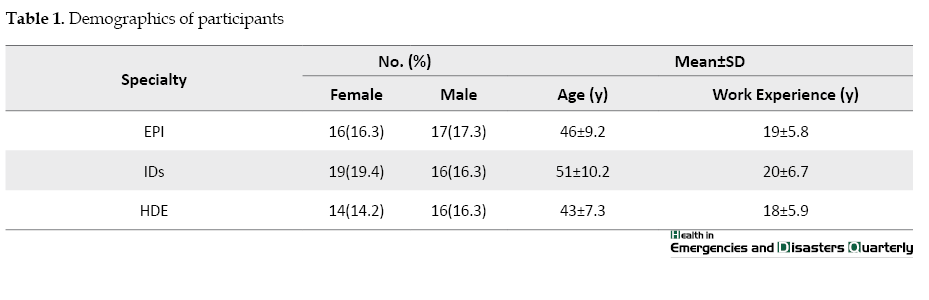
Of the 98 respondents (out of 135 invited), the demographics were balanced across specialties and genders. Mean age was 47.5 years; average work experience was 19 years (Table 1).
The overall risk evaluation score was 5.84 (Table 2).
.PNG)
A significant difference in risk assessment scores and risk mitigation scores was observed between the specialist groups (P<0.05). The risk mitigation scores, derived from 85 WHO tool indicators assessing preparedness capacity across healthcare systems, surveillance infrastructure, and emergency response capabilities, revealed significant inter-specialty variation in perceived preparedness levels. No significant difference was observed between men and women in any of the variables (P>0.05).
After calculating the risk score and risk reduction score from the relevant risk assessment and risk reduction, the overall COVID-19 risk for the large Arbaeen gathering was calculated separately for specialized groups and for the overall population (Table 3).
.PNG)
As shown in the risk assessment matrix in Table 3, the overall risk of COVID-19 was assessed as moderate by IDs specialists, and other specialties assessed the overall risk level as very high. Final risk categorization was estimated overall as high.
Risk mitigation scores revealed concrete inadequacies, particularly in EPI (22.1±3.6), suggesting a weak preparedness infrastructure, such as limited quarantine capacity, delayed diagnostic testing, and fragmented interagency coordination. In contrast, higher scores among ID specialists may reflect greater confidence in clinical preparedness but not necessarily in broader system readiness.
No systematic differences were observed between respondents and non-respondents beyond age and administrative role, as noted in the Methods. This suggests the final analytic sample was broadly representative of the intended expert population.
Discussion
The results of this study underscore the critical public health risks posed by the Arbaeen mass gathering in the post-COVID-19 period. Although the general public has become less concerned about COVID-19, this complacency poses a significant risk in the context of large-scale, cross-border religious gatherings [11-13].
The categorization of the COVID-19 risk as “very high” by both epidemiologists and health and disaster-and-emergency experts, and “moderate” by ID specialists, suggests a consensus on the need for heightened preparedness. However, the lower mitigation score in EPI compared to ID suggests structural and organizational gaps in translating risk awareness into actionable measures.
However, the lower mitigation score in EPI compared to ID suggests structural and organizational gaps in translating risk awareness into actionable measures. These include limited quarantine facilities, diagnostic testing delays, and fragmented interagency response capacity. Such inadequacies must be addressed to transform awareness into effective preparedness.
The lower assessment by IDs specialists may be linked to improved availability of antiviraltreatments (e.g. Paxlovid) and booster vaccinations, which they weigh heavily in clinical risk judgments. By contrast, epidemiologists and disaster experts emphasize broader systemic vulnerabilities in testing, surveillance, and coordination, resulting in higher risk ratings.
This disparity between risk perception and mitigation capacity reflects broader challenges in Iran’s health emergency system and the necessity for multi-sectoral coordination. Moreover, the study’s reliance on expert consensus via the WHO tool—while practical does not incorporate dynamic SEIR-type modeling that could better capture transmission under evolving conditions, including immune-escaping variants expected through 2025. Risk mitigation for mass gatherings must go beyond clinical interventions to include infrastructure design, public education, risk communication, and real-time surveillance systems [14].
Compared to prior Iranian assessments of Arbaeen [5], conducted during the acute pandemic phase, the present study identifies enduring vulnerabilities even in a post-emergency context. While both studies emphasize risk, the current results highlight a shift: Clinical confidence has improved, but systemic preparedness gaps remain. This contrast underscores the importance of longitudinal evaluation.
The findings echo those of international studies on the Hajj and similar events, emphasizing that risk can be significantly curtailed with proactive measures including mandatory mask usage, pre-travel screening, vaccination verification, and spatial planning to reduce overcrowding [15].
Future research would benefit from inclusion of Iraqi health experts and WHO representatives, whose perspectives are critical to aligning recommendations with ground−level realities in Karbala.
Surveillance data from 2024–2025 reinforce this urgency: Despite overall lower global hospitalization rates, periodic variant-driven surges continue to be recorded in the Middle East and South Asia, highlighting that waning immunity and reduced preventive behavior sustain the risk environment for Arbaeen [7].
The risk matrix results (Table 3) indicate that, in the absence of strong mitigating actions, such mass gatherings may act as catalysts for regional or even international outbreaks. Therefore, national policy must integrate evidence-based frameworks, such as the WHO risk assessment tool, into operational preparedness planning.
Cultural, political, and logistical barriers complicate implementation but must not delay necessary interventions. This is especially important in multinational contexts where harmonized health protocols are difficult but crucial.
The COVID-19 pandemic has demonstrated that no nation is insulated from global health threats [16]. In this regard, consideration of new subvariants, such as JN.1 and the uncertain durability of booster-derived immunity, is critical for justifying assumptions about 2025 risks [8].
As such, countries participating in the Arbaeen ceremony must adopt a shared responsibility model. Future policy should incorporate real-time monitoring systems, rapid response units, and localized containment strategies to ensure early detection and intervention.
This study acknowledges several important limitations that warrant discussion. The composition of our expert panel, drawn entirely from Iranian professionals, potentially introduced geographical bias into the consensus-building process. Our recruitment strategy through social media channels raises concerns about selection bias, as Delphi methodology can inadvertently favor specific demographic groups [17]. Research indicates that response patterns often skew toward participants with higher socioeconomic status or those embedded in well-connected professional networks.
While we achieved a satisfactory response rate, the absence of formal comparative analysis between respondents and non-respondents represents a methodological gap. Consequently, our findings may not fully encompass the breadth of professional perspectives within the target population.
An additional consideration involves the experiential background of our participants. Although we recruited individuals based on their clinical expertise in relevant medical disciplines, we did not systematically evaluate their personal familiarity with Arbaeen pilgrimage practices. Direct exposure to the cultural dynamics, behavioral patterns, and logistical complexities inherent to this mass gathering could have substantially strengthened our risk assessment framework. While three-quarters of participants possessed professional experience in mass gathering health management, future investigations would benefit from deliberately integrating both clinical competency and firsthand knowledge of Arbaeen-specific contextual factors.
Conclusion
A comprehensive analysis using WHO’s validated risk assessment tool reveals that the 2025 Arbaeen ceremony poses a high risk of COVID-19 transmission. This emphasizes the urgency of implementing robust risk mitigation strategies, including:
- Implement pre-event screening and vaccination validation
- Enhanced health communication strategies tailored for multicultural audiences
- Interagency and cross-border coordination, especially with Iraqi health authorities
- Deployment of mobile health units for early diagnosis and isolation
- Continuous monitoring using real-time digital surveillance platforms
In addition, addressing systemic weaknesses such as limited quarantine facilities, delayed testing capacities, and fragmented coordination mechanisms remains essential to closing the preparedness gap. Policymakers must also consider input from Iraqi experts and representatives to ensure on-the-ground realities in Karbala are adequately reflected in planning.
Such interventions, when systematically integrated, will reduce the risk of disease spread and help preserve public health security during one of the world’s largest religious gatherings.
Our findings align with the global literature on the high potential for COVID-19 transmission at mass gatherings [3]. Despite reduced public anxiety, immunity waning and variant adaptability persist [4]. The highest perceived threat from disaster health experts highlights gaps in structural preparedness.
Lower mitigation scores among epidemiologists suggest inadequate implementation despite risk awareness. Similar global studies (e.g. Jeddah Framework and Hajj modeling) support the effectiveness of layered control strategies. Arbaeen’s transnational nature complicates harmonized interventions.
Ethical Considerations
Compliance with ethical guidelines
This study was approved by the Ethics Committee of Mazandaran University of Medical Sciences, Sari, Iran (Code: IR.MAZUMS.REC.1404.114). Informed consent was obtained electronically via secure online forms prior to checklist completion; participants confirmed their consent by digitally signing the form attached to the invitation. All procedures conformed to the ethical standards outlined in the Declaration of Helsinki.
Funding
This work was supported by the Research Deputy of Mazandaran University of Medical Sciences (Grant No.: 23878).
Authors' contributions
Conceptualization, study design, and methodology: Reza Habibisaravi; Data collection and analysis: Seyed Hossein Hosseini, Nahid Aghaei, and Zoya Hadinejad; Data interpretation: Fariba Ghasemihamedani, Mohammad Javad Moradian, and Reza Habibisaravi; Writing and Final approval: All authors.
Conflict of interest
The authors declared no conflict of interest.
Acknowledgments
The authors thank the Research Deputy of Mazandaran University of Medical Sciences for supporting this research.
References
Mass gatherings inherently pose significant public health challenges due to their potential to facilitate rapid transmission of infectious diseases (IDs), particularly respiratory pathogens, such as severe acute respiratory syndrome coronavirus 2 [1]. Historical precedents have consistently demonstrated that large-scale congregations, especially religious events, such as the annual Arbaeen ceremony, can act as amplifiers for disease spread [2]. The sheer scale and density of such events, coupled with shared accommodations, communal transportation, and ritual practices, create an environment highly conducive to the proliferation of infectious agents [3].
Although the World Health Organization (WHO) has lifted the global emergency status for COVID-19, the threat posed by the virus persists. Recent surveillance data (2024–2025) continue to show periodic surges in global cases, particularly in regions with limited booster coverage, reinforcing the rationale for a renewed risk assessment. The continued emergence of new variants, coupled with a global regression in preventive behaviors and waning population immunity, necessitates an ongoing and proactive approach to risk assessment and mitigation [4].
The Arbaeen Pilgrimage is one of the world’s largest religious gatherings, held annually in Karbala, Iraq, attracting millions of pilgrims from many countries [4]. In recent years, global COVID-19 dynamics have shifted: By mid-2025, reported cases were generally low, with WHO data showing 181,225 new cases globally from June 9 to July 6, 2025 (versus 393,785 in the prior 28-day period) [5]. Notably, new Omicron sublineages have emerged (e.g. XFG, NB.1.8.1) and JN.1, a BA.2.86 descendant, became prevalent earlier in 2024 [6]. Existing vaccines and treatments remain effective against them, and >97% of people have antibodies from vaccination or infection [7]. However, vaccine uptake has been suboptimal; for example, only 22.5% of US adults received the updated 2023–2024 booster [5]. These factors (waning immunity, emerging variants, low booster coverage) informed our 2025 risk assessment [8].
The Arbaeen pilgrimage, drawing over 20 million participants annually from diverse countries, exemplifies this challenge, presenting unique complexities for health systems due to its cross-border mobility and the heterogeneous adherence to health protocols among pilgrims from varied cultural and national backgrounds [9]. This study builds upon prior Iranian work [5]. However, it goes further by critically comparing current findings with international literature on Hajj and other mass gatherings, highlighting both consistencies and unique regional gaps.
Employing experts and the latest WHO mass-gathering risk assessment tool (2022 version) [10], the research sought to generate data-driven insights crucial for informed decision-making and comprehensive preparedness planning. Moreover, while this study involved Iranian experts, it acknowledges the critical role that Iraqi specialists and WHO representatives should play in shaping context-specific preparedness strategies for Karbala.
Materials and Methods
This descriptive cross-sectional study was conducted in Iran Spring 2025. The target population comprised national experts in epidemiology (EPI), IDs, and health in disaster and emergency (HDE) in different medical universities around the country.
Data collection utilized the Persian-validated WHO COVID-19 mass gathering risk assessment checklist, which scores 17 items for risk and 85 items for mitigation [8]. The selection of the WHO COVID-19 mass gathering risk assessment tool was based on several methodological considerations. While the study title references transmission risk assessment, we employed the comprehensive WHO tool because it evaluates transmission risk within a broader framework that includes healthcare capacity, population vulnerability, and mitigation measures. This approach provides a more holistic risk evaluation suitable for operational decision-making in complex mass gathering scenarios, such as Arbaeen. The tool generates two primary outputs: A risk evaluation score (0-7 scale) based on 17 risk factors, and a mitigation capacity score (0-100% scale) based on 85 preparedness indicators. The mitigation component evaluates preparedness across multiple domains including healthcare surge capacity, diagnostic capabilities, isolation facilities, communication systems, and inter-agency coordination mechanisms. The combination of these scores using WHO risk matrices yields the final risk categorization.
Experts received the checklist via social media platforms (WhatsApp, Telegram, Bale and Eitaa), and follow-up was conducted to ensure completeness. We acknowledge that the exclusive use of these digital channels may have excluded specialists who are less active on such platforms, thereby introducing potential selection bias. To mitigate this limitation, repeated reminders and alternative communication attempts (e-mail) were also used, though the overall response rate was still affected. Non-respondent analysis revealed that older specialists and those in administrative (rather than clinical) positions were less likely to participate. Informed consent was obtained electronically prior to participation; participants confirmed their agreement via secure online forms linked to the invitation, in compliance with ethical requirements for digital data collection.
Participants were selected based on professional expertise rather than personal experience with Arbaeen attendance. While approximately 75% had professional involvement in mass-gathering health preparedness, systematic data on personal pilgrimage experiences were not collected.
Although ethical approval was granted, the potential for conflicts of interest was recognized. Some participating specialists were affiliated with governmental institutions, which may have influenced perspectives on preparedness.
All completed checklists received were summarized by specialty group, and the final average score for each group was determined. Sampling was purposive, targeting individuals with recognized academic or professional expertise in mass gathering health. Finally, the overall average COVID-19 risk score was calculated as the mean all scores and categorized using WHO risk matrices.
The WHO checklist used in this study relies on expert scoring rather than mathematical transmission models (such as SEIR). While this approach enables rapid consensus-building, it is less dynamic in forecasting transmission under varying epidemiological scenarios. This limitation is acknowledged, particularly regarding emerging immune-escaping variants through 2025.
The results were presented in the form of tables and statistical analysis. For analytical statistical tests, parametric tests were used where the data had a normal distribution, and otherwise nonparametric tests were used. Epi-info 7.2 was used for statistical analysis [9].
Results
Of the 98 respondents (out of 135 invited), the demographics were balanced across specialties and genders. Mean age was 47.5 years; average work experience was 19 years (Table 1).
The overall risk evaluation score was 5.84 (Table 2).
A significant difference in risk assessment scores and risk mitigation scores was observed between the specialist groups (P<0.05). The risk mitigation scores, derived from 85 WHO tool indicators assessing preparedness capacity across healthcare systems, surveillance infrastructure, and emergency response capabilities, revealed significant inter-specialty variation in perceived preparedness levels. No significant difference was observed between men and women in any of the variables (P>0.05).
After calculating the risk score and risk reduction score from the relevant risk assessment and risk reduction, the overall COVID-19 risk for the large Arbaeen gathering was calculated separately for specialized groups and for the overall population (Table 3).
As shown in the risk assessment matrix in Table 3, the overall risk of COVID-19 was assessed as moderate by IDs specialists, and other specialties assessed the overall risk level as very high. Final risk categorization was estimated overall as high.
Risk mitigation scores revealed concrete inadequacies, particularly in EPI (22.1±3.6), suggesting a weak preparedness infrastructure, such as limited quarantine capacity, delayed diagnostic testing, and fragmented interagency coordination. In contrast, higher scores among ID specialists may reflect greater confidence in clinical preparedness but not necessarily in broader system readiness.
No systematic differences were observed between respondents and non-respondents beyond age and administrative role, as noted in the Methods. This suggests the final analytic sample was broadly representative of the intended expert population.
Discussion
The results of this study underscore the critical public health risks posed by the Arbaeen mass gathering in the post-COVID-19 period. Although the general public has become less concerned about COVID-19, this complacency poses a significant risk in the context of large-scale, cross-border religious gatherings [11-13].
The categorization of the COVID-19 risk as “very high” by both epidemiologists and health and disaster-and-emergency experts, and “moderate” by ID specialists, suggests a consensus on the need for heightened preparedness. However, the lower mitigation score in EPI compared to ID suggests structural and organizational gaps in translating risk awareness into actionable measures.
However, the lower mitigation score in EPI compared to ID suggests structural and organizational gaps in translating risk awareness into actionable measures. These include limited quarantine facilities, diagnostic testing delays, and fragmented interagency response capacity. Such inadequacies must be addressed to transform awareness into effective preparedness.
The lower assessment by IDs specialists may be linked to improved availability of antiviraltreatments (e.g. Paxlovid) and booster vaccinations, which they weigh heavily in clinical risk judgments. By contrast, epidemiologists and disaster experts emphasize broader systemic vulnerabilities in testing, surveillance, and coordination, resulting in higher risk ratings.
This disparity between risk perception and mitigation capacity reflects broader challenges in Iran’s health emergency system and the necessity for multi-sectoral coordination. Moreover, the study’s reliance on expert consensus via the WHO tool—while practical does not incorporate dynamic SEIR-type modeling that could better capture transmission under evolving conditions, including immune-escaping variants expected through 2025. Risk mitigation for mass gatherings must go beyond clinical interventions to include infrastructure design, public education, risk communication, and real-time surveillance systems [14].
Compared to prior Iranian assessments of Arbaeen [5], conducted during the acute pandemic phase, the present study identifies enduring vulnerabilities even in a post-emergency context. While both studies emphasize risk, the current results highlight a shift: Clinical confidence has improved, but systemic preparedness gaps remain. This contrast underscores the importance of longitudinal evaluation.
The findings echo those of international studies on the Hajj and similar events, emphasizing that risk can be significantly curtailed with proactive measures including mandatory mask usage, pre-travel screening, vaccination verification, and spatial planning to reduce overcrowding [15].
Future research would benefit from inclusion of Iraqi health experts and WHO representatives, whose perspectives are critical to aligning recommendations with ground−level realities in Karbala.
Surveillance data from 2024–2025 reinforce this urgency: Despite overall lower global hospitalization rates, periodic variant-driven surges continue to be recorded in the Middle East and South Asia, highlighting that waning immunity and reduced preventive behavior sustain the risk environment for Arbaeen [7].
The risk matrix results (Table 3) indicate that, in the absence of strong mitigating actions, such mass gatherings may act as catalysts for regional or even international outbreaks. Therefore, national policy must integrate evidence-based frameworks, such as the WHO risk assessment tool, into operational preparedness planning.
Cultural, political, and logistical barriers complicate implementation but must not delay necessary interventions. This is especially important in multinational contexts where harmonized health protocols are difficult but crucial.
The COVID-19 pandemic has demonstrated that no nation is insulated from global health threats [16]. In this regard, consideration of new subvariants, such as JN.1 and the uncertain durability of booster-derived immunity, is critical for justifying assumptions about 2025 risks [8].
As such, countries participating in the Arbaeen ceremony must adopt a shared responsibility model. Future policy should incorporate real-time monitoring systems, rapid response units, and localized containment strategies to ensure early detection and intervention.
This study acknowledges several important limitations that warrant discussion. The composition of our expert panel, drawn entirely from Iranian professionals, potentially introduced geographical bias into the consensus-building process. Our recruitment strategy through social media channels raises concerns about selection bias, as Delphi methodology can inadvertently favor specific demographic groups [17]. Research indicates that response patterns often skew toward participants with higher socioeconomic status or those embedded in well-connected professional networks.
While we achieved a satisfactory response rate, the absence of formal comparative analysis between respondents and non-respondents represents a methodological gap. Consequently, our findings may not fully encompass the breadth of professional perspectives within the target population.
An additional consideration involves the experiential background of our participants. Although we recruited individuals based on their clinical expertise in relevant medical disciplines, we did not systematically evaluate their personal familiarity with Arbaeen pilgrimage practices. Direct exposure to the cultural dynamics, behavioral patterns, and logistical complexities inherent to this mass gathering could have substantially strengthened our risk assessment framework. While three-quarters of participants possessed professional experience in mass gathering health management, future investigations would benefit from deliberately integrating both clinical competency and firsthand knowledge of Arbaeen-specific contextual factors.
Conclusion
A comprehensive analysis using WHO’s validated risk assessment tool reveals that the 2025 Arbaeen ceremony poses a high risk of COVID-19 transmission. This emphasizes the urgency of implementing robust risk mitigation strategies, including:
- Implement pre-event screening and vaccination validation
- Enhanced health communication strategies tailored for multicultural audiences
- Interagency and cross-border coordination, especially with Iraqi health authorities
- Deployment of mobile health units for early diagnosis and isolation
- Continuous monitoring using real-time digital surveillance platforms
In addition, addressing systemic weaknesses such as limited quarantine facilities, delayed testing capacities, and fragmented coordination mechanisms remains essential to closing the preparedness gap. Policymakers must also consider input from Iraqi experts and representatives to ensure on-the-ground realities in Karbala are adequately reflected in planning.
Such interventions, when systematically integrated, will reduce the risk of disease spread and help preserve public health security during one of the world’s largest religious gatherings.
Our findings align with the global literature on the high potential for COVID-19 transmission at mass gatherings [3]. Despite reduced public anxiety, immunity waning and variant adaptability persist [4]. The highest perceived threat from disaster health experts highlights gaps in structural preparedness.
Lower mitigation scores among epidemiologists suggest inadequate implementation despite risk awareness. Similar global studies (e.g. Jeddah Framework and Hajj modeling) support the effectiveness of layered control strategies. Arbaeen’s transnational nature complicates harmonized interventions.
Ethical Considerations
Compliance with ethical guidelines
This study was approved by the Ethics Committee of Mazandaran University of Medical Sciences, Sari, Iran (Code: IR.MAZUMS.REC.1404.114). Informed consent was obtained electronically via secure online forms prior to checklist completion; participants confirmed their consent by digitally signing the form attached to the invitation. All procedures conformed to the ethical standards outlined in the Declaration of Helsinki.
Funding
This work was supported by the Research Deputy of Mazandaran University of Medical Sciences (Grant No.: 23878).
Authors' contributions
Conceptualization, study design, and methodology: Reza Habibisaravi; Data collection and analysis: Seyed Hossein Hosseini, Nahid Aghaei, and Zoya Hadinejad; Data interpretation: Fariba Ghasemihamedani, Mohammad Javad Moradian, and Reza Habibisaravi; Writing and Final approval: All authors.
Conflict of interest
The authors declared no conflict of interest.
Acknowledgments
The authors thank the Research Deputy of Mazandaran University of Medical Sciences for supporting this research.
References
- Ranse J, Beckwith D, Khan A, Yezli S, Hertelendy AJ, Hutton A, et al. Novel respiratory viruses in the context of mass-gathering events: A systematic review to inform event planning from a health perspective. Prehospital and Disaster Medicine. 2021; 36(5):599-610. [DOI:10.1017/S1049023X21000662] [PMID]
- Aggrawal V, Dikid T, Jain SK, Pandey A, Khasnobis P, Choudhary S, et al. Disease surveillance during a large religious mass gathering in India: The Prayagraj Kumbh 2019 experience. International Journal of Infectious Diseases. 2020; 101:167-73. [DOI:10.1016/j.ijid.2020.09.1424] [PMID]
- McCloskey B, Zumla A, Ippolito G, Blumberg L, Arbon P, Cicero A, et al. Mass gathering events and reducing further global spread of COVID-19: A political and public health dilemma. The Lancet. 2020; 395(10230):1096-9. [DOI:10.1016/S0140-6736(20)30681-4] [PMID]
- Moulaei K, Bastaminejad S, Haghdoost A. Health challenges and facilitators of arbaeen pilgrimage: A scoping review. BMC Public Health. 2024; 24(1):132. [DOI:10.1186/s12889-024-17640-9] [PMID]
- Lubell J. Updated 2024–2025 COVID-19 vaccines: Who should get them—and when. Chicago: American Medical Association; 2024. [Link]
- World Health Organization. WHO COVID-19 dashboard: Summary. Geneva: World Health Organization; 2025. [LiNational Center for Immunization and Respiratory Diseases. COVID-19 activity increases as prevalence of JN.1 variant continues to rise. Georgia: National Center for Immunization and Respiratory Diseases; 2024. [Link]
- Mambelli F, de Araujo ACVSC, Farias JP, de Andrade KQ, Ferreira LCS, Minoprio P, et al. An update on anti-COVID-19 vaccines and the challenges to protect against new SARS-CoV-2 variants. Pathogens. 2025; 14(1):23. [DOI:10.3390/pathogens14010023] [PMID]
- Yousefian S, Abbasabadi-Arab M, Saberian P, Kolivand P, Mobini A, Amin SM, et al. Risk Assessment of Arbaeen mass gathering in the Covid-19 pandemic. Dialogues in Health. 2022; 1:100061. [DOI:10.1016/j.dialog.2022.100061] [PMID]
- World Health Organization. WHO guidance on research methods for health emergency and disaster risk management, revised 2022. Geneva: World Health Organization; 2022. [Link]
- Soltani A, Mohaghegh S. Reliability and validity of Persian version of WHO mass gathering COVID-19 risk assessment tool- generic events in Iranian population. Iranian Red Crescent Medical Journal (IRCMJ). 2023; 25(2):e189085. [DOI:10.32592/ircmj.2023.25.2.2320]
- Dean AG, Arner TG, Sunki GG, Friedman R, Lantinga M, Sangam S, et al. Epi Info™, a database and statistics program for public health professionals. Atlanta: Centers for Disease Control and Prevention; 2011. [Link]
- Ali SS, Alhilfi RA, Majeed YY, Mohammed AR, Jassim RA, Hussein SS, et al. Risk evaluation for COVID-19 in Arba’eenia mass gathering in Iraq 2021 using WHO assessment tool for mass gathering risk. Arabia. 2022; 3:6. [Link]
- HabibiSaravi R, Khankeh H, Azar A, Ghasemihamedani F. Research paper: Communicable diseases surveillance system in iran: strengths and weaknesses 30 years following its implementation. Health in Emergencies and Disasters Quarterly. 2019; 5 (1):25-36. [DOI:10.32598/hdq.5.1.34.1]
- Hashim HT, Babar MS, Essar MY, Ramadhan MA, Ahmad S. The Hajj and COVID-19: How the pandemic shaped the world’s largest religious gathering. The American Journal of Tropical Medicine and Hygiene. 2021; 104(3):797-9. [DOI:10.4269/ajtmh.20-1563] [PMID]
- González-Val R, Marcén M. Mass gathering events and the spread of infectious diseases: Evidence from the early growth phase of COVID-19. Economics & Human Biology. 2022; 46:101140. [DOI:10.1016/j.ehb.2022.101140] [PMID]
- Lunny C, Veroniki AA, Hutton B, White I, Higgins J, Wright JM, et al. Knowledge user survey and Delphi process to inform development of a new risk of bias tool to assess systematic reviews with network meta-analysis (RoB NMA tool). BMJ Evidence-Based Medicine. 2023; 28(1):58-67. [DOI:10.1136/bmjebm-2022-111944] [PMID]
Type of article: Research |
Subject:
Special
Received: 2025/06/28 | Accepted: 2025/10/24 | Published: 2026/06/21
Received: 2025/06/28 | Accepted: 2025/10/24 | Published: 2026/06/21
Send email to the article author
| Rights and permissions | |
 |
This work is licensed under a Creative Commons Attribution-NonCommercial 4.0 International License. |

Copyright © The Author(s);
This is an open access article distributed under the terms of the Creative Commons Attribution-NonCommercial 4.0 (CC-By-NC 4.0), which permits use, distribution, and reproduction in any medium, provided the original work is properly cited and is not used for commercial purposes.
Contact Information
This is an open access article distributed under the terms of the Creative Commons Attribution-NonCommercial 4.0 (CC-By-NC 4.0), which permits use, distribution, and reproduction in any medium, provided the original work is properly cited and is not used for commercial purposes.
Contact Information
